
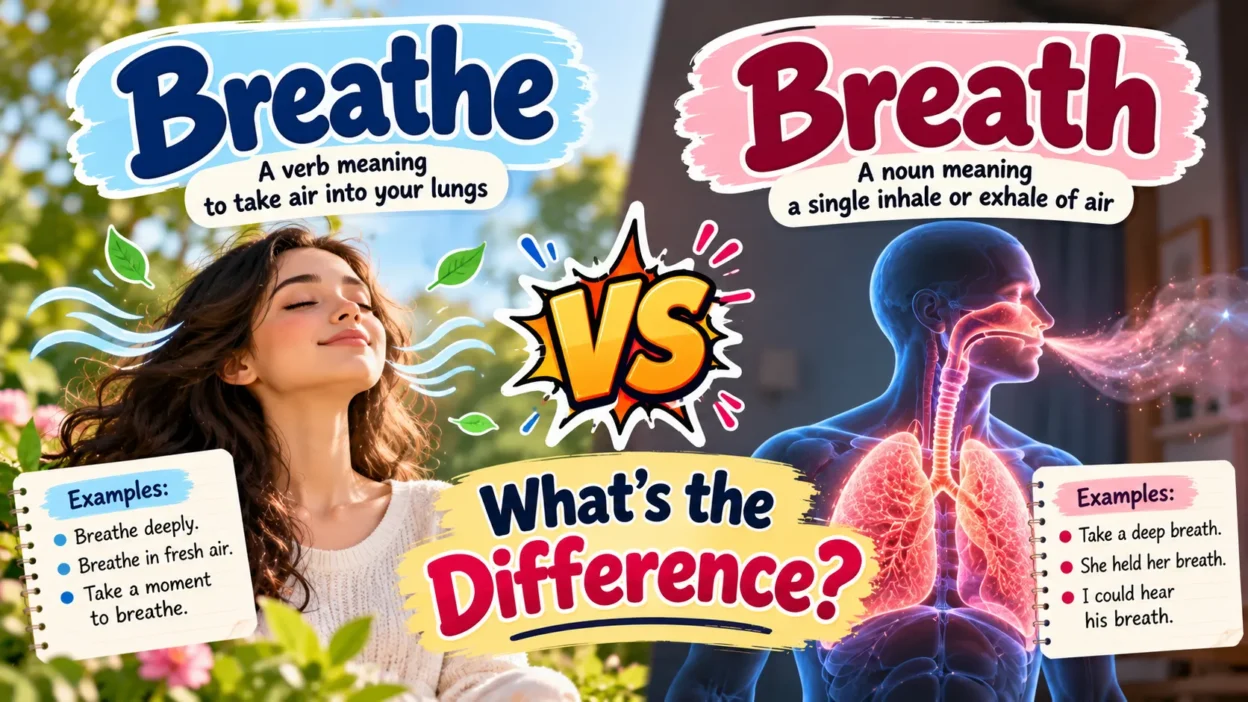
The words “breathe” and “breath” look nearly identical and sound almost the same, yet they function differently in English. One is a verb describing an action; the other is a noun naming a thing. The breathe vs breath confusion ranks among the most common spelling errors in English writing, appearing in everything from casual texts to published articles about health and wellness.
“Breathe” is the verb—the action of inhaling and exhaling air. “Breath” is the noun—the air itself that you take in and let out. The difference between them is more than spelling; it’s the difference between doing and thing. This comprehensive guide explains the distinction, explores their origins, provides practical examples, and helps you choose the correct word every time you write.
Quick Answer
“Breathe” is a verb meaning to inhale and exhale air, as in “Breathe deeply.” “Breath” is a noun referring to the air taken into or expelled from the lungs, as in “Take a deep breath.” Remember: breathe has an “e” at the end and rhymes with “seethe”; breath has no “e” and rhymes with “death.”
Meaning Overview Table
| Aspect | Meaning |
|---|---|
| Definition | Breathe: to inhale and exhale air (verb). Breath: the air inhaled or exhaled (noun) |
| Pronunciation | Breathe: /briːð/ (long “e” sound); Breath: /brɛθ/ (short “e” sound) |
| Part of Speech | Breathe: verb. Breath: noun |
| Usage | “Breathe deeply” vs. “Take a deep breath” |
| Context | Health, wellness, meditation, medicine, everyday speech |
Main Meaning
Definition
Breathe is a verb meaning to draw air into the lungs and expel it, to inhale and exhale. It describes the physiological process of respiration and, figuratively, the act of being alive or taking a moment to relax.
Breath is a noun referring to the air taken into and expelled from the lungs. It describes the substance itself—the invisible vapor of life—and appears in phrases like “take a breath,” “shortness of breath,” and “hold your breath.”
Origin
“Breathe” comes from the Old English brǣþian, meaning “to breathe.” “Breath” comes from the Old English brǣþ, meaning “odor, scent, exhalation.” Both words share the same Germanic root and have coexisted in English for over a thousand years, with their spellings eventually diverging to distinguish verb from noun.
Context
The distinction matters across several contexts:
- Health and Medicine: “Shortness of breath” is a medical symptom; “breathe deeply” is a medical instruction
- Wellness and Meditation: “Take a deep breath” is a relaxation prompt; “breathe in, breathe out” is a meditation instruction
- Everyday Writing: Confusing the two creates embarrassing errors in emails, essays, and social media posts
- Literary Writing: Both words carry poetic and metaphorical weight
Modern Usage
Today, “breathe” appears frequently in health, fitness, and wellness content. “Breath” appears in medical discussions, meditation guides, and everyday conversation. The confusion between the two persists because they sound similar and spell-check often fails to catch the error.
Detailed Explanation
Literal Meaning
Literally, “breathe” means to perform the action of taking air into the lungs and letting it out. “Breath” literally means the air itself—the substance that moves in and out of the lungs.
Common Meaning
Commonly, people use “breathe” when giving instructions or describing the action. “Just breathe” is a calming command. People use “breath” when describing the result or the substance. “Take a deep breath” focuses on the thing being taken.
Medical Meaning
In medicine, “breath” describes the air and its properties. “Shortness of breath” (dyspnea) is a common symptom. “Bad breath” (halitosis) describes odor. “Breath sounds” are the sounds doctors hear through a stethoscope. “Breathe” describes the action: “breathe through your nose,” “breathe slowly.”
Meditation Meaning
In meditation and yoga, both words appear. “Take a deep breath” invites relaxation. “Breathe in for four counts, breathe out for six” gives instructions. The distinction matters: you take a breath, but you breathe.
Idiomatic Meaning
Both words appear in idioms:
- Take a breath: Pause and relax
- Hold your breath: Wait eagerly or literally stop breathing
- Save your breath: Don’t bother speaking
- Under your breath: Spoken very quietly
- A breath of fresh air: Something new and refreshing
- Breathe down someone’s neck: Watch someone closely
Examples Table
| Example | Meaning |
|---|---|
| Breathe deeply through your nose. | Verb: action of inhaling |
| Take a deep breath and relax. | Noun: the air inhaled |
| She stopped to breathe after the run. | Verb: action of inhaling |
| His breath was visible in the cold air. | Noun: exhaled vapor |
| The doctor told him to breathe slowly. | Verb: action of inhaling |
| She held her breath underwater. | Noun: the air she held |
| Breathe in, breathe out. | Verb: action of inhaling and exhaling |
| Shortness of breath is a common symptom. | Noun: the air and its movement |
| I can’t breathe in this crowded room. | Verb: action of inhaling |
| He saved his breath and said nothing. | Noun: the air he would have used |
Related Meanings Table
| Related Term | Meaning |
|---|---|
| Breathing | The act of inhaling and exhaling |
| Breath | The air inhaled or exhaled |
| Breathe | To inhale and exhale |
| Breathless | Unable to breathe easily |
| Breathtaking | Astonishing, stunning |
| Inhalation | The act of breathing in |
| Exhalation | The act of breathing out |
| Respiration | The physiological process of breathing |
| Lungs | The organs that facilitate breathing |
| Hyperventilate | To breathe too quickly |
| Dyspnea | Shortness of breath |
| Halitosis | Bad breath |
| Breathalyzer | A device that measures alcohol in breath |
| Winded | Having difficulty breathing |
| Sigh | A long, deep breath expressing emotion |
Common Uses
People use “breathe” and “breath” across numerous contexts:
Health and Medicine: Doctors ask patients to “breathe deeply” during examinations. Patients report “shortness of breath” as a symptom. Medical devices monitor breathing.
Wellness and Fitness: Yoga instructors say “breathe in, breathe out.” Meditation apps prompt users to “take a deep breath.” Fitness coaches remind clients to breathe during exercise.
Everyday Conversation: People say “take a breath” when someone is upset. They say “breathe” when calming someone down. The phrases appear constantly in casual speech.
Literary Writing: Writers use both words for poetic effect. “A breath of fresh air” and “breathe freely” carry figurative weight.
Public Speaking: Speakers are advised to “take a deep breath” before beginning. Voice coaches teach breathing techniques.
Common Mistakes
| Mistake | Correction |
|---|---|
| Writing “take a deep breathe” | Write “take a deep breath” (noun) |
| Writing “breath deeply” | Write “breathe deeply” (verb) |
| Writing “I can’t breath” | Write “I can’t breathe” (verb) |
| Writing “shortness of breathe” | Write “shortness of breath” (noun) |
| Writing “breath in and out” | Write “breathe in and out” (verb) |
| Writing “hold your breathe” | Write “hold your breath” (noun) |
| Writing “bad breathe” | Write “bad breath” (noun) |
| Writing “breathe taking” | Write “breathtaking” (adjective) |
| Assuming spell-check will catch the error | Spell-check often misses the error; proofread manually |
| Confusing the pronunciation | Breathe has a long “e” sound; breath has a short “e” |
Related Questions
Is it “breathe” or “breath”?
It depends on function. Use “breathe” as the verb (action). Use “breath” as the noun (thing).
What is the difference between breathe and breath?
“Breathe” is a verb meaning to inhale and exhale air. “Breath” is a noun referring to the air itself.
How do you pronounce breathe and breath?
“Breathe” has a long “e” sound, rhyming with “seethe.” “Breath” has a short “e” sound, rhyming with “death” .
Can “breathe” be a noun?
No. “Breathe” is always a verb. The noun form is “breath.”
Can “breath” be a verb?
No. “Breath” is always a noun. The verb form is “breathe.”
What does “take a deep breath” mean?
It means to inhale deeply, often as a way to relax or prepare for something .
What does “breathe deeply” mean?
It means to perform the action of breathing with long, slow inhalations and exhalations.
FAQs
What does “breathe” mean?
“Breathe” is a verb meaning to draw air into the lungs and expel it. It describes the physiological process of respiration.
What does “breath” mean?
“Breath” is a noun referring to the air taken into or expelled from the lungs. It describes the substance itself.
Is it “take a deep breath” or “take a deep breathe”?
The correct phrase is “take a deep breath.” “Breath” is the noun required here.
Is it “breathe deeply” or “breath deeply”?
The correct phrase is “breathe deeply.” “Breathe” is the verb required here.
Why do people confuse breathe and breath?
They look similar, sound similar, and differ by only one letter. The vowel sound changes between the two, but spell-check often misses the error.
What is the past tense of breathe?
The past tense of “breathe” is “breathed.”
What is the plural of breath?
The plural of “breath” is “breaths.”
How can I remember the difference?
Remember: “breathe” has an “e” at the end, like “action.” “Breath” has no “e,” like “thing.” If you’re doing the action, use “breathe.” If you’re naming the thing, use “breath.”
Conclusion
Mastering the breathe vs breath distinction protects your writing from embarrassing errors. “Breathe” is the verb—the action of inhaling and exhaling. “Breath” is the noun—the air itself. Remember the simple rule: breathe has an “e” and rhymes with “seethe” (action); breath has no “e” and rhymes with “death” (thing). Whether you’re writing a health article, a meditation guide, or a social media post, choosing the correct word ensures your meaning is clear. Practice using “breathe” for actions and “breath” for things, and your readers will understand exactly what you intend. Small distinctions like this separate careful writers from careless ones.

Clara Morgan is a language and vocabulary writer passionate about making English easier to understand. At Wordestic, she creates clear and practical guides on word meanings, synonyms, antonyms, grammar, word differences, and commonly confused words.
Her writing focuses on simple explanations, useful examples, and everyday usage to help readers expand their vocabulary and communicate with greater confidence.