
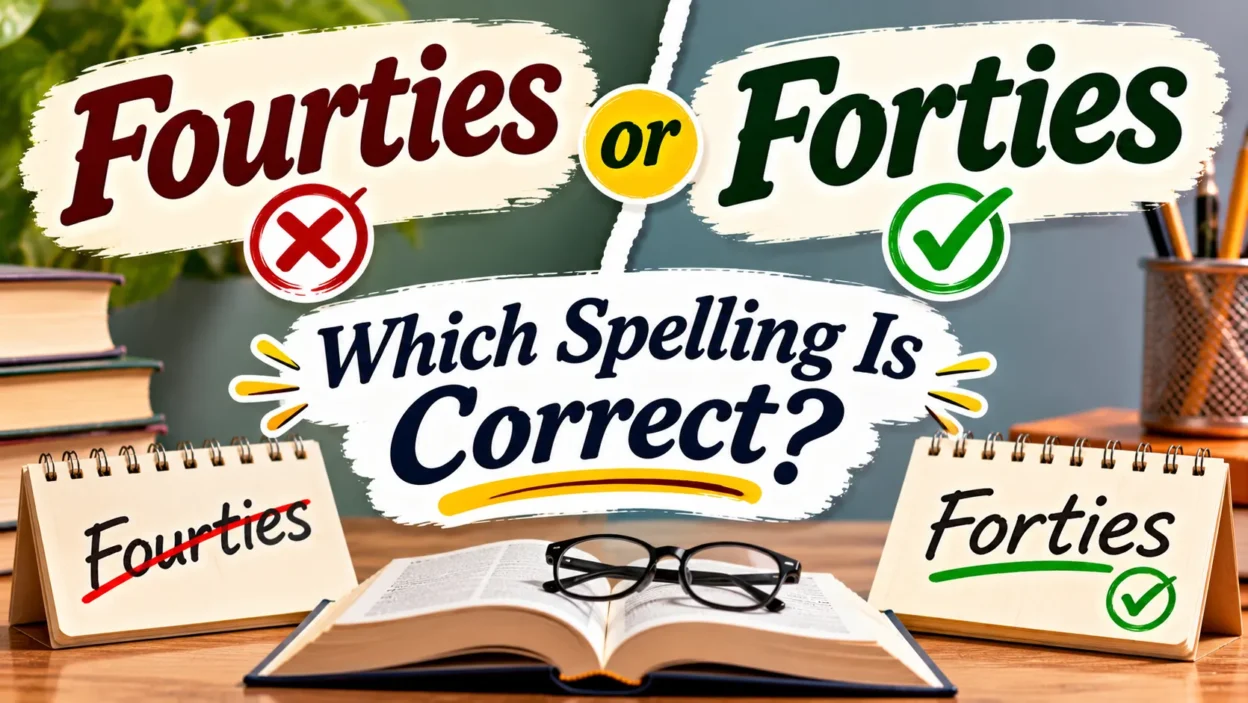
The spelling of the number 40 and its plural form trips up writers constantly. When you need to refer to the decade of the 1940s or the age range between 40 and 49, the fourties or forties question arises. The confusion stems from the fact that the number four contains a “u,” but its multiples often do not follow the same pattern.
The correct spelling is forties—without a “u.” The word “fourties” is a misspelling that appears frequently online and in informal writing, but it has never been accepted as standard English . This comprehensive guide explains the correct spelling, explores the history behind this linguistic oddity, provides practical examples, and helps you remember the rule for good.
Quick Answer
The correct spelling is forties—no “u.” It is the plural form of forty, referring to the numbers 40 through 49, the decade of the 1940s, or the age range between 40 and 49. “Fourties” is always a misspelling. Remember: forty has no “u,” so forties has no “u” either .
Meaning Overview Table
| Aspect | Meaning |
|---|---|
| Definition | The plural of forty; refers to numbers 40–49, the 1940s decade, or ages 40–49 |
| Pronunciation | /ˈfɔːrtiz/ (FOR-teez) |
| Part of Speech | Noun (plural) |
| Usage | “She is in her forties” or “music from the forties” |
| Context | Everyday speech, historical writing, age descriptions, temperature ranges |
Main Meaning
Definition
Forties is the plural form of the noun “forty.” It refers to the numbers from 40 through 49, the years of a decade ending in “40” (especially the 1940s), or the period of life between ages 40 and 49 . The word appears in phrases like “in her forties,” “the forties,” and “the high forties” (referring to temperature) .
Origin
The word “forty” traces back to Old English fēowertig, a compound meaning “four tens” . In Middle English, spellings like fourti and fourty appeared, reflecting the influence of “four.” However, by the end of the 18th century, the spelling “forty” had become standard, and the “u” was dropped for reasons that remain unclear . The plural “forties” followed the same pattern, appearing without the “u” in modern usage.
Context
The word appears in several distinct contexts:
- Ages: “She is in her forties” describes someone between 40 and 49 years old
- Decades: “The forties” refers to the 1940s, especially in cultural or historical discussions
- Temperature: “The temperature is in the forties” means between 40 and 49 degrees
- Streets: “The West Forties” refers to street numbers in the 40s, particularly in New York City
- Geography: “The Forties” is a region of the North Sea
Modern Usage
Today, “forties” appears constantly in journalism, literature, and everyday speech. The misspelling “fourties” remains common online, but dictionaries, style guides, and spell-checkers all flag it as incorrect . The word’s unusual spelling—lacking the “u” that appears in “four”—makes it a frequent source of error.
Detailed Explanation
Literal Meaning
Literally, “forties” means “multiple sets of forty” or “the numbers from forty to forty-nine.” It is the plural of the cardinal number forty.
Common Meaning
Commonly, people use “forties” to describe an age range or a decade. “She’s in her forties” means she is between 40 and 49 years old. “Music from the forties” means music from the 1940s.
Historical Meaning
“The forties” often refers to the 1940s, a decade marked by World War II, the beginning of the Cold War, and significant cultural shifts. Writers and historians use “the forties” as shorthand for this period.
Temperature Meaning
Weather reports and everyday conversation use “forties” to describe temperatures between 40 and 49 degrees Fahrenheit or Celsius. “It’s in the forties today” means the temperature is in that range .
Age Meaning
Describing someone as “in their forties” is a standard way to indicate age without giving an exact number. The phrase carries no negative connotation, simply indicating the fifth decade of life.
Examples Table
| Example | Meaning |
|---|---|
| She is in her forties. | She is between 40 and 49 years old |
| The temperature is in the high forties. | The temperature is between 47 and 49 degrees |
| He loves music from the forties. | He enjoys music from the 1940s |
| The forties were a turbulent decade. | The 1940s were marked by war and change |
| My parents are in their forties. | My parents are between 40 and 49 |
| The wind blew through the roaring forties. | A region of the ocean with strong winds |
| She celebrated her fortieth birthday. | She turned 40 years old |
| The office is in the West Forties. | A street address in the 40s |
| The forties brought significant technological change. | The 1940s saw major innovations |
| Temperatures will stay in the forties all week. | The weather will remain between 40 and 49 degrees |
Related Meanings Table
| Related Term | Meaning |
|---|---|
| Forty | The number 40; no “u” in modern spelling |
| Four | The number 4; contains a “u” |
| Fourteen | The number 14; contains a “u” |
| Fortieth | The ordinal form of forty; no “u” |
| Fourth | The ordinal form of four; contains a “u” |
| Forties | The plural of forty; no “u” |
| Fourties | A misspelling; never correct |
| Mid-forties | The middle of the forties range, around 44–46 |
| Roaring Forties | A windy region of the ocean between 40 and 50 degrees latitude |
| The Forties | A region of the North Sea |
| Fortieth | The ordinal number for 40 |
| Forty-niner | A gold prospector who went to California in 1849 |
| Forty winks | A short nap |
| Forty-ounce | A large bottle of beer or malt liquor |
| Fortysomething | A person in their forties |
Common Uses
People use “forties” across numerous contexts:
Everyday Conversation: People describe their age or others’ ages using “in their forties.” This usage is neutral and common.
Weather Reports: Meteorologists say temperatures will be “in the forties” to describe mild but cool weather.
Historical Writing: Historians and journalists refer to “the forties” when discussing the 1940s, a decade of global conflict and change.
Cultural Commentary: Music, fashion, and film from the 1940s are described as “from the forties.”
Geography: The “Roaring Forties” describes a windy belt of ocean in the Southern Hemisphere. “The Forties” also refers to a North Sea region.
Common Mistakes
| Mistake | Correction |
|---|---|
| Writing “fourties” | Write “forties” (no “u”) |
| Writing “fourty” | Write “forty” (no “u”) |
| Writing “fourtieth” | Write “fortieth” (no “u”) |
| Assuming “fourties” is a British variant | It is not a variant; it is always a misspelling |
| Adding a “u” by analogy with “four” | Forty and forties are exceptions to the pattern |
| Writing “in her fourties” | Write “in her forties” |
| Writing “the fourties” | Write “the forties” |
| Writing “forty-four” as “fourty-four” | Write “forty-four” (no “u” in forty) |
| Believing the spelling changed recently | “Forty” has been standard since the 16th–18th centuries |
| Trusting spell-check alone | Spell-check may miss the error; learn the rule |
Related Questions
Is it “fourties” or “forties”?
The correct spelling is “forties” without a “u.” “Fourties” is always a misspelling, despite appearing frequently online .
Why is “forty” spelled without a “u”?
The reason is unclear. “Four” and “fourteen” contain a “u,” but “forty” and “fortieth” do not. The spelling “forty” became standard by the 18th century, and the “u” was dropped for reasons that remain unexplained .
Is “fourties” a British spelling?
No. Both American and British English use “forties.” “Fourties” is not a recognized variant in any English-speaking region .
What does “in her forties” mean?
“In her forties” means a woman is between 40 and 49 years old. The phrase is standard and neutral.
What are the “Roaring Forties”?
The “Roaring Forties” is a region of the ocean between 40 and 50 degrees south latitude, known for strong westerly winds and rough seas.
What is “the Forties” in geography?
“The Forties” is a region of the central North Sea between Scotland and Norway, named for its depth of forty fathoms or more .
FAQs
Is it “fourties” or “forties”?
The correct spelling is “forties” without a “u.” “Fourties” is a common misspelling and is never correct .
Why do people spell it “fourties”?
People add the “u” by analogy with “four,” “fourteen,” and “fourth.” However, “forty” and “forties” are exceptions to this pattern .
What does “forties” mean?
“Forties” is the plural of forty. It refers to the numbers 40–49, the decade of the 1940s, or the age range between 40 and 49 .
Is “fourties” ever acceptable?
No. “Fourties” is always a misspelling. No dictionary or style guide accepts it as a valid variant .
How do you spell the ordinal form?
The ordinal form is “fortieth” without a “u.” “Fourtieth” is incorrect .
What is the difference between “forty” and “fourty”?
“Forty” is the correct spelling. “Fourty” is a misspelling that was common in the past but has been considered incorrect since the 18th century .
What are “the forties”?
“The forties” usually refers to the 1940s, a decade in the 20th century. It can also refer to the age range or temperature range.
How can I remember the spelling?
Remember: “forty” has no “u,” so “forties” has no “u.” Think of “forty winks” or “forty-niner”—both use the correct spelling without a “u.”
Conclusion
The fourties or forties question has a clear answer: the correct spelling is forties—no “u.” This unusual spelling reflects a historical quirk in English, where the “u” from “four” disappeared from “forty” centuries ago. While “fourties” appears frequently online and in informal writing, it is always a misspelling. Whether you are writing about someone’s age, the 1940s, or temperatures in the 40s, use “forties” with confidence. Remember the simple rule: forty has no “u,” so forties has no “u.” This small distinction separates careful writers from careless ones.

Clara Morgan is a language and vocabulary writer passionate about making English easier to understand. At Wordestic, she creates clear and practical guides on word meanings, synonyms, antonyms, grammar, word differences, and commonly confused words.
Her writing focuses on simple explanations, useful examples, and everyday usage to help readers expand their vocabulary and communicate with greater confidence.