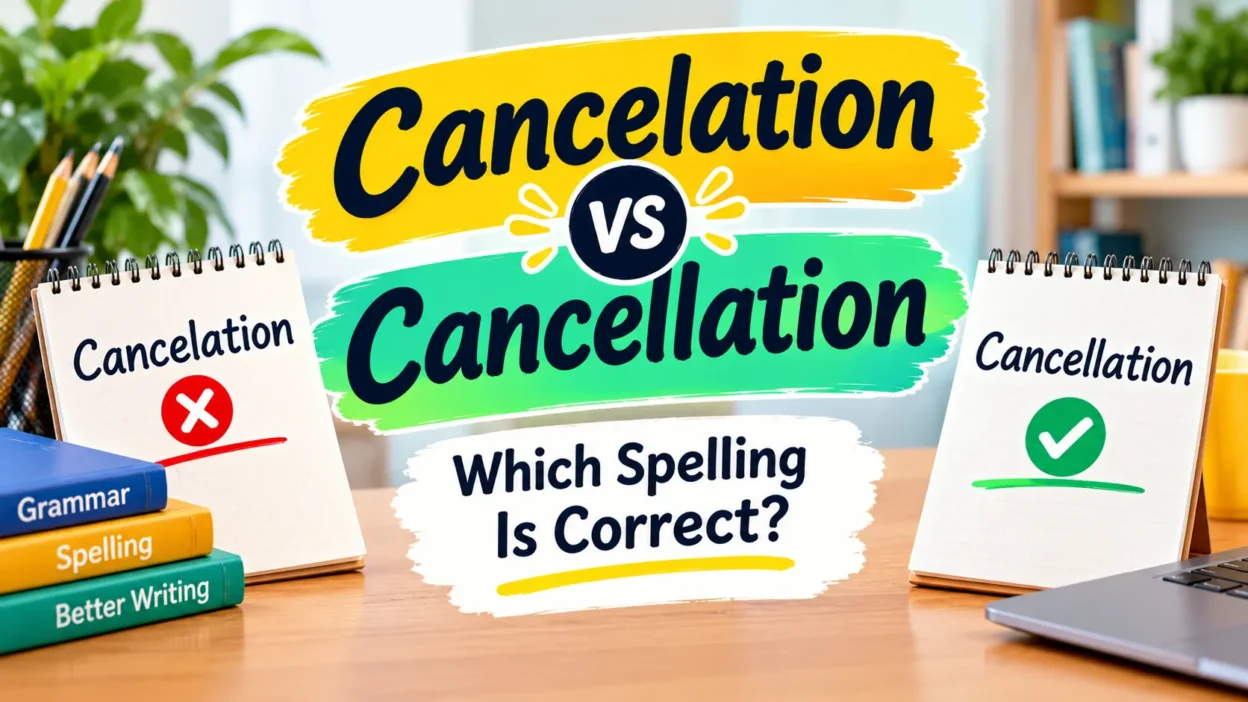
The words “cancelation” and “cancellation” represent one of the trickiest spelling variations in English. Both appear in print, both are technically recognized by dictionaries, and both sound identical when spoken. Yet the cancelation vs cancellation distinction confuses writers, editors, and even native speakers who want to get it right.
“Cancellation” with two L’s is the standard spelling in both American and British English, while “cancelation” with one L is a rare variant that occasionally appears in American English but is widely discouraged . The confusion arises because the related words “canceled” and “canceling” follow a different pattern, using one L in American English. This comprehensive guide explains the rules, explores the origins, provides practical examples, and helps you choose the correct spelling every time.
Quick Answer
“Cancellation” with two L’s is the standard spelling in both American and British English. “Cancelation” with one L is a rare variant that appears occasionally in American English but is best avoided. Remember: the noun always takes two L’s, even though the verb forms “canceled” and “canceling” take one L in American English .
Meaning Overview Table
| Aspect | Meaning |
|---|---|
| Definition | The act of canceling something, or a canceled arrangement |
| Pronunciation | /ˌkænsəˈleɪʃən/ (both spellings) |
| Part of Speech | Noun |
| Usage | “The cancellation of the flight caused delays” (standard) vs. “The cancelation of the flight” (rare variant) |
| Context | Travel, business, publishing, everyday scheduling |
Main Meaning
Definition
“Cancellation” and “cancelation” are spelling variants of the same noun, which refers to the act of canceling something or to a canceled arrangement. A flight cancellation, a hotel cancellation, or a subscription cancellation all describe the annulment of a previously arranged plan or booking. The word also refers to something made available by a cancellation, such as a canceled hotel room.
Origin
The word derives from the Latin verb cancelare, meaning “to make void” or “to cross out.” The noun form entered English through French influence. The single-L spelling “cancelation” reflects the American tendency to simplify spellings by dropping one L, but unlike “canceled” and “canceling,” the noun form resisted this simplification. Most style guides and dictionaries preserved the double-L spelling for the noun, creating the unusual pattern where the verb and noun follow different rules.
Context
The distinction matters across several contexts:
- Travel and Hospitality: Airlines, hotels, and booking platforms use “cancellation” almost universally in their policies and communications
- Business and Publishing: Contracts and publications follow style guides that prefer “cancellation”
- American vs. British English: Both varieties prefer “cancellation” with two L’s
- Technical Writing: Software documentation and APIs often use “cancellation” as the standard identifier
Modern Usage
Today, “cancellation” dominates overwhelmingly. Corpus data shows “cancelation” appears roughly 1.5 million times online compared to over 109 million for “cancellation” . Merriam-Webster lists “cancelation” as a “less common” variant , while most writing guides recommend avoiding it entirely . The single-L form persists mainly as a misspelling or as an occasional American variant.
Detailed Explanation
Literal Meaning
Literally, “cancellation” means the act of making something void or invalid. It describes the process of revoking a commitment, booking, or arrangement.
Common Meaning
Commonly, people use “cancellation” to describe travel disruptions, subscription endings, and event postponements. “Flight cancellation” is one of the most frequent phrases in news reports and travel advisories.
Travel Meaning
In travel, “cancellation” appears constantly. Airlines publish cancellation policies. Hotels charge cancellation fees. Travel insurance covers trip cancellation. The word is standardized across the industry.
Business Meaning
In business, “cancellation” refers to ending contracts, orders, or subscriptions. Companies process cancellations, track cancellation rates, and set cancellation windows. The spelling is consistent in professional communication.
Spelling Pattern Meaning
The spelling pattern is unusual because it breaks the usual American rule. American English typically simplifies double L’s to single L’s before suffixes (traveling/travelling, modeling/modelling). But “cancellation” resists this pattern. The verb forms follow the rule (canceled, canceling in American English), while the noun keeps the double L .
Examples Table
| Example | Meaning |
|---|---|
| The flight cancellation caused hours of delays. | The standard spelling |
| The hotel charges a cancellation fee. | The standard spelling |
| Notice of cancellation must be given in writing. | The standard spelling |
| The cancelation policy is unclear. | A rare variant spelling |
| Trip cancellation insurance covers unexpected events. | The standard spelling |
| The storm led to widespread event cancellations. | The standard spelling |
| There is a cancellation fee for late bookings. | The standard spelling |
| The software handles subscription cancellation automatically. | The standard spelling |
| The show’s cancellation disappointed fans. | The standard spelling |
| The cancelation of the order was processed quickly. | A rare variant spelling |
Related Meanings Table
| Related Term | Meaning |
|---|---|
| Cancel | To annul or revoke |
| Canceled | Past tense of cancel (American spelling) |
| Cancelled | Past tense of cancel (British spelling) |
| Canceling | Present participle (American spelling) |
| Cancelling | Present participle (British spelling) |
| Cancellation | The noun form (standard spelling) |
| Cancelation | A rare variant spelling |
| Revocation | The act of revoking something |
| Annulment | The act of making void |
| Termination | The act of ending something |
| Rescission | The act of canceling a contract |
| Withdrawal | The act of removing or taking back |
| Postponement | The act of delaying an event |
| Abolition | The act of formally ending something |
| Nullification | The act of making legally void |
Common Uses
People use “cancellation” across numerous contexts:
Travel and Hospitality: Airlines, hotels, and booking sites use “cancellation” in policies and confirmations. “Cancellation fee” and “cancellation policy” are standard industry terms.
Business and Contracts: Companies include “cancellation clauses” in agreements. Subscriptions have “cancellation windows.” The spelling is consistent in professional writing.
Media and Entertainment: Television show cancellations dominate entertainment news. Streaming services report cancellation rates. The word appears constantly in headlines.
Healthcare: Medical appointments have cancellation policies. Patients receive cancellation notices. Healthcare systems track cancellation rates to manage scheduling.
Technology and Software: APIs and documentation use “cancellation” for operations that stop processes. “Cancellation token” is a common programming term.
Common Mistakes
| Mistake | Correction |
|---|---|
| Writing “cancelation” in professional documents | Write “cancellation” (standard spelling) |
| Writing “flight cancelation” | Write “flight cancellation” (standard spelling) |
| Assuming “cancelation” follows American simplification rules | The noun keeps double L even in American English |
| Writing “cancellation” when the style guide requires consistency | Check your style guide, but “cancellation” is standard |
| Confusing the noun spelling with verb spelling | Verb: canceled/canceling (American); Noun: cancellation |
| Using “cancelation” because spell-check didn’t flag it | Spell-check may accept variants; use the standard form |
| Writing “cancelation fee” in contracts | Write “cancellation fee” (standard) |
| Assuming British English uses “cancelation” | Both American and British English prefer “cancellation” |
| Writing “cancelation policy” on websites | Write “cancellation policy” for professional credibility |
| Forgetting that “cancelation” is rare | Use “cancellation” unless you have a specific reason not to |
Related Questions
Is it “cancelation” or “cancellation”?
“Cancellation” with two L’s is the standard spelling in both American and British English. “Cancelation” with one L is a rare variant that is best avoided.
Why is “cancellation” spelled with two L’s?
The noun form preserved the double-L spelling even as American English simplified the verb forms (canceled, canceling). This creates an unusual pattern where the noun and verb follow different rules.
Is “cancelation” ever correct?
Merriam-Webster lists “cancelation” as a less common variant . Some American writers occasionally use it, but most style guides and dictionaries recommend “cancellation” .
Does British English use “cancelation”?
No. British English consistently uses “cancellation” with two L’s. The single-L variant appears mainly in American English, and even there it is rare.
What is the difference between “canceled” and “cancellation”?
“Canceled” (one L) is the American past tense of the verb. “Cancellation” (two L’s) is the noun. The spellings follow different patterns.
Which spelling should I use in business writing?
Use “cancellation” with two L’s. It is the standard spelling in professional communication and appears in most style guides.
FAQs
What does “cancellation” mean?
“Cancellation” refers to the act of canceling something or to a canceled arrangement. It describes the annulment of a booking, contract, or plan.
Is “cancelation” a word?
Yes, but it is a rare variant. “Cancellation” is the standard spelling. Dictionaries list “cancelation” as a less common form, but most writing guides recommend avoiding it .
Why do people spell it “cancelation”?
People sometimes assume the noun follows the same pattern as “canceled” and “canceling” (one L in American English). However, the noun form resisted this simplification and kept the double L.
Which is more common: “cancelation” or “cancellation”?
“Cancellation” is far more common. Corpus data shows “cancellation” appears roughly 70 times more often than “cancelation” .
Is “cancelation” acceptable in American English?
It appears occasionally, but most style guides and dictionaries prefer “cancellation.” Use “cancellation” for consistency and professionalism.
What is the British spelling of “cancellation”?
British English uses “cancellation” with two L’s, just like American English. The single-L variant is not standard in the UK.
How can I remember the spelling?
Remember: the noun always takes two L’s, even though the verb takes one in American English. Think of “cancellation” as the exception to the rule.
Conclusion
Mastering the cancelation vs cancellation distinction is simpler than it seems: “cancellation” with two L’s is the standard spelling in both American and British English. “Cancelation” with one L is a rare variant that appears occasionally but is best avoided in professional writing. The unusual pattern—where the verb takes one L in American English but the noun takes two—trips up many writers. Remember the rule: the noun keeps the double L. Whether you’re writing a travel policy, a business contract, or a news report, choosing “cancellation” ensures clarity and professionalism. Practice using the standard spelling, and your writing will reflect the care and precision that readers expect.

Clara Morgan is a language and vocabulary writer passionate about making English easier to understand. At Wordestic, she creates clear and practical guides on word meanings, synonyms, antonyms, grammar, word differences, and commonly confused words.
Her writing focuses on simple explanations, useful examples, and everyday usage to help readers expand their vocabulary and communicate with greater confidence.