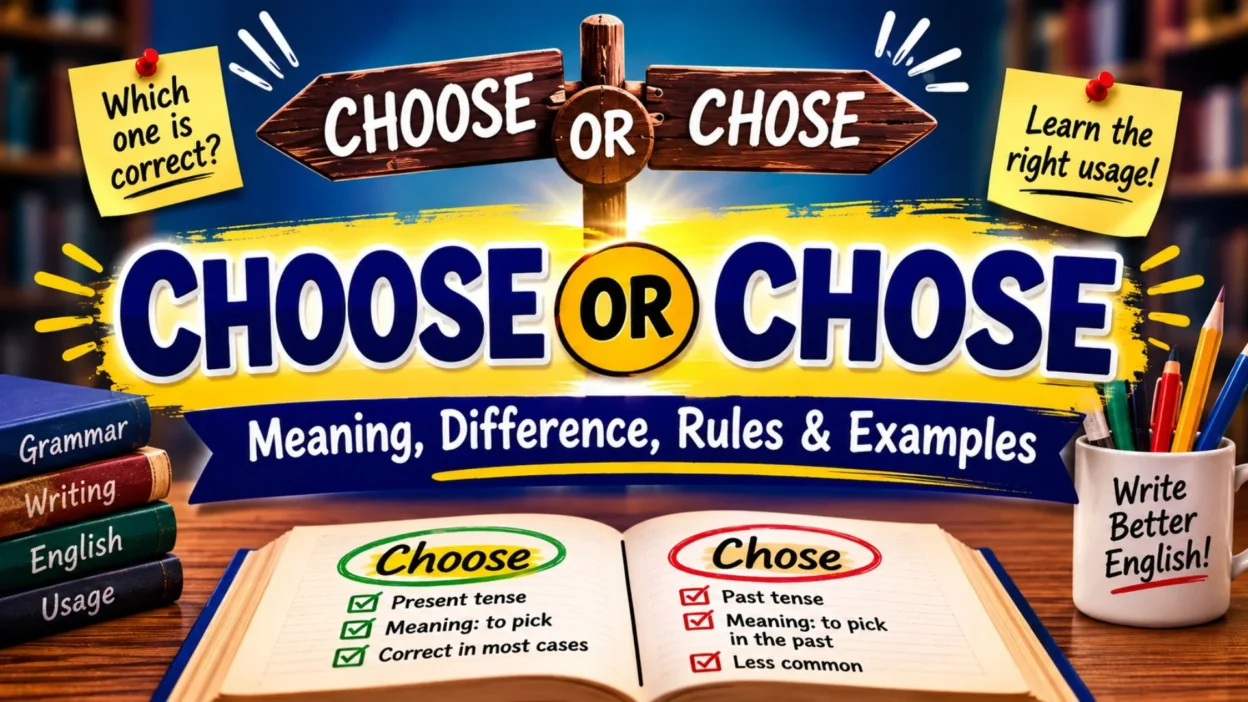
The words choose and chose come from the same verb, but they are used for different times. Choose is the base and present-tense form, while chose is the simple past form. Knowing when to use each one can prevent common grammar and spelling mistakes.
For example, you can say, “I choose the blue shirt” when making a choice now, but “I chose the blue shirt yesterday” when talking about a decision you already made. The difference becomes even clearer when helping verbs are involved. After will, can, could, should, or did, you normally use choose, not chose. With have, has, or had, you need the third form, chosen.
Although the difference looks small, understanding the pattern makes your writing and speaking much more accurate.
Quick Answer: Choose or Chose?
Use choose when the action is happening now, happens regularly, or refers to a future decision.
Use chose when the decision happened in the past.
| Word | When to Use It | Example |
|---|---|---|
| Choose | Present or future | I choose this one. |
| Chose | Past | I chose this one yesterday. |
| Chosen | With have, has, or had | I have chosen this one. |
Easy Rule
Choose = now or later
Chose = already happened
Chosen = used with have, has, or had
What Does Choose Mean?
Choose means to select one thing, person, option, or possibility from several choices.
Examples:
- I choose the red dress.
- You can choose any seat.
- We need to choose a restaurant.
- She usually chooses healthy food.
- They will choose a new leader tomorrow.
The word choose is the base form of the verb.
It can describe something happening now:
I choose the blue one.
It can also describe a general habit:
I usually choose tea instead of coffee.
And it can refer to a future decision:
I will choose tomorrow.
What Does Chose Mean?
Chose is the simple past form of choose.
Use it when someone made a selection or decision in the past.
Examples:
- I chose the blue shirt yesterday.
- She chose the first option.
- He chose to stay home.
- We chose a different hotel last night.
- They chose the cheaper plan.
The important point is that the choice has already happened.
For example:
I choose the black jacket.
This describes a current choice.
I chose the black jacket yesterday.
This describes a completed past choice.
Choose or Chose: The Main Difference
The simplest way to understand choose or chose is to look at the time of the action.
Choose for the Present
Use choose when the decision is happening now or describes a regular preference.
Examples:
- I choose this option.
- We choose our meals carefully.
- She chooses the window seat.
- I always choose the simplest solution.
Chose for the Past
Use chose when the decision happened earlier.
Examples:
- I chose this option yesterday.
- We chose the restaurant last week.
- She chose the blue dress.
- He chose a different career.
Choose for the Future
Use choose after will or other future constructions.
Examples:
- I will choose tomorrow.
- She will choose later.
- We are going to choose a new design.
- They will choose their captain next week.
Choose, Chose, and Chosen
If you want to use these words correctly, it helps to learn all three forms together.
| Verb Form | Word | Example |
|---|---|---|
| Base form | Choose | I want to choose. |
| Present | Choose | I choose this one. |
| Past | Chose | I chose this one yesterday. |
| Past participle | Chosen | I have chosen this one. |
| Present participle | Choosing | I am choosing a dress. |
The core pattern is:
Choose → Chose → Chosen
This is an irregular verb because its past forms do not simply add -ed.
When to Use Choose
There are several situations where choose is correct.
For a Choice Happening Now
Examples:
- I choose the blue one.
- We choose this restaurant.
- I choose option two.
For a Habit or General Preference
Examples:
- I usually choose tea.
- She often chooses healthy meals.
- He always chooses the cheapest option.
For a Future Choice
Examples:
- I will choose tomorrow.
- She will choose after the interview.
- We are going to choose a new location.
After Modal Verbs
Examples:
- You can choose one.
- She could choose another option.
- We should choose carefully.
- They might choose a different route.
When to Use Chose
Use chose when you are describing a completed decision in the past.
Examples:
- I chose the red shirt.
- She chose the first answer.
- He chose to leave early.
- We chose the smaller apartment.
- They chose a new manager.
Time expressions can make the past meaning obvious:
- yesterday
- last night
- last week
- last month
- last year
- earlier
- before
- a few days ago
Examples:
- I chose this restaurant yesterday.
- She chose the dress last week.
- They chose a new leader last month.
When to Use Chosen
Chosen is the past participle of choose.
Use it after:
- Have
- Has
- Had
Examples:
- I have chosen my favorite.
- She has chosen a new career.
- They had chosen their seats.
- He has chosen the final design.
Chosen is also used in passive sentences:
- She was chosen as captain.
- He was chosen for the position.
- They were chosen to represent the school.
Choose or Chose After Did?
This is one of the most important rules.
After did, always use the base form choose.
Correct:
- Did you choose this?
- Why did she choose that option?
- Which dress did you choose?
- When did they choose the winner?
Incorrect:
- Did you chose this?
- Why did she chose that option?
- Which dress did you chose?
Why?
Because did already marks the sentence as past tense. The main verb returns to its base form.
Remember
Did + choose
Not:
Did + chose
Choose or Chose After Will?
After will, use choose.
Correct:
- I will choose tomorrow.
- She will choose later.
- We will choose a new design.
- They will choose their seats.
Incorrect:
- I will chose tomorrow.
- She will chose later.
The same rule applies to other modal and auxiliary structures.
Choose or Chose After Can, Could, and Should
After modal verbs, use choose.
Examples:
- You can choose any color.
- She could choose another option.
- We should choose carefully.
- They might choose a different route.
- He would choose the simpler option.
Incorrect:
- ❌ You can chose.
- ❌ She could chose.
- ❌ We should chose.
Correct:
- ✅ You can choose.
- ✅ She could choose.
- ✅ We should choose.
Choose or Chose After Have and Has?
After have or has, use chosen.
Correct:
- I have chosen my favorite.
- She has chosen the winner.
- We have chosen a new location.
- He has chosen to stay.
Incorrect:
- ❌ I have chose.
- ❌ She has chose.
Remember:
Have/has + chosen
Choose or Chose After Had?
After had, use chosen.
Examples:
- I had chosen my seat before the movie started.
- She had chosen her dress before the event.
- They had already chosen a winner.
- We had chosen the restaurant before our friends arrived.
The structure is:
had + chosen
Choose or Chose in Questions
The correct form depends on the question structure.
Present Questions
- Which one do you choose?
- What do you choose?
- Why do you choose this option?
Past Questions
Use choose after did:
- Which one did you choose?
- What did you choose?
- Why did you choose this option?
- When did you choose your major?
Future Questions
Use choose after will:
- Which one will you choose?
- What will you choose?
- When will you choose?
This is why “Did you chose?” is incorrect even though the question refers to the past.
Choose or Chose in Negative Sentences
The same principle applies to negative sentences.
Present
- I do not choose that option.
- She does not choose expensive products.
- They do not choose this route.
Past
- I did not choose that option.
- She did not choose the red dress.
- They did not choose the first proposal.
Notice that even though these sentences are past, the verb after did not is choose.
Correct:
I didn’t choose it.
Incorrect:
I didn’t chose it.
Choose or Chose With “To”
Both forms can appear before to when describing a decision.
Present:
- I choose to stay.
- She chooses to continue.
- They choose to work together.
Past:
- I chose to stay.
- She chose to continue.
- They chose to work together.
Future:
- I will choose to stay.
- She will choose to continue.
The tense determines whether you use choose or chose.
Choose or Chose in Everyday Examples
Consider a simple restaurant situation.
Making the Choice Now
The waiter asks what you want.
You say:
I choose the chicken.
Talking About Yesterday
Someone asks what you ordered yesterday.
You say:
I chose the chicken.
Talking About a Future Decision
Someone asks what you will order tomorrow.
You say:
I will choose when I see the menu.
Talking About a Completed Choice
You tell someone:
I have chosen my meal.
Each sentence uses a different form because the time relationship is different.
Choose or Chose in Professional Writing
The same rules apply in business and professional writing.
Present
The manager chooses the final design.
Past
The manager chose the final design yesterday.
Future
The manager will choose the final design tomorrow.
Present Perfect
The manager has chosen the final design.
This pattern is useful in emails, reports, presentations, and workplace communication.
Choose or Chose in Academic Writing
Academic writing often discusses decisions made during research.
For example:
Present/general:
Researchers choose participants according to specific criteria.
Past study:
The researchers chose participants according to specific criteria.
Present perfect:
Researchers have chosen participants according to several criteria.
The correct form depends on the timeframe of the research being described.
Choose or Chose in Conditional Sentences
Conditional sentences can also use either form depending on the situation.
Examples:
- If you choose carefully, you may get better results.
- If she chooses the blue option, the design will look cleaner.
- If I had to decide yesterday, I chose the safest option.
For hypothetical situations, you may also see:
- If I were you, I would choose the simpler option.
- If they had known earlier, they might have chosen differently.
The important point is that the surrounding grammar determines the correct form.
Choose or Chose: Pronunciation Difference
The two words are spelled similarly, but their pronunciation differs.
Choose
Choose sounds approximately like “chooz.”
It has a long oo sound.
Examples of words with a similar vowel sound include:
- Food
- Moon
- Blue
Chose
Chose sounds approximately like “chohz.”
Its vowel sound is similar to words such as:
- Rose
- Nose
- Those
Chosen
Chosen sounds approximately like “CHOH-zən.”
Learning the pronunciation can make it easier to distinguish these forms when listening.
Common Mistakes With Choose or Chose
Mistake 1: “I Chose This” When Making the Choice Now
If the decision is happening right now, use choose.
Incorrect:
I chose this one now.
Better:
I choose this one.
However, if you’re referring to a choice already made, chose is correct.
Mistake 2: “I Choose Yesterday”
A past-time expression such as yesterday requires the past form.
Incorrect:
I choose the blue one yesterday.
Correct:
I chose the blue one yesterday.
Mistake 3: “Did You Chose?”
This is extremely common.
Incorrect:
Did you chose this?
Correct:
Did you choose this?
Remember: did + choose.
Mistake 4: “I Will Chose”
Incorrect:
I will chose later.
Correct:
I will choose later.
Remember: will + choose.
Mistake 5: “I Have Chose”
Incorrect:
I have chose my favorite.
Correct:
I have chosen my favorite.
Remember: have + chosen.
Mistake 6: “She Was Chose”
Incorrect:
She was chose for the team.
Correct:
She was chosen for the team.
This is a passive construction, so use the past participle.
A Quick Comparison Table
| Sentence | Correct Form | Why |
|---|---|---|
| I ___ this one now. | choose | Present |
| I ___ this one yesterday. | chose | Past |
| I will ___ tomorrow. | choose | After will |
| Did you ___ this? | choose | After did |
| I have ___ already. | chosen | After have |
| She has ___ a winner. | chosen | After has |
| They had ___ a location. | chosen | After had |
| She was ___ for the team. | chosen | Passive |
| I usually ___ tea. | choose | Habit |
| We ___ the hotel last night. | chose | Past |
Choose or Chose: 20 Quick Examples
Choose
- I choose this option.
- You can choose any color.
- We choose carefully.
- She chooses healthy meals.
- I usually choose tea.
- They will choose tomorrow.
- Did you choose a seat?
- You should choose wisely.
- We might choose another route.
- I want to choose first.
Chose
- I chose the blue one.
- She chose the first option.
- He chose to stay.
- We chose the cheaper hotel.
- They chose a new leader.
- I chose it yesterday.
- She chose the wrong answer.
- He chose a different career.
- We chose the second plan.
- They chose to leave early.
How to Remember Choose or Chose
A simple three-step memory trick is:
Choose = Present
Think:
I choose now.
Chose = Past
Think:
I chose yesterday.
Chosen = Perfect or Passive
Think:
I have chosen.
So the complete pattern is:
Choose → Chose → Chosen
You can also remember the helping-verb rule:
Did + choose
Will + choose
Can + choose
Have + chosen
Has + chosen
Had + chosen
Once you memorize these combinations, many common errors become easy to spot.
When Should You Use Choose?
Use choose when:
- The decision is happening now.
- You describe a regular preference.
- The decision will happen in the future.
- It follows will.
- It follows a modal verb.
- It follows do, does, or did.
Examples:
- I choose this one.
- She usually chooses coffee.
- We will choose tomorrow.
- Did you choose already?
- You can choose any option.
When Should You Use Chose?
Use chose when:
- The action happened in the past.
- You are describing a completed decision.
- There is no helping verb such as did or will requiring the base form.
Examples:
- I chose this yesterday.
- She chose the blue dress.
- They chose a new manager.
- He chose to leave early.
When Should You Use Chosen?
Use chosen when:
- It follows have.
- It follows has.
- It follows had.
- It appears in passive constructions.
Examples:
- I have chosen my favorite.
- She has chosen a new path.
- They had chosen their seats.
- He was chosen for the position.
Frequently Asked Questions
Is it choose or chose?
Both are correct words, but they have different uses. Choose is the present or base form, while chose is the simple past form.
What is the past tense of choose?
The past tense of choose is chose.
Example: She chose the blue dress yesterday.
What is the past participle of choose?
The past participle is chosen.
Example: She has chosen the blue dress.
Is “I choose” correct?
Yes. Use I choose for a current decision, general preference, or habit.
Is “I chose” correct?
Yes. Use I chose when describing a choice that happened in the past.
Is it “I will choose” or “I will chose”?
The correct form is I will choose.
Is it “Did you choose” or “Did you chose”?
The correct form is Did you choose?
After did, use the base form choose.
Is it “I have chose” or “I have chosen”?
The correct form is I have chosen.
Why is “did you chose” wrong?
Because did already marks the question as past tense. The main verb must remain in its base form: choose.
Why is “I will chose” wrong?
Because will is followed by the base form of a verb. Therefore, the correct phrase is will choose.
Can choose refer to the future?
Yes. For example:
I will choose tomorrow.
Can chose refer to the present?
Normally, no. Chose is the simple past form, so it refers to a completed past action.
What are the three forms of choose?
The three main forms are:
Choose — Chose — Chosen
Is choose an irregular verb?
Yes. Its forms do not follow the regular -ed pattern.
Final Thoughts
Understanding choose or chose becomes simple once you focus on time and helping verbs. Use choose for present choices, general preferences, and future decisions. Use chose when the decision happened in the past. When you need the past participle, use chosen.
The most useful pattern to remember is:
Choose → present/base form
Chose → simple past
Chosen → past participle
Also remember that helping verbs control the form that follows them. Say did choose, will choose, and can choose, but say have chosen, has chosen, and had chosen.
If you are ever unsure, look at the sentence’s time and structure. Is the choice happening now? Use choose. Did it happen before? Use chose. Is it being used with have, has, or had? Use chosen.
That simple approach will help you use these forms correctly in everyday conversations, essays, professional writing, and SEO content.

Clara Morgan is a language and vocabulary writer passionate about making English easier to understand. At Wordestic, she creates clear and practical guides on word meanings, synonyms, antonyms, grammar, word differences, and commonly confused words.
Her writing focuses on simple explanations, useful examples, and everyday usage to help readers expand their vocabulary and communicate with greater confidence.