
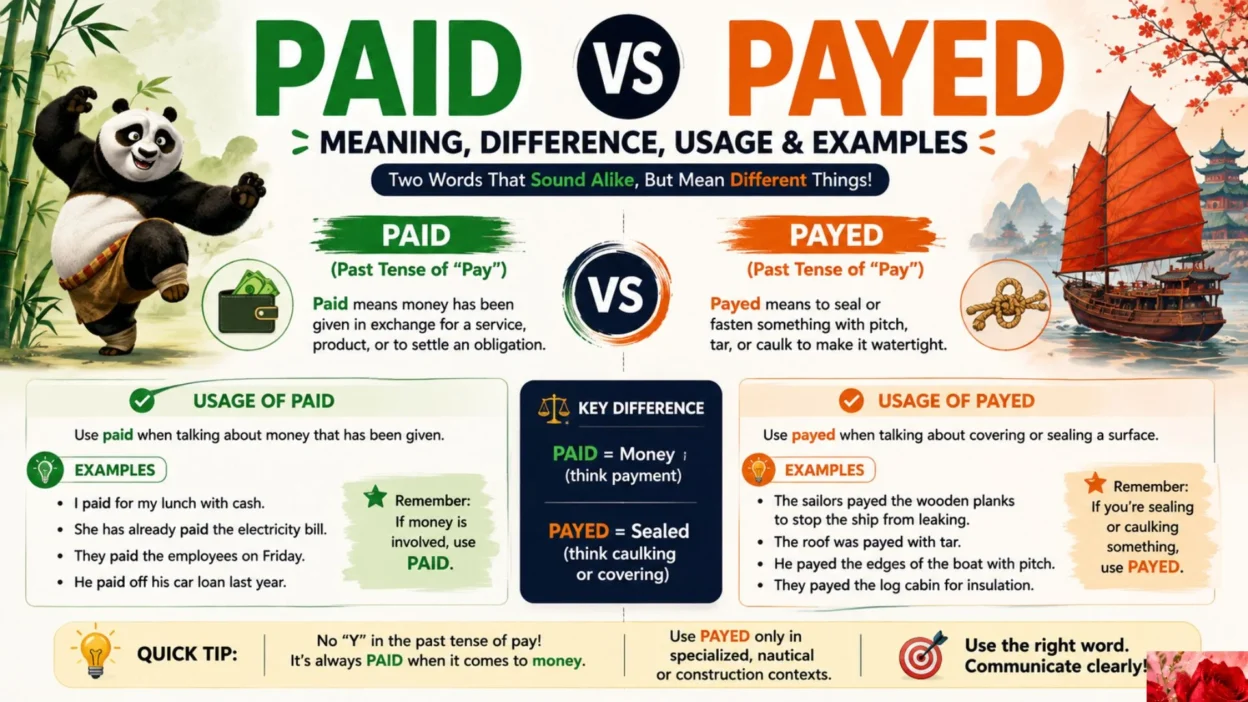
Paid vs payed is a common English confusion because both words are related to the verb pay, but they are not normally interchangeable. In standard English, paid is the correct past tense and past participle of pay when talking about money, bills, wages, purchases, or debts.
Payed has a much more limited use. People mainly use it as a specialized nautical term for sealing or covering the deck, seams, or other parts of a ship with tar or similar material.
| Word | Meaning | Common Use |
|---|---|---|
| Paid | Past tense of pay | Money, bills, wages, debts |
| Payed | Specialized nautical term | Ships, ropes, decks, seams |
What Does Paid Mean?
Paid is the past tense and past participle of pay.
It means that someone exchanged money for goods, cleared a debt, or received payment for services.
| Use | Example |
|---|---|
| Bill | I paid the electricity bill. |
| Purchase | She paid for the dress. |
| Debt | He paid his debt. |
| Salary | The workers were paid on Friday. |
| Fee | We paid the admission fee. |
| Rent | They paid their rent on time. |
| Service | She paid the mechanic. |
| Price | He paid a high price for the car. |
What Does Payed Mean?
Payed is a real word, but it is uncommon in everyday English. It is primarily a specialized nautical term.
It can refer to applying material such as tar or pitch to a ship’s seams or deck, or to certain nautical uses involving rope or cable.
| Term | Meaning |
|---|---|
| Payed | Applied tar, pitch, or similar material |
| Payed out | Nautical use involving letting out rope or cable |
| Nautical context | Mainly used in maritime writing |
Paid vs Payed: The Main Difference
The simplest way to remember the difference is:
Paid = money
Payed = specialized nautical use
| Situation | Correct Word |
|---|---|
| Paid a bill | Paid |
| Paid for food | Paid |
| Paid rent | Paid |
| Paid an employee | Paid |
| Paid a debt | Paid |
| Paid a fee | Paid |
| Ship seam treated with tar | Payed |
| Specialized nautical usage | Payed |
Paid vs Payed Examples
| Incorrect | Correct |
|---|---|
| I payed the bill. | I paid the bill. |
| She payed for lunch. | She paid for lunch. |
| He payed his rent. | He paid his rent. |
| We payed the workers. | We paid the workers. |
| They payed the fee. | They paid the fee. |
| I payed for the tickets. | I paid for the tickets. |
| She has payed the amount. | She has paid the amount. |
| He had payed the debt. | He had paid the debt. |
Why Is Paid the Correct Past Tense of Pay?
Many English verbs form their past tense by adding -ed, but pay is irregular.
The forms are:
| Verb Form | Word |
|---|---|
| Base form | Pay |
| Present | Pay |
| Past tense | Paid |
| Past participle | Paid |
| -ing form | Paying |
So:
Pay → Paid → Paid
Not:
Pay → Payed → Payed
Examples
| Tense | Example |
|---|---|
| Present | I pay the bill every month. |
| Past | I paid the bill yesterday. |
| Present perfect | I have paid the bill. |
| Past perfect | I had paid the bill before leaving. |
| Future | I will pay the bill tomorrow. |
| Continuous | I am paying the bill now. |
Paid in Everyday English
Thisappears in many common expressions.
| Expression | Meaning |
|---|---|
| Paid in full | Entire amount has been paid |
| Paid on time | Payment was made when required |
| Paid in advance | Payment was made beforehand |
| Paid by card | Payment made using a card |
| Paid in cash | Payment made using cash |
| Paid weekly | Receiving payment every week |
| Paid monthly | Receiving payment every month |
| Paid vacation | Vacation time for which an employee receives pay |
| Paid leave | Leave during which an employee continues receiving pay |
| Well-paid | Receiving a good salary |
Paid for vs Paid
A common grammar point is the difference between paid and paid for.
Paid
Use paid when the sentence focuses on the person receiving the money or the payment itself.
| Example | Meaning |
|---|---|
| I paid the cashier. | The cashier received the payment. |
| She paid the driver. | The driver received the payment. |
| He paid his employee. | The employee received money. |
Paid for
Use paid for when you mean that someone bought or covered the cost of something.
| Example | Meaning |
|---|---|
| I paid for dinner. | I covered the cost of dinner. |
| She paid for the tickets. | She covered the ticket cost. |
| He paid for the repairs. | He covered the repair costs. |
Paid With vs Paid By
Another useful distinction involves with and by.
| Expression | Example |
|---|---|
| Paid with cash | I paid with cash. |
| Paid with a card | She paid with a credit card. |
| Paid by check | He paid by check. |
| Paid by bank transfer | They paid by bank transfer. |
| Paid by the customer | The bill was paid by the customer. |
The exact construction can vary depending on what you want to emphasize.
Paid as a Past Tense
Use paid when describing something that happened in the past.
| Present | Past |
|---|---|
| I pay the bill. | I paid the bill. |
| She pays rent. | She paid rent. |
| They pay the fee. | They paid the fee. |
| We pay for lunch. | We paid for lunch. |
| He pays his employees. | He paid his employees. |
Example Sentences
- I paid the bill yesterday.
- She paid for the meal.
- We paid the registration fee.
- He paid his workers on Friday.
- They paid their debt last month.
Paid as a Past Participle
Paid is also used as the past participle of pay.
| Construction | Example |
|---|---|
| Have + paid | I have paid the bill. |
| Has + paid | She has paid the fee. |
| Had + paid | He had paid before the deadline. |
| Be + paid | The employees were paid yesterday. |
| Been + paid | Everyone has been paid. |
Common Expressions With Paid
| Expression | Example |
|---|---|
| Paid in full | The loan has been paid in full. |
| Paid off | She paid off her debt. |
| Paid back | He paid back the money. |
| Paid up | The membership is fully paid up. |
| Paid in advance | We paid in advance. |
| Paid on time | The invoice was paid on time. |
| Paid well | She is paid well for her work. |
| Paid leave | Employees receive paid leave. |
When do you spell it “payed”?
Although paid is the normal past form of pay, payed can be correct in specialized contexts.
Nautical terminology most commonly comes to mind when people hear it.
| Specialized Use | Meaning |
|---|---|
| Payed a seam | Covered or sealed a seam |
| Payed the deck | Applied material to the deck |
| Payed out a rope | Specialized maritime expression |
| Nautical terminology | Technical use rather than ordinary payment |
For everyday financial transactions, however, use paid.
Payed Out vs Paid Out
This is one area where context matters.
Paid out normally refers to distributing money.
| Phrase | Meaning | Example |
|---|---|---|
| Paid out | Money distributed | The company paid out bonuses. |
| Paid out | Money given to someone | The insurance company paid out the claim. |
| Payed out | Specialized nautical usage | The crew payed out the rope. |
So if you’re talking about money, paid out is the correct choice.
Paid vs Payed in American English
In standard American English, paid is the normal form when talking about money.
| Meaning | American English |
|---|---|
| Gave money | Paid |
| Settled a bill | Paid |
| Received wages | Paid |
| Bought something | Paid |
| Settled a debt | Paid |
| Distributed money | Paid out |
Payed remains a specialized word and is not the normal spelling for financial payment.
Paid vs Payed in British English
The same basic distinction applies in British English.
| Context | Correct Form |
|---|---|
| Money | Paid |
| Salary | Paid |
| Bill | Paid |
| Rent | Paid |
| Debt | Paid |
| Purchase | Paid |
| Nautical terminology | Payed may occur |
Therefore, the difference is not mainly between American and British English. It is primarily a difference in meaning and context.
Paid vs Payed: Quick Grammar Test
When you’re unsure which word to use, ask:
Am I talking about money?
If the answer is yes, use paid.
| Question | Answer |
|---|---|
| Did you give someone money? | Paid |
| Did you settle a bill? | Paid |
| Did you buy something? | Paid |
| Did you receive your salary? | Paid |
| Did you settle a debt? | Paid |
| Did you distribute money? | Paid |
| Are you describing a specialized nautical action? | Payed may be correct |
Common Mistakes With Paid and Payed
Mistake 1: Payed the Bill
Incorrect:
I payed the bill yesterday.
Correct:
I paid the bill yesterday.
Mistake 2: Payed for Dinner
Incorrect:
She payed for dinner.
Correct:
She paid for dinner.
Mistake 3: Have Payed
Incorrect:
We have payed the amount.
Correct:
We have paid the amount.
Mistake 4: Payed My Rent
Incorrect:
He payed his rent.
Correct:
He paid his rent.
Paid vs Payed in Questions
The same rule applies when asking questions.
| Incorrect | Correct |
|---|---|
| Did you payed the bill? | Did you pay the bill? |
| Have you payed the fee? | Have you paid the fee? |
| Did she payed for it? | Did she pay for it? |
| Has he payed the rent? | Has he paid the rent? |
Notice something important: after did, use the base form pay, not paid or payed.
Examples
- Did you pay the bill?
- Did she pay for lunch?
- Did they pay the fee?
- Have you paid the bill?
- Has he paid the rent?
Paid vs Payed in Negative Sentences
| Tense | Correct Example |
|---|---|
| Past | I did not pay the bill. |
| Present perfect | I have not paid the bill. |
| Past perfect | I had not paid the bill. |
| Present | I do not pay the fee. |
After did not, use pay.
After have not or had not, use paid.
Paid vs Payed in Different Sentences
| Situation | Correct Sentence |
|---|---|
| Bill | I paid the bill. |
| Shopping | She paid for the shoes. |
| Salary | The company paid its employees. |
| Rent | We paid our rent. |
| Debt | He paid his debt. |
| Fee | They paid the registration fee. |
| Ticket | I paid for my ticket. |
| Loan | She paid off her loan. |
| Bonus | The company paid out bonuses. |
| Nautical | The crew payed out the rope. |
Paid vs Payed: Easy Memory Trick
A simple way to remember the difference is:
Money = PAID
Think about your payment. Both words begin with pay, but when the verb refers to money, people use “paid” as its past form.
Quick Reminder
| If You Mean… | Use |
|---|---|
| Money | Paid |
| Bills | Paid |
| Wages | Paid |
| Purchases | Paid |
| Debts | Paid |
| Fees | Paid |
| Nautical terminology | Payed |
Frequently Asked Questions
Is paid or payed correct?
Paid is correct when you are talking about money, bills, wages, purchases, fees, or debts. Payed has specialized nautical uses.
Is payed a real word?
Yes. Payed is a real word, but it is uncommon. It is mainly used in specialized nautical contexts.
Is it paid or payed for something?
The correct phrase is paid for something.
For example: She paid for the tickets.
Is it paid or payed off?
The correct phrase is paid off.
For example: He paid off his loan.
Is it paid or payed out?
When talking about distributing money, the correct phrase is paid out.
For example: The company paid out bonuses.
Why is the past tense of pay paid instead of payed?
Pay is an irregular verb, so its standard past tense and past participle are paid.
Can I ever use payed?
Yes, but mainly in specialized nautical contexts. For ordinary financial situations, use paid.
What is the past tense of pay?
The past tense of pay is paid.
What is the past participle of pay?
The past participle is also paid.
Is payed used in American English?
It can appear in specialized technical or nautical writing, but paid is the standard form for financial meanings.
Paid vs Payed Final Comparison
| Category | Paid | Payed |
|---|---|---|
| Standard past tense of pay | ✓ | ✗ |
| Standard past participle | ✓ | ✗ |
| Paying a bill | ✓ | ✗ |
| Buying something | ✓ | ✗ |
| Paying rent | ✓ | ✗ |
| Paying wages | ✓ | ✗ |
| Paying a debt | ✓ | ✗ |
| Paying a fee | ✓ | ✗ |
| Paid off a loan | ✓ | ✗ |
| Paid out money | ✓ | ✗ |
| Nautical terminology | Sometimes | ✓ |
| Everyday English | ✓ | Rare |
Conclusion
The difference between paid vs payed is simple once you focus on context. Paid is the standard past tense and past participle of pay when referring to money. Use it for bills, salaries, purchases, rent, fees, debts, loans, and other financial situations.
Payed is a specialized word that appears mainly in nautical terminology. Because most everyday writing does not involve these technical meanings, paid will almost always be the word you need.
The easiest rule to remember is:
So write I paid the bill, She paid for dinner, and They paid their employees—not payed.

Clara Morgan is a language and vocabulary writer passionate about making English easier to understand. At Wordestic, she creates clear and practical guides on word meanings, synonyms, antonyms, grammar, word differences, and commonly confused words.
Her writing focuses on simple explanations, useful examples, and everyday usage to help readers expand their vocabulary and communicate with greater confidence.