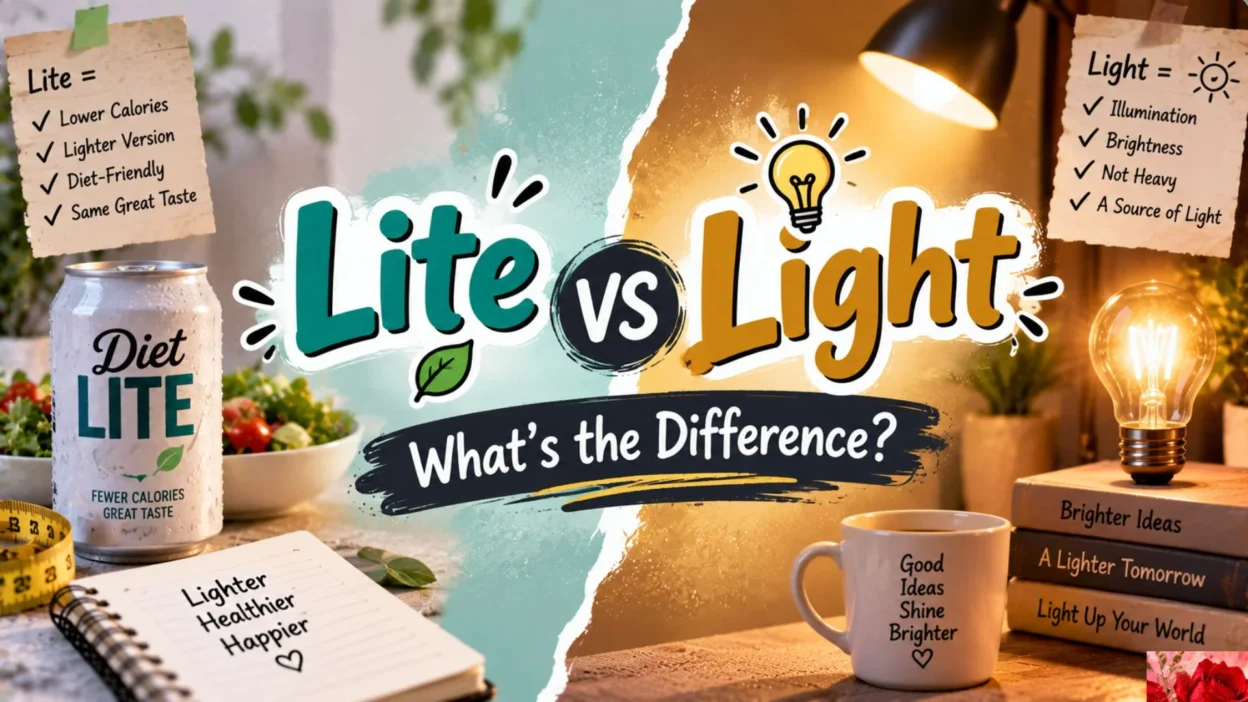
Have you ever stood in a grocery store aisle, staring at two nearly identical products—one labeled “lite” and the other “light”—and wondered if there’s any real difference between them? You’re not alone. The lite vs light distinction confuses many people, from native English speakers to those learning the language.
These two words are homophones, meaning they sound exactly the same when spoken, but they have different spellings and definitions . “Light” serves as the standard, versatile word with many meanings, while “lite” functions as an informal variant used primarily in commercial contexts. Understanding the difference between lite and light will help you write more precisely and avoid common errors that can undermine your credibility.
Quick Answer
The difference is straightforward: “light” is the standard word with multiple meanings. It can refer to illumination, something not heavy, or a pale color. “Lite” is an informal spelling of “light” that means “containing fewer calories or less of something” or “being a simpler version.” Use “lite” only in informal contexts like advertising, branding, or casual writing. When in doubt, choose “light”—it’s always correct.
Meaning Overview Table
| Aspect | Meaning |
|---|---|
| Definition | The distinction between standard word “light” and informal variant “lite” |
| Pronunciation | Both are pronounced the same: /laɪt/ |
| Part of Speech | Light: noun, verb, adjective, adverb; Lite: adjective (informal) |
| Usage | “Turn on the light” vs. “I ordered the lite beer.” |
| Context | Formal writing, commercial branding, everyday communication |
Main Meaning
Definition
“Lite vs light” refers to the grammatical distinction between the standard English word “light” and its informal variant “lite.” “Light” has multiple definitions: it can mean illumination (the opposite of darkness), something not heavy (the opposite of heavy), or a pale color . “Lite” is a simplified spelling of “light” that means “containing fewer calories or less of an ingredient,” “lacking in seriousness or substance,” or “being a less complex version” .
Origin
“Light” has ancient roots dating back to before the year 900, originating from the Old English word “lēoht” . The word has always had two primary meanings: illumination and not heavy. “Lite” emerged much later as a marketing variant in the 20th century . Food and beverage companies created the simplified spelling to distinguish their reduced-calorie products from standard versions . The term “lite beer” and “lite mayonnaise” helped popularize this spelling, which then expanded to describe simpler versions of software, news, and other products .
Context
The distinction operates in several contexts:
- Formal Writing: Use “light” exclusively. “Lite” is informal and inappropriate for academic, professional, or formal writing .
- Commercial Branding: “Lite” appears in product names and advertising to suggest reduced calories, fat, or complexity .
- Software and Technology: “Lite” often describes a free or simplified version of a program with fewer features.
- Everyday Communication: In casual writing and speech, you may encounter both forms.
- Food Labeling: “Lite” or “light” on food products must comply with regulations indicating at least 25% less of a nutrient compared to standard products .
Modern Usage
Today, “light” is the dominant and acceptable form in all contexts. “Lite” is a niche variant used for commercial and informal purposes . In American English, the distinction is more pronounced than in British English, though both forms are understood everywhere. “Lite” has expanded beyond food to describe “lite news” (simplified news), “lite software” (free or trial versions), and even “reggae lite” (a more accessible version of the genre) . The word has become a convenient shorthand for “less of something” in marketing and casual language.
Detailed Explanation
Literal Meaning
“Light” literally refers to the natural agent that stimulates sight and makes things visible—the opposite of darkness. It also literally describes something that has little weight or is not heavy . “Lite” has no independent literal meaning; it exists only as an informal variant of “light” meaning “having fewer calories” or “diminished in substance” .
Common Meaning
Commonly, people understand “light” as brightness or the opposite of heavy. They use it to describe lamps, sunshine, feathers, or pale colors. “Lite” is widely understood as “reduced” or “simplified” because of its frequent appearance on food packages and product names.
Text Meaning
In writing, choosing “lite” over “light” signals informality. In formal writing, using “lite” would be considered an error. The distinction is similar to using “thru” instead of “through” or “nite” instead of “night.”
Internet Meaning
Online, “lite” has taken on additional meanings. Software companies offer “lite” versions of their products as free or trial editions. The term “lite” implies a stripped-down or simplified version. On social media, people might describe a “lite” version of a hobby or activity meaning they engage in a less intense way.
Social Media Meaning
On social media platforms, “lite” often appears in hashtags (#lite, #litebeer) and product mentions. It also appears in humorous or self-deprecating contexts, like saying you’re a “lite” version of something, implying you’re not fully committed or serious.
Cultural Meaning
Culturally, “lite” represents a broader trend toward simplicity, health, and accessibility. The proliferation of “lite” products reflects consumer desires for lower-calorie options and easier-to-use versions of complex products. However, the term also carries criticism—”lite” can imply “less authentic” or “watered down.”
Examples Table
| Example | Meaning |
|---|---|
| Turn off the light when you leave. | Illumination; makes vision possible |
| This bag feels very light. | Not heavy; low weight |
| She wore a light blue dress. | Pale color; not dark |
| I ordered the lite beer. | Reduced calories or alcohol |
| The software has a free lite version. | Simplified version with fewer features |
| He only reads lite news. | Simplified, not serious news |
| Light a candle for her. | To set burning; ignite |
| The light from the sun warms us. | Natural illumination |
| We need to lighten the mood. | To make less serious or heavy |
| That suitcase is light enough to carry. | Easy to lift; not heavy |
Related Meanings Table
| Related Term | Meaning |
|---|---|
| Illuminate | To light up; to make bright |
| Illuminate | To clarify; to explain |
| Weightless | Having no weight; extremely light |
| Pale | Light in color; not dark |
| Luminous | Bright; full of light |
| Bright | Emitting much light |
| Dim | Low in light; not bright |
| Heavy | The opposite of light (weight) |
| Dark | The opposite of light (illumination) |
| Calorie-free | Containing no calories; often associated with “lite” products |
| Low-fat | Reduced fat content; common “lite” claim |
| Simplified | Made easier or less complex; “lite” often implies this |
| Diet | Reduced calorie; similar to “lite” |
| Mild | Low in intensity; not strong |
| Trial version | A free “lite” version of software |
Common Uses
People commonly encounter “lite vs light” in several settings:
Food and Beverage Labeling: Food companies use “lite” or “light” to indicate reduced calories, fat, sugar, or salt. Regulations require at least 25% less of the claimed nutrient compared to the regular product . However, “lite” may also describe texture, color, or flavor with no nutritional change .
Software and Technology: “Lite” versions of apps and programs offer limited features, often for free or at a lower price. These are also called “trial” or “starter” versions.
Reading and Entertainment: “Lite” news, “lite” reading, or “lite” entertainment suggests something less serious, easier to digest, or more accessible.
Everyday Conversation: People use “light” constantly in daily speech. They talk about turning on lights, carrying light bags, or having a light breakfast. “Lite” appears less often in conversation unless discussing products.
Descriptive Writing: Writers use “light” to describe colors (light blue), feelings (lighthearted), intensity (light rain), and more.
Common Mistakes
| Mistake | Correction |
|---|---|
| Using “lite” in formal writing or academic essays | Use “light” in all formal contexts; “lite” is informal |
| Using “lite” to mean “illumination” | “Lite” is not a noun; it doesn’t mean brightness. Use “light” for illumination |
| Using “lite” to mean “not heavy” | “Lite” does not mean “not heavy”; use “light” |
| Confusing “lite” as the correct spelling | “Light” is the standard spelling; “lite” is only for specific informal contexts |
| Writing “lite” on a resume or cover letter | Avoid “lite” in professional writing |
| Assuming “lite” always means healthier | “Lite” can describe color, texture, or flavor with no nutritional change |
| Using “lite” interchangeably with “light” | They are not interchangeable; “lite” is a variant with limited use |
| Using “light” when marketing a reduced-calorie product | “Lite” is common in branding, but “light” is also used (e.g., “light beer”) |
| Thinking “lite” is an abbreviation | “Lite” is a variant spelling, not an abbreviation |
| Using “lite” to describe a color | Colors can be “light” (e.g., light blue), not “lite” |
Related Questions
What is the difference between “lite” and “light”?
“Light” is the standard English word with multiple meanings: illumination, not heavy, and pale color. “Lite” is an informal spelling of “light” that specifically means “containing fewer calories or less of something” or “being a simpler version” .
Can “lite” and “light” be used interchangeably?
No, they are not interchangeable in formal writing. “Light” is always correct and preferred in formal contexts. “Lite” is restricted to informal contexts, particularly in branding and advertising. In product names, “lite” and “light” are sometimes used interchangeably—both “lite beer” and “light beer” exist .
Is “lite” a real word?
Yes, “lite” is a real word recognized by dictionaries. It is an informal variant of “light” meaning “having fewer calories” or “diminished in substance” . You’ll find it in Scrabble and other word games.
When should I use “lite”?
Use “lite” in informal contexts, particularly when referring to a product with reduced calories, fat, or features. For example, “lite beer,” “lite software,” or “lite reading.” However, avoid using it in formal writing.
Is “light” or “lite” correct on food labels?
Both forms appear on food labels. Regulations in many countries require “lite” or “light” claims to indicate at least 25% less of a nutrient compared to regular products . However, “lite” may also describe taste or texture, which doesn’t change nutritional content.
What is the plural of “lite”?
The plural of “lite” is “lites” .
What does “lite” mean in software? In software, “lite” indicates a simplified version with fewer features. These are often free trial versions or “starter” editions.
FAQs
Is “lite” a word?
Yes, “lite” is a word. It’s an informal variant of “light” meaning “having fewer calories” or “diminished in substance” .
What is the pronunciation of “lite” and “light”?
Both are pronounced identically: /laɪt/ .
Is “lite” acceptable in academic writing?
No, “lite” is informal and should not be used in academic, professional, or formal writing .
What’s the plural of “lite”?
The plural is “lites” .
What does “lite” mean in the food industry?
In food labeling, “lite” or “light” can mean reduced calories, fat, sugar, or salt. Regulations require at least 25% less of the claimed nutrient compared to the regular product . It may also describe color, texture, or flavor.
What is “lite beer”?
“Lite beer” is a beer with fewer calories and usually lower alcohol content than regular beer . It’s a common use of the word “lite.”
What does “lite” mean in software?
In software, “lite” indicates a simplified version with limited features. It’s often free or a trial version.
Why do companies use “lite” instead of “light”?
Companies use “lite” as a marketing tool to distinguish their reduced-calorie or simplified products from standard versions. The variant spelling catches the eye and suggests “less” or “easier.”
Conclusion
The distinction between “lite” and “light” is simple but important. “Light” is the versatile, standard word used for illumination, low weight, pale colors, and much more. “Lite” is an informal variant used almost exclusively to mean “having fewer calories” or “being a simplified version.” In formal writing, always choose “light.” In informal contexts, you may use “lite” for commercial products, simplified versions, or casual descriptions. When in doubt, use “light”—it’s always correct and never considered informal. Understanding this distinction will help you write more precisely, avoid common errors, and communicate with confidence in both formal and informal contexts.

Clara Morgan is a language and vocabulary writer passionate about making English easier to understand. At Wordestic, she creates clear and practical guides on word meanings, synonyms, antonyms, grammar, word differences, and commonly confused words.
Her writing focuses on simple explanations, useful examples, and everyday usage to help readers expand their vocabulary and communicate with greater confidence.