Have you ever stopped mid-sentence, unsure whether to describe someone as “empathic” or “empathetic”? You’re not alone. This common dilemma trips up writers, students, and professionals alike. The empathic or empathetic question has sparked countless grammar debates, yet the answer is simpler than you might think.
Both words mean essentially the same thing: having the ability to understand and share the feelings of another person . However, subtle differences in usage, origin, and context set them apart. This guide will help you confidently choose the right word every time, understand the historical debate, and avoid common mistakes.
Quick Answer
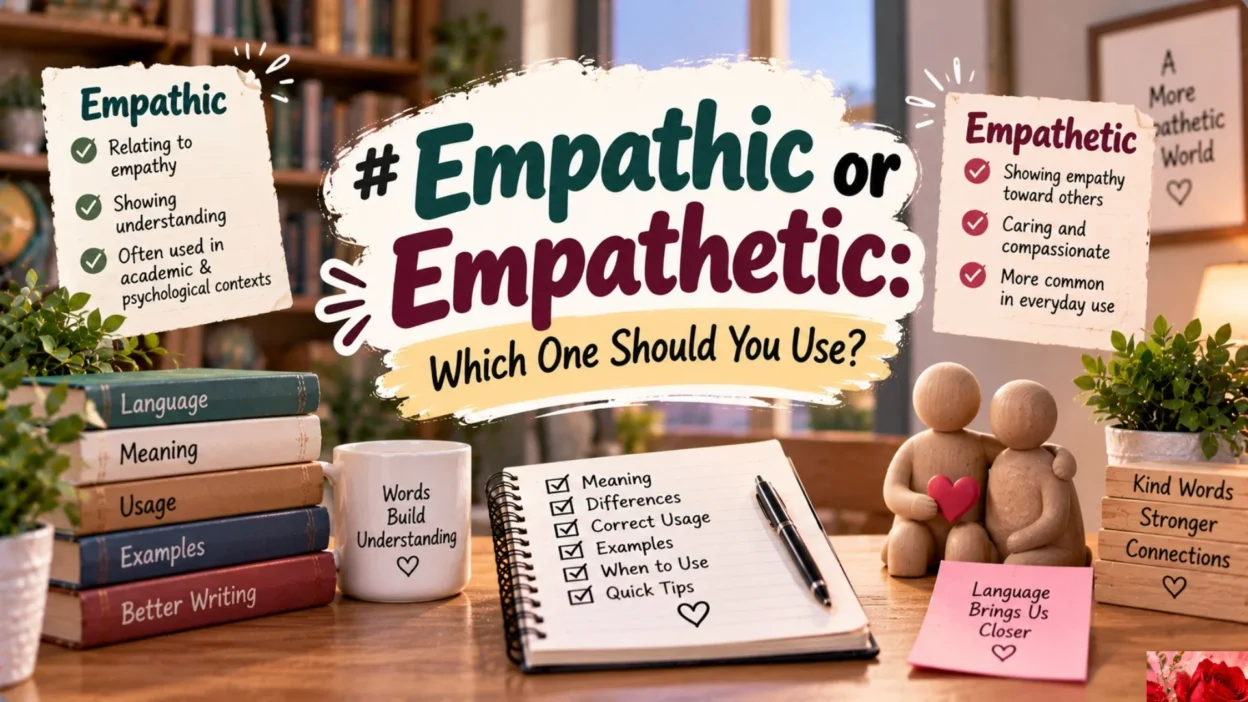
“Empathic” and “empathetic” are interchangeable and mean the same thing: showing or relating to empathy.”Empathic” appears more often in scientific and psychological writing, while “empathetic” is more common in everyday usage . Choose either—both are correct!
Meaning Overview Table
| Aspect | Meaning |
|---|---|
| Definition | Both words mean having or showing empathy—the ability to understand and share another person’s feelings |
| Pronunciation | Empathetic: em-puh-THET-ik; Empathic: em-PATH-ik |
| Part of Speech | Both are adjectives |
| Usage | “She gave an empathic response” vs. “She gave an empathetic response” |
| Context | Scientific writing, psychology, everyday conversation, professional settings |
Main Meaning
Definition
Both “empathic” and “empathetic” are adjectives that describe someone who exhibits empathy—the ability to understand, share, and connect with another person’s emotional experience . Empathy goes beyond sympathy (feeling sorry for someone) to actively feeling or imagining what another person might be experiencing .
Origin
The word “empathy” traces back to 1858, when German philosopher Rudolf Lotze coined it from the Greek empatheia, meaning “passion” . Lotze believed that when you view a work of art, you project your own sensibilities onto it. To make the word, he turned to the ancient Greek empatheia .
“Empathic” appeared first, with its first recorded use in 1909, followed by “empathetic” in 1932 . Some language experts suggest that “empathic” may have emerged through analogy with “telepathic” in science fiction, where an “empath” is someone with the direct ability to experience another’s feelings . This connection to science fiction may explain some of the subtle distinctions people perceive between the two words.
Context
Both words appear across various settings:
- Psychology and Scientific Writing: “Empathic” is more common, particularly in research papers and academic contexts
- Healthcare and Counseling: Professionals often use “empathetic” to describe patient-centered care
- Personal Communication: Both appear frequently, though “empathetic” is more common in everyday speech
- Professional Settings: Both are acceptable in business communication
- New Age and Spiritual Contexts: “Empathic” sometimes carries New Age connotations due to its association with “empaths”
Modern Usage
Today, “empathetic” has become the more common word in everyday use. However, both forms remain fully acceptable. “Empathic” often appears in formal academic writing, while “empathetic” is more widely used in general contexts . In scientific writing, researchers tend to prefer “empathic” when discussing phenomena like “empathic perception” or “empathic understanding” .
Detailed Explanation
Literal Meaning
At their core, both words describe the capacity for empathy. The German term Einfühlung (feeling into) preceded the English word “empathy.” An empathic or empathetic person does not just understand another’s feelings intellectually—they participate in them in an “as if” mode, imagining what it’s like to experience that situation from the other person’s perspective .
Common Meaning
Commonly, people use “empathetic” to describe someone who genuinely cares about and understands others’ emotional states. For example, an empathetic friend listens without judgment and responds with compassion. An empathetic counselor creates a safe environment for clients to share their deepest concerns.
Nuanced Meaning
Some language users and scholars perceive subtle distinctions :
- Innate vs. Transient: Some feel “empathic” implies a more lasting, innate quality, while “empathetic” can be temporary. For instance: “She is generally empathic, but she was an empathetic listener in that moment”
- Action vs. Internal State: Others believe “empathic” suggests action (like actively listening or responding), while “empathetic” denotes just an internal feeling . This appears in professional contexts like “empathic listening” or “empathic responses” used in counseling and call centers
However, these distinctions are not universally accepted, and most style guides treat the words as interchangeable.
Cultural Meaning
Culturally, both words reflect our growing awareness of emotional intelligence, mental health, and the importance of connection. The concept of empathy has become central to fields like psychology, healthcare, education, and even business . Organizations increasingly value empathetic employees, recognizing that social intelligence is as essential as professional skills .
Examples Table
| Example | Meaning |
|---|---|
| The empathic counselor understood her client’s unspoken fears. | Counselor actively engaged with client’s emotions |
| She gave an empathetic response to her friend’s struggle. | She responded with emotional understanding |
| His empathic nature made him an excellent leader. | He consistently connected with his team |
| The nurse’s empathetic care comforted the patient’s family. | The nurse expressed understanding through care |
| I need an empathic listener, not a problem-solver. | Someone who will feel with me, not fix me |
| Her empathetic spirit shone through in every conversation. | She consistently showed understanding |
| The therapist used empathic listening techniques. | She applied active, understanding listening skills |
| He is the most empathetic person I know. | He understands others’ feelings well |
| Empathic perception does not always lead to prosocial behavior. | Understanding doesn’t always mean acting kindly |
| The interview process requires an empathetic approach. | The approach should show understanding |
Related Meanings Table
| Related Term | Meaning |
|---|---|
| Empathy | The ability to understand and share another’s feelings |
| Sympathy | Feeling pity or sorrow for someone, but not feeling their pain yourself |
| Sympathetic | Feeling or showing sympathy; feeling sorry for others |
| Compassionate | Feeling empathy and a desire to help |
| Understanding | Having insight into someone’s situation |
| Sensitive | Quick to detect or respond to others’ feelings |
| Emotional intelligence | Ability to recognize and manage emotions in oneself and others |
| Active listening | Fully concentrating, understanding, and responding to a speaker |
| Emotional contagion | “Catching” others’ emotions without understanding them |
| Personal distress | Feeling overwhelmed by others’ emotions |
| Affective empathy | Feeling what others feel emotionally |
| Cognitive empathy | Understanding what others think or feel intellectually |
| Perspective-taking | Imagining another’s viewpoint |
| Mirror neurons | Brain cells associated with empathy |
| Empath | A person with the direct ability to experience another’s feelings |
Common Uses
People commonly use “empathic” or “empathetic” in various settings:
Counseling and Psychology: Professionals describe “empathic listening” or “empathetic communication” as essential skills. The terms appear in training, clinical practice, and academic literature .
Healthcare: Nurses, doctors, and caregivers aim for empathetic care, which research shows improves patient outcomes and satisfaction. An empathetic approach helps build trust and alleviate anxiety .
Workplace and Leadership: Organizations increasingly value empathetic leaders who can navigate complex interpersonal dynamics, build morale, and foster collaboration . Training often includes developing “empathic responses.”
Customer Service: Call centers train staff in “empathy and empathetic responses” to better handle complaints and build customer loyalty .
Everyday Conversation: People describe friends, family, and colleagues as empathetic when they show understanding and care in difficult moments.
Common Mistakes
| Mistake | Correction |
|---|---|
| Thinking one is correct and the other is wrong | Both are correct and interchangeable |
| Using “empathetic” when “sympathetic” is meant | Sympathetic = feeling sorry; empathetic = feeling with |
| Confusing the pronunciation | Empathetic: em-puh-THET-ik; Empathic: em-PATH-ik |
| Believing they have different meanings | They mean the same thing |
| Using “empathic” only in scientific contexts | It is more common in science but works anywhere |
| Believing “empathetic” is the only “correct” form | Both are correct, though “empathetic” is more common |
| Overusing in formal writing | Use sparingly in formal academic writing |
| Assuming empathy always means agreeing | Empathy does not require approval or agreement |
| Forgetting that empathy can be used negatively | Empathy can serve manipulative or selfish purposes too |
| Thinking empathy is just feeling sad with someone | Empathy also means understanding perspectives, not just sharing emotions |
Related Questions
What is the difference between “empathic” and “empathetic”?
There is no meaningful difference in meaning. Both mean having or showing empathy. “Empathic” is the older term and appears more in scientific writing, while “empathetic” is more common in everyday use .
Is “empathic” a real word?
Yes, “empathic” is a real, established word that has been in use since 1909 . Dictionary.com lists it as a variant of “empathetic” .
Which is more common: “empathic” or “empathetic”?
“Empathetic” is much more common in everyday writing and speech. However, “empathic” is more frequently used in scientific, psychological, and academic literature .
Are “empathic” and “empathetic” interchangeable?
Yes, they are near-perfect synonyms and can be used interchangeably .
FAQs
Is “empathic” or “empathetic” correct?
Both are grammatically correct. Neither is wrong. “Empathetic” is more common, but “empathic” is equally valid, especially in academic contexts .
What does it mean to be empathic?
To be empathic means to have the ability to understand and share another person’s feelings. Empathic people are sensitive to others’ emotional states and can imagine what it’s like to be in someone else’s situation .
What is the difference between empathy and sympathy?
Empathy means feeling what another person feels as if you are experiencing it yourself. Sympathy means feeling pity or sorrow for someone, but you don’t necessarily share their emotional experience .
Can someone be described as both empathic and empathetic?
Yes, both adjectives describe the same quality. You can use either term to describe someone with high emotional intelligence and the ability to connect with others’ feelings.
Why do some people prefer “empathic” over “empathetic”?
Some prefer “empathic” because it’s the older term or because they feel it suggests a more innate, enduring quality rather than a temporary state . Others favor it in scientific writing where it remains more common .
What is an “empathic person”?
An empathic person is someone who naturally understands and shares the emotional experiences of others. They are often described as good listeners, caring, and sensitive to the needs of those around them .
Where does the word “empathy” come from?
The philosopher Rudolf Lotze coined “empathy” in 1858 from the Greek empatheia, meaning “passion.” Lotze believed that when people view art, they project their own feelings onto it .
Conclusion
The empathic or empathetic debate is ultimately a matter of preference rather than correctness. Both words mean the same thing, share the same origins, and are accepted in all contexts. “Empathetic” has become the more common choice in everyday speech, while “empathic” remains a popular option in scientific and academic writing. The most important thing is not which word you choose, but the quality it represents—the ability to understand and connect with others’ emotions. In a world that often feels divided, the power of empathy to build bridges, heal wounds, and foster understanding has never been more essential. Whether you choose “empathic” or “empathetic,” what truly matters is living with compassion and connection.

Clara Morgan is a language and vocabulary writer passionate about making English easier to understand. At Wordestic, she creates clear and practical guides on word meanings, synonyms, antonyms, grammar, word differences, and commonly confused words.
Her writing focuses on simple explanations, useful examples, and everyday usage to help readers expand their vocabulary and communicate with greater confidence.