
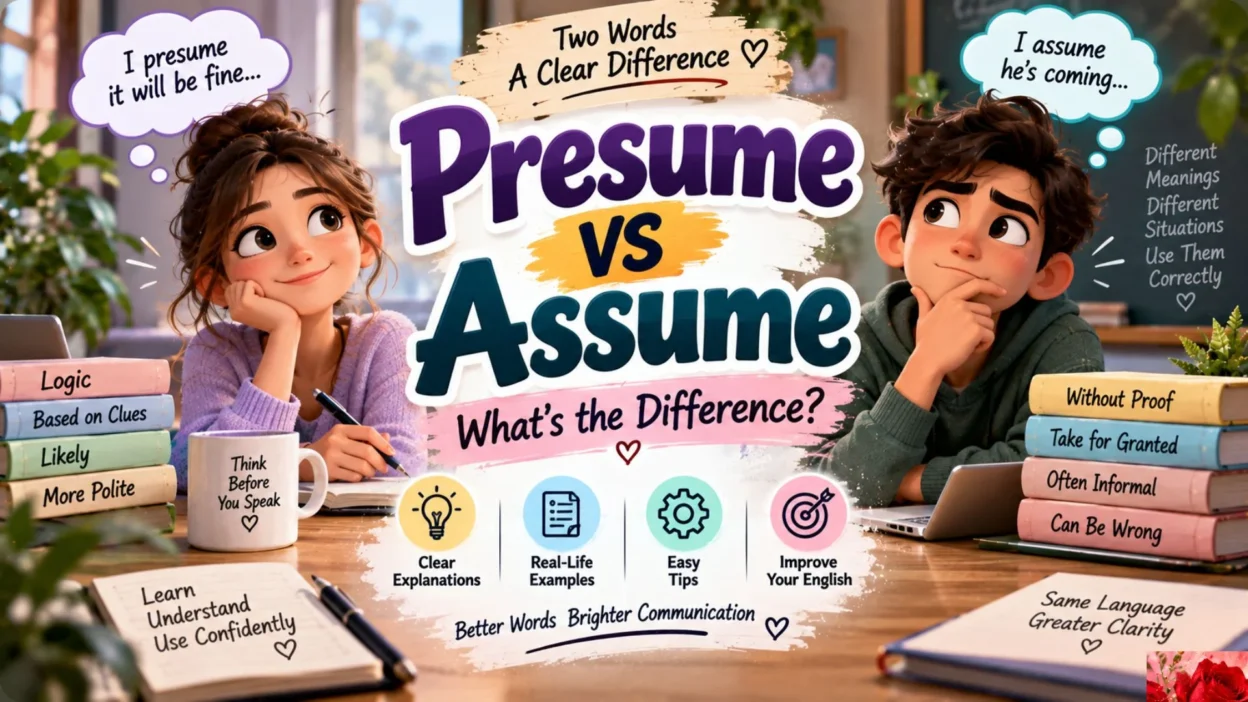
English contains many word pairs that sound similar but carry distinct meanings, and “presume” and “assume” rank among the most commonly confused. Both verbs describe forming a belief without complete proof, yet they differ in confidence level, evidence, and implication. Understanding the presume vs assume distinction helps you write with precision and speak with authority, whether you’re drafting a legal document, composing a professional email, or settling a friendly debate.
The confusion makes sense. These two words share Latin roots and overlap in everyday conversation. Many people use them interchangeably without noticing. However, careful writers recognize that “assume” suggests taking something for granted without proof, while “presume” implies a reasonable belief based on probability or evidence. This comprehensive guide breaks down the difference, explores their origins, provides practical examples, and helps you choose the right word every time.
Quick Answer
The difference between presume and assume comes down to evidence and confidence. “Assume” means to take something as true without proof—a guess or supposition. “Presume” means to believe something is true based on probability, evidence, or reasonable grounds. Assume suggests less certainty; presume suggests more. You assume something without evidence; you presume something because evidence points that way.
Meaning Overview Table
| Aspect | Meaning |
|---|---|
| Definition | Two verbs describing beliefs formed without complete certainty, distinguished by evidence and confidence level |
| Pronunciation | Assume: uh-SOOM; Presume: prih-ZOOM |
| Part of Speech | Both are verbs (transitive) |
| Usage | “I assume you’re coming” (no evidence) vs. “I presume you’re coming since you RSVP’d” (evidence-based) |
| Context | Formal writing, legal language, professional communication, everyday speech |
Main Meaning
Definition
“Assume” means to take something as true or certain without proof or verification. It describes a supposition, a guess, or a belief accepted without evidence. “Presume” means to believe something to be true based on reasonable evidence, probability, or strong likelihood. It implies a belief grounded in circumstance rather than certainty.
Origin
Both words trace back to Latin. “Assume” derives from assumere, meaning “to take up” or “to take to oneself,” combining ad (“to”) and sumere (“to take”). “Presume” derives from praesumere, meaning “to take before” or “to anticipate,” combining prae (“before”) and sumere (“to take”). The prefix difference—ad versus prae—explains much of the modern distinction. Assuming involves taking something in; presuming involves taking something beforehand, based on prior expectation.
Context
The distinction operates across several settings:
- Legal Writing: “Presume” carries heavy weight in law, as in “presumed innocent until proven guilty”
- Professional Communication: “Assume” often flags potential misunderstanding, while “presume” signals confident expectation
- Everyday Speech: Most people use both casually, though careful speakers preserve the distinction
- Academic Writing: Precise usage demonstrates command of language and logical reasoning
- Social Interaction: “Presume” can sound more formal or even bold in conversation
Modern Usage
Today, both words appear frequently in English. Many speakers treat them as synonyms, particularly in casual conversation. However, style guides, dictionaries, and writing instructors continue to emphasize the distinction. In legal contexts, the difference is critical. In everyday usage, the nuance often depends on how much evidence supports the belief.
Detailed Explanation
Literal Meaning
Literally, “assume” means to take something upon oneself or to take something as granted. “Presume” literally means to take something before it is proven, implying anticipation based on prior knowledge. Both describe mental acts of acceptance, but the literal roots show different orientations toward evidence and timing.
Common Meaning
Commonly, people use “assume” when making a guess or jumping to a conclusion. They use “presume” when forming a belief grounded in reasonable expectation. For example, if a coworker is late and you have no information, you assume traffic delayed them. If that same coworker always arrives late on Mondays and today is Monday, you presume traffic delayed them.
Legal Meaning
In law, “presume” carries significant weight. The phrase “presumed innocent” means the legal system treats a defendant as innocent until the prosecution proves guilt beyond reasonable doubt. “Assume” appears in legal contexts too, often in contracts or risk clauses, as in “assume liability” or “assume the risk.”
Logical Meaning
In logic and reasoning, “assume” introduces a premise for the sake of argument. Mathematicians and philosophers say “let us assume X is true” to establish conditions for a proof. “Presume” appears less often in formal logic and more in practical reasoning about probabilities.
Everyday Meaning
In casual conversation, the two words often blur together. A person might say “I assume so” or “I presume so” with little practical difference. However, careful speakers notice that “presume” sounds slightly more formal and implies more confidence than “assume.”
Examples Table
| Example | Meaning |
|---|---|
| I assume you’re coming to the party. | You have no evidence; you’re guessing. |
| I presume you’re coming since you RSVP’d. | Evidence supports your expectation. |
| Let’s assume the budget is fixed. | Establishing a premise for discussion. |
| The defendant is presumed innocent. | Legal standard based on principle, not evidence. |
| She assumed he was joking. | She guessed without confirmation. |
| He presumed she would say yes based on her smile. | He drew a reasonable inference from evidence. |
| Don’t assume everyone agrees with you. | Warning against unfounded belief. |
| I presume you’ve read the report. | Expectation based on reasonable likelihood. |
| They assumed control of the company. | Taking power or responsibility (different sense). |
| We presume the meeting will proceed as scheduled. | Confidence based on normal patterns. |
Related Meanings Table
| Related Term | Meaning |
|---|---|
| Assume | To take as true without proof |
| Presume | To believe based on probability or evidence |
| Suppose | To think or assume something is the case |
| Infer | To deduce from evidence and reasoning |
| Conclude | To reach a judgment after consideration |
| Speculate | To form a theory without firm evidence |
| Surmise | To suppose something is true without confirmation |
| Guess | To estimate or suppose without sufficient information |
| Presuppose | To require as a precondition |
| Postulate | To suggest or assume as a basis for reasoning |
| Take for granted | To assume something without question |
| Jump to conclusions | To form opinions without sufficient evidence |
| Presumption | A belief based on probability; also boldness |
| Assumption | Something accepted as true without proof |
| Presumptive | Based on probability; presumed |
| Assumptive | Characterized by assumption |
| Presumptuous | Overstepping bounds; excessively bold |
| Assumable | Capable of being assumed |
Common Uses
People use “assume” and “presume” across numerous contexts:
Legal Settings: Lawyers and judges carefully distinguish between the two, especially in criminal proceedings where “presumed innocent” carries constitutional weight. Contracts often include clauses where parties “assume” risk or liability.
Professional Communication: Colleagues use “assume” to flag uncertainty, as in “I assume the deadline is Friday—correct me if I’m wrong.” They use “presume” to signal confident expectation, as in “I presume the client approved the proposal.”
Academic Writing: Scholars use “assume” when establishing premises for arguments. “Let us assume a constant rate of growth” introduces a hypothetical condition. “Presume” appears less often in academic prose, though it can describe reasonable inferences.
Everyday Conversation: Friends and family use both words casually. “I assume you’re hungry” differs subtly from “I presume you’re hungry”—the latter sounds slightly more formal and confident.
Customer Service: Representatives often say “I presume you’d like a refund” when evidence suggests that outcome, versus “I assume you’d like a refund” when they have no indication either way.
Common Mistakes
| Mistake | Correction |
|---|---|
| Using “assume” and “presume” as exact synonyms | They differ in evidence and confidence; choose accordingly |
| Saying “I presume” when you have no evidence | Use “assume” when you lack supporting information |
| Using “assume” in legal contexts where presumption applies | “Presumed innocent” is the correct legal standard |
| Confusing “presumptuous” with “presumptive” | “Presumptuous” means overstepping; “presumptive” means based on probability |
| Using “presume” to sound more formal without cause | Precision matters more than formality |
| Assuming “presume” always means arrogance | “Presume” can simply mean reasonable belief |
| Mixing up “assumption” and “presumption” in writing | Each noun carries the nuance of its verb |
| Using “assume” when evidence clearly supports belief | “Presume” better captures evidence-based expectation |
| Forgetting that “assume” has other meanings | “Assume” also means to take on a role or responsibility |
| Ignoring context when choosing between them | Context determines which word fits best |
Related Questions
What is the main difference between presume and assume?
“Assume” means to take something as true without proof. “Presume” means to believe something based on evidence or probability. Assume suggests guessing; presume suggests reasonable confidence.
Can you use assume and presume interchangeably?
In casual conversation, many people do. However, careful writers preserve the distinction because the words carry different levels of confidence and evidence.
Which word is stronger, presume or assume?
“Presume” is stronger because it implies evidence or reasonable grounds. “Assume” is weaker because it suggests a guess without proof.
Is “presume” more formal than “assume”?
Yes, “presume” tends to sound more formal and is common in legal and professional contexts. “Assume” appears more often in everyday speech.
What does “presumed innocent” mean?
“Presumed innocent” is a legal principle stating that a defendant is treated as innocent until the prosecution proves guilt beyond a reasonable doubt. It reflects the legal system’s commitment to fairness.
What is the noun form of each word?
The noun form of “assume” is “assumption.” The noun form of “presume” is “presumption.” “Presumption” can also mean boldness or overstepping.
FAQs
What does presume mean?
Presume means to believe something is true based on probability or reasonable evidence. It implies confidence grounded in circumstance rather than certainty.
What does assume mean?
Assume means to take something as true without proof. It describes a supposition, guess, or belief accepted without evidence.
Is it “I assume” or “I presume”?
Both are correct, but they differ in nuance. “I assume” signals a guess without evidence. “I presume” signals a belief based on reasonable grounds.
Can assume mean something else?
Yes. “Assume” also means to take on a role, responsibility, or quality, as in “She assumed the role of manager” or “He assumed a calm demeanor.”
What is a presumptuous person?
A presumptuous person oversteps boundaries or acts with excessive boldness. The word comes from “presume” but carries a negative connotation of arrogance.
Why do people confuse presume and assume?
They share Latin roots, sound similar, and overlap in casual usage. Both describe beliefs without complete certainty, making the distinction subtle.
How do I remember the difference?
Think of the prefixes. “Assume” starts with “a” like “guess.” “Presume” starts with “pre” like “previous evidence.” Presume needs prior grounds.
Is presume always about evidence?
Not always. In legal and formal contexts, “presume” implies a reasonable basis. In everyday speech, it can simply sound more confident than “assume.”
Conclusion
Mastering the presume vs assume distinction elevates your writing and speech. “Assume” describes taking something as true without proof—a guess, a supposition, a leap. “Presume” describes believing something based on evidence, probability, or reasonable grounds—a confident expectation grounded in circumstance. While casual conversation often blurs the line, precise communication preserves the difference. Remember the simple rule: assume without evidence, presume with it. This small distinction carries real weight in legal settings, professional writing, and everyday credibility. Choose your words deliberately, and your readers will trust your judgment.

Clara Morgan is a language and vocabulary writer passionate about making English easier to understand. At Wordestic, she creates clear and practical guides on word meanings, synonyms, antonyms, grammar, word differences, and commonly confused words.
Her writing focuses on simple explanations, useful examples, and everyday usage to help readers expand their vocabulary and communicate with greater confidence.