
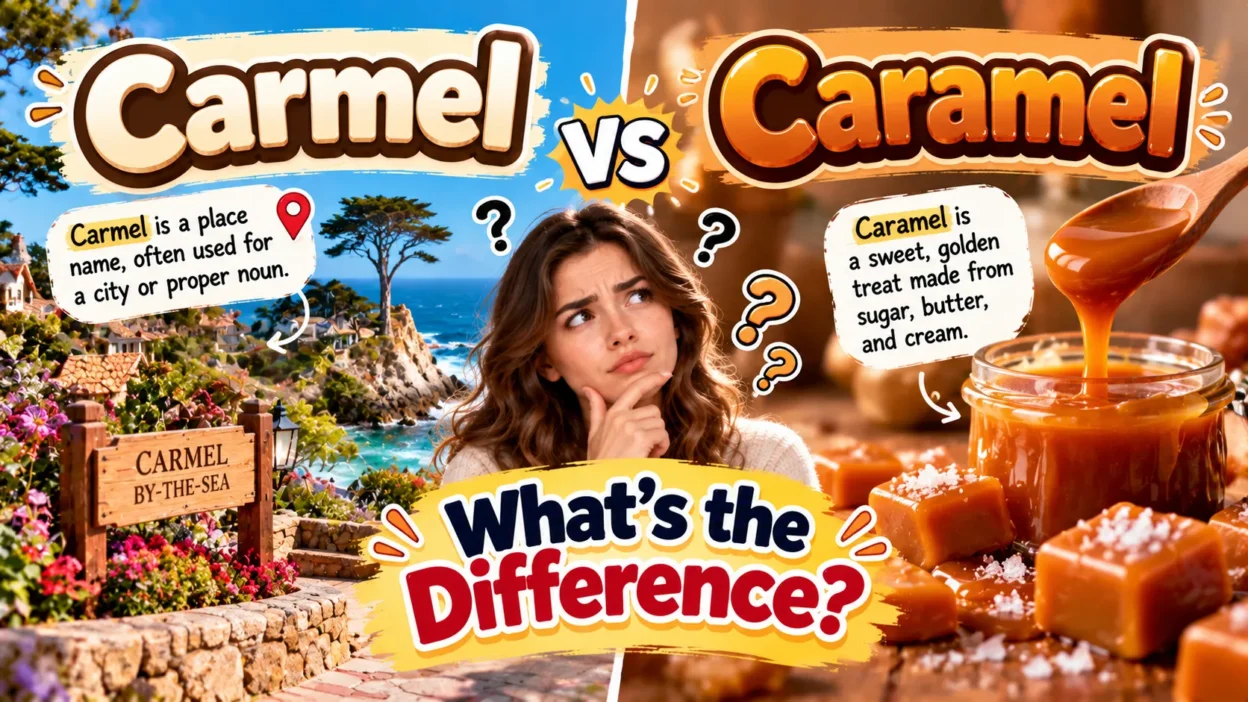
Few spelling debates stir up as much passion as the carmel vs caramel question. You see it everywhere—on candy wrappers, in coffee shop menus, and across social media comment sections. People fiercely defend their preferred spelling and pronunciation, often insisting the other version is simply wrong. But is it?
The truth is more nuanced than most people realize. “Caramel” is the standard spelling for the sweet treat and the color, while “Carmel” is a proper noun referring to geographical locations like the California beach town or Mount Carmel in Israel . However, the pronunciation “car-mel” (two syllables) has become so common that it has influenced spelling habits, creating widespread confusion. This comprehensive guide will clarify the distinction, explore the pronunciation debate, and help you choose the correct spelling every time.
Quick Answer
Use caramel when referring to the sweet candy, the flavoring, or the light brown color. Use Carmel only as a proper noun for places like Carmel-by-the-Sea in California or Mount Carmel. The two-syllable pronunciation “car-mel” is widely accepted, but it does not change the correct spelling for the food or color .
Meaning Overview Table
| Aspect | Meaning |
|---|---|
| Definition | Caramel: a sweet candy or light brown color. Carmel: a proper noun for places and people |
| Pronunciation | Caramel: KARR-uh-mel, KARR-uh-mul, or KARR-mul. Carmel: KARR-mel |
| Part of Speech | Caramel: noun, adjective. Carmel: proper noun |
| Usage | “I love salted caramel” vs. “We visited Carmel-by-the-Sea” |
| Context | Food, color, geography, proper names |
Main Meaning
Definition
Caramel is a noun with three primary meanings: a chewy candy made from sugar, butter, and milk; the brown substance created by heating sugar; and a light brown color . Carmel is a proper noun used for geographical locations and personal names, most notably the town of Carmel-by-the-Sea in California and Mount Carmel in Israel .
Origin
The word “caramel” entered English in the early 1700s from French, which borrowed it from Spanish or Portuguese . Its deeper origins are debated, with some tracing it to Latin calamellus (small reed) and others to the Latin phrase canna mellis (honey cane) . The proper noun “Carmel” has a completely different origin, deriving from the Hebrew Karmel, meaning “God’s vineyard” or “garden” .
Context
The distinction operates in several contexts:
- Food and Cooking: Always use “caramel” for the candy, sauce, flavoring, or the process of caramelization
- Color Description: Use “caramel” for the light brown shade
- Geography: Use “Carmel” for place names like Carmel-by-the-Sea, Mount Carmel, or the Carmel River
- Personal Names: “Carmel” is also a given name, particularly in Catholic communities
- Informal Spelling: Some people misspell “caramel” as “carmel” because of the two-syllable pronunciation, but this is incorrect in formal writing
Modern Usage
Today, “caramel” dominates in food and color contexts. “Carmel” appears almost exclusively as a proper noun. The confusion arises because the two-syllable pronunciation “car-mel” is extremely common in American English, leading many people to spell the word the way they say it . Dictionaries acknowledge the two-syllable pronunciation as standard, but they do not accept “carmel” as a correct spelling for the food or color .
Detailed Explanation
Literal Meaning
Literally, “caramel” refers to the product of heating sugar until it browns. This process, called caramelization, creates complex flavors and colors . “Carmel” literally refers to specific geographic locations, most famously the mountain in Israel and the coastal California town .
Common Meaning
Commonly, people use “caramel” to describe anything from a soft candy to a coffee drink to a hair color. They use “Carmel” to refer to the California town, the biblical mountain, or as a person’s name. The two words are not interchangeable.
Pronunciation Debate
The pronunciation of “caramel” varies widely. The three-syllable version (KARR-uh-mel) follows the spelling more closely, while the two-syllable version (KARR-mul) drops the middle vowel . A Harvard dialect study found that 38% of respondents used two syllables, 37.66% used three, and 17.26% used both interchangeably . Regional patterns exist: New England, the Mid-Atlantic, and the South favor three syllables, while the West, Midlands, and inland North favor two .
Merriam-Webster lists the two-syllable pronunciation first, indicating its widespread acceptance . Some bakers even distinguish between the forms: two syllables for solid caramels and three for liquid caramel or flavoring . However, this is a personal preference, not a rule.
Spelling Confusion
The spelling confusion stems directly from the pronunciation. When people say “car-mel,” they naturally want to spell it “carmel” . This is a common phonetic error, but it remains an error in standard English. The correct spelling for the food and color is always “caramel,” regardless of how you pronounce it.
Cultural Meaning
Culturally, “caramel” evokes warmth, sweetness, and comfort. It appears in candy, desserts, coffee drinks, and seasonal treats. “Carmel” carries a different cultural weight, associated with the California coastline, religious pilgrimage sites, and personal names. The two words live in separate cultural spheres.
Examples Table
| Example | Meaning |
|---|---|
| I love salted caramel ice cream. | Correct spelling for the food |
| We drove down the coast to Carmel. | Correct spelling for the California town |
| The caramel sauce is too thick. | Correct spelling for the liquid form |
| She wore a caramel-colored sweater. | Correct spelling for the color |
| Mount Carmel is a biblical site. | Correct spelling for the geographic location |
| Caramelize the onions before adding broth. | Correct spelling for the cooking process |
| The caramels in this box are chewy. | Correct spelling for the candy pieces |
| Carmel-by-the-Sea is a popular tourist destination. | Correct spelling for the specific town |
| The recipe calls for one cup of caramel. | Correct spelling for the ingredient |
| He pronounced it “car-mel” but spelled it “caramel.” | The pronunciation does not change the spelling |
Related Meanings Table
| Related Term | Meaning |
|---|---|
| Caramelize | To heat sugar until it browns; always spelled with two A’s |
| Caramelization | The process of browning sugar |
| Caramel color | A food coloring made from heated sugars |
| Caramel apple | An apple coated in caramel |
| Salted caramel | Caramel with added salt, a popular flavor |
| Crème caramel | A custard dessert with caramel sauce |
| Carmel-by-the-Sea | A coastal town in California |
| Mount Carmel | A mountain range in Israel |
| Carmelite | A member of a Catholic religious order |
| Caramel corn | Popcorn coated in caramel |
| Caramel macchiato | A coffee drink with caramel flavoring |
| Caramelized onions | Onions cooked until browned and sweet |
| Caramel candy | Chewy candy made from sugar and milk |
| Caramel sauce | A liquid caramel used as a topping |
| Caramel color (E150) | A food additive used for coloring |
Common Uses
People use “caramel” across numerous contexts:
Food and Cooking: Caramel appears in candy, desserts, sauces, coffee drinks, and baked goods. Recipes call for caramel sauce, caramel squares, and caramelized sugar .
Color Description: The light brown shade inspired by caramel appears in fashion, hair color, and interior design.
Geography: “Carmel” appears in place names worldwide, from the California coast to the biblical mountain in Israel, to countless churches and schools named after Mount Carmel .
Personal Names: Carmel is a given name, particularly in Catholic communities, honoring the Virgin Mary of Mount Carmel.
Product Branding: Candy companies and coffee shops use “caramel” to describe flavors and products. The incorrect “carmel” sometimes appears on packaging, perpetuating the confusion.
Common Mistakes
| Mistake | Correction |
|---|---|
| Spelling the candy “carmel” | Always spell the food “caramel” with two A’s |
| Spelling the color “carmel” | Use “caramel” for the light brown color |
| Spelling the California town “Caramel” | The town is “Carmel” with one A |
| Thinking “carmel” is an accepted variant for the food | “Carmel” is a misspelling in food contexts |
| Pronouncing “caramel” with two syllables and spelling it that way | Pronunciation does not determine spelling |
| Using “Carmel” as a given name for the candy | Carmel is a name; caramel is the food |
| Assuming the two-syllable pronunciation is wrong | Both pronunciations are accepted |
| Writing “caramelize” as “carmelize” | The verb is always spelled with two A’s |
| Confusing the river “Carmel” with the candy | The Carmel River is a proper noun |
| Spelling “crème caramel” as “crème carmel” | The dessert uses “caramel” with two A’s |
Related Questions
Is it caramel or carmel?
It depends on the meaning. For the food or color, use “caramel” with two A’s. For the California town or Mount Carmel, use “Carmel” with one A .
Why do people spell caramel as carmel?
Because the two-syllable pronunciation “car-mel” is common, people often spell the word phonetically. This is a natural error but remains incorrect in standard writing .
Is carmel a real word?
Yes, “Carmel” is a real word, but it is a proper noun for places and people. It is not an alternative spelling for the candy or color .
Is the two-syllable pronunciation of caramel wrong?
No. Both “car-a-mel” and “car-mel” are accepted pronunciations. Merriam-Webster lists the two-syllable version first . The pronunciation does not affect the spelling.
What is the difference between Mount Carmel and caramel?
Mount Carmel is a geographic location in Israel with biblical significance. Caramel is the sweet food product. The two words have different origins and meanings .
Where is Carmel-by-the-Sea?
Carmel-by-the-Sea is a coastal town in California known for its artistic community and scenic beaches. It is always spelled with one A .
How do you spell the process of turning sugar into caramel?
The verb is “caramelize” (American) or “caramelise” (British), always with two A’s. The noun is “caramelization” .
Is “carmelize” a word?
No. The correct spelling is “caramelize.” “Carmelize” is a misspelling .
FAQs
What is the correct spelling for the candy?
The correct spelling is caramel with two A’s. “Carmel” is a misspelling in food contexts .
Is “Carmel” ever correct for the food?
No. “Carmel” is only correct as a proper noun for places and people. It is never the correct spelling for the candy or color .
Why is it spelled caramel but pronounced carmel?
English spelling and pronunciation often diverge. The word came from French and Spanish, and the two-syllable pronunciation developed naturally in American English while the spelling remained fixed .
Which pronunciation is more common?
In the United States, the two-syllable pronunciation “car-mel” is slightly more common than the three-syllable version, according to a Harvard dialect study .
Is “caramel” a color?
Yes. “Caramel” describes a light brown color, similar to the candy. “Carmel” is not a color .
What does “Carmel” mean in Hebrew?
Carmel derives from the Hebrew Karmel, meaning “God’s vineyard” or “garden.” It is a biblical place name .
Can I use “carmel” in casual writing?
In casual writing, people often misspell “caramel” as “carmel” without confusion. However, in professional, academic, or published writing, use the correct spelling: “caramel” .
Is “caramel” a noun or adjective?
“Caramel” functions as both a noun (the candy, the substance) and an adjective (the color). “Carmel” is always a proper noun .
Conclusion
Mastering the carmel vs caramel distinction is simpler than the internet debates suggest. “Caramel” with two A’s is the correct spelling for the sweet treat, the flavoring, the cooking process, and the light brown color. “Carmel” with one A is a proper noun reserved for places like Carmel-by-the-Sea and Mount Carmel, as well as personal names . The two-syllable pronunciation “car-mel” is perfectly acceptable—it does not change the spelling. Remember the simple rule: if you’re talking about something sweet or brown, use two A’s. If you’re talking about a place or a person, use one A. This small distinction will keep your writing precise and your credibility intact.

Clara Morgan is a language and vocabulary writer passionate about making English easier to understand. At Wordestic, she creates clear and practical guides on word meanings, synonyms, antonyms, grammar, word differences, and commonly confused words.
Her writing focuses on simple explanations, useful examples, and everyday usage to help readers expand their vocabulary and communicate with greater confidence.