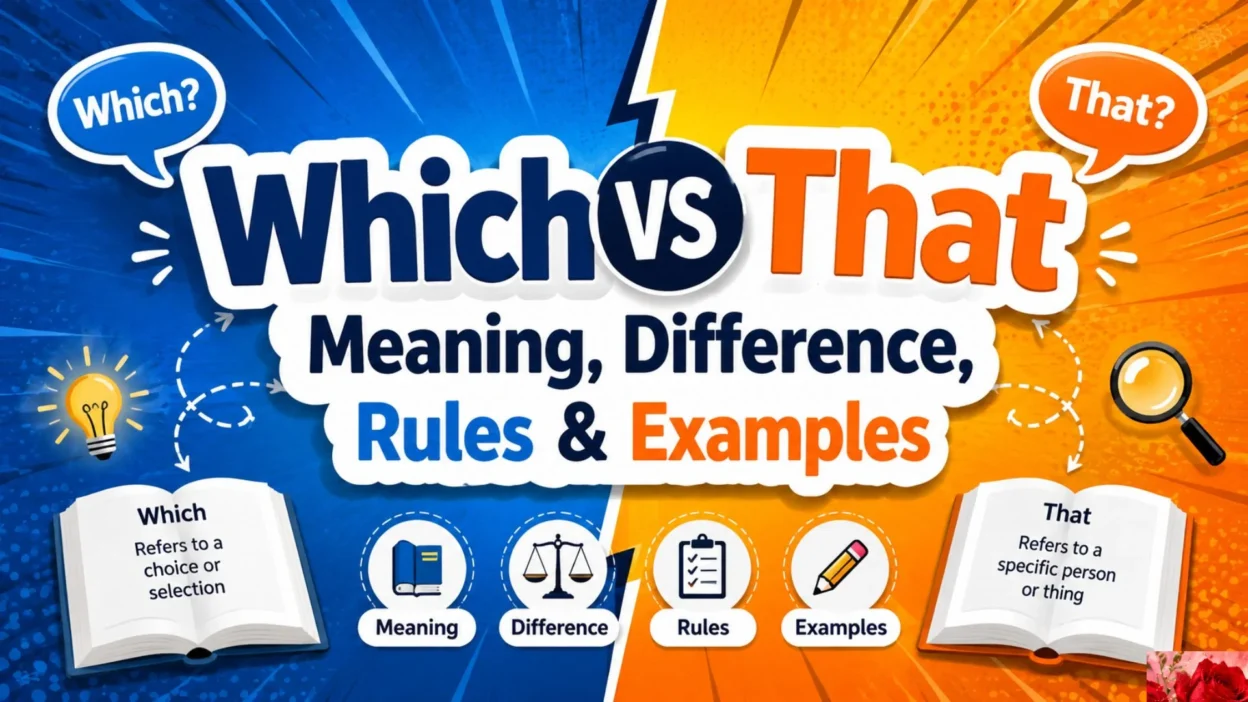
Which and that are both commonly used to introduce information about a noun, but they do not always work in the same way. The main difference is whether the information is essential to identify the noun or simply additional information.
For example:
- The car that I bought is red.
- My car, which I bought last year, is red.
In the first sentence, the information helps identify which car we mean. In the second, the information about when the car was bought is extra.
Understanding which vs that becomes much easier when you learn the difference between restrictive and nonrestrictive clauses.
Quick Answer: Which vs That
Use that when the information is essential to identify the person or thing you are talking about.
Use which when the information is additional or nonessential and is normally separated by commas.
| Word | Common Use | Example |
|---|---|---|
| That | Essential information | The book that I bought is interesting. |
| Which | Extra information | The book, which I bought yesterday, is interesting. |
Easy Rule
That = identifies
Which = adds information
This rule works especially well in American English, although usage can vary between American and British English.
What Does That Mean?
That can have several grammatical functions, but in this context it is commonly used as a relative pronoun.
It introduces a relative clause that provides information essential to the meaning of the sentence.
Example:
The shoes that I bought are comfortable.
The phrase that I bought tells us which shoes we mean.
Without it, the sentence becomes:
The shoes are comfortable.
That could refer to any shoes, so the relative clause helps identify them.
What Does Which Mean?
Which can also function as a relative pronoun. It introduces information about a noun.
Example:
My laptop, which I bought last year, still works perfectly.
The phrase which I bought last year gives additional information about the laptop.
The listener already knows which laptop is being discussed, so the extra information is not necessary for identification.
Which vs That: The Main Difference
The biggest difference is whether the clause is essential or nonessential.
Essential Information
Use that when the information is necessary to identify the noun.
Example:
The phone that has a cracked screen belongs to Sara.
There may be several phones, so the clause that has a cracked screen identifies the correct one.
Nonessential Information
Use which when the information simply adds something extra.
Example:
My phone, which has a cracked screen, still works.
We already know which phone we mean. The information about the cracked screen is additional.
Restrictive Clauses and That
A restrictive clause provides information that is essential to the meaning of the sentence.
It restricts or narrows the noun being discussed.
Examples:
- The students that studied passed the test.
- The dress that she bought was expensive.
- The restaurant that we visited was crowded.
- The car that has a sunroof belongs to my brother.
In each case, the relative clause helps identify the specific noun.
Why Commas Are Usually Not Used
Restrictive clauses are not normally separated with commas.
Correct:
The book that I ordered arrived today.
Not:
The book, that I ordered, arrived today.
When that introduces an essential relative clause, commas should generally be avoided.
Nonrestrictive Clauses and Which
A nonrestrictive clause adds information that is not necessary to identify the noun.
Examples:
- My sister, which is incorrect for a person, is a doctor.
- My car, which is five years old, still runs well.
- Paris, which is famous for its landmarks, attracts millions of visitors.
- The laptop, which I bought last month, is already running slowly.
Notice the commas around the extra information.
For things, which is commonly used in nonrestrictive clauses.
Why Commas Matter
Commas can change the meaning of a sentence.
Compare these two examples:
The books that are on the table belong to me.
This suggests that only the books on the table belong to me.
Now consider:
My books, which are on the table, belong to me.
The information about their location is additional. The sentence already identifies the books as my books.
The comma signals that the information is extra.
Which vs That With Things
When referring to things, both that and which can sometimes be used.
That
Use that for essential information:
The computer that I bought is fast.
Which
Use which for nonessential information:
The computer, which I bought last week, is fast.
The distinction is not simply about the noun. It is mainly about the role of the relative clause.
Can You Use Which Without Commas?
This depends on the style and variety of English.
In traditional American English grammar, which is strongly associated with nonrestrictive clauses, while that is preferred for restrictive clauses.
However, which can also appear in restrictive clauses, especially in British English and formal writing.
For clear modern American English, a useful approach is:
- that → restrictive
- which → nonrestrictive
This makes your writing easier to understand and helps avoid punctuation problems.
Which vs That for People
When referring to people, who is generally preferred.
For example:
The woman who called me is my neighbor.
Not:
The woman which called me…
In some contexts, that can refer to people:
The person that called me left a message.
This is grammatically acceptable, although who is often more natural when referring to people.
Which is generally used for things, not people.
Which vs That in Everyday Examples
Here are some simple examples:
Using That
- The shirt that I bought is blue.
- The movie that we watched was funny.
- The house that has a red door is mine.
- The phone that you recommended works well.
- The restaurant that serves Italian food is nearby.
Using Which
- My shirt, which I bought yesterday, is blue.
- The movie, which lasted two hours, was funny.
- My house, which has a red door, is easy to find.
- This phone, which you recommended, works well.
- The restaurant, which serves Italian food, is nearby.
Which vs That in Relative Clauses
A relative clause gives more information about a noun.
For example:
The laptop that I bought is expensive.
Here:
- Laptop = noun
- that I bought = relative clause
The clause identifies which laptop we mean.
Now:
My laptop, which I bought yesterday, is expensive.
Here, which I bought yesterday simply gives additional information.
That Can Be Omitted
In some restrictive clauses, that can be left out when it functions as the object of the clause.
Example:
The book that I bought was expensive.
You can also say:
The book I bought was expensive.
The meaning remains essentially the same.
Another example:
The movie that we watched was excellent.
Can become:
The movie we watched was excellent.
However, you cannot simply remove that when it functions as the subject.
For example:
The dog that lives next door is friendly.
You cannot normally say:
The dog lives next door is friendly.
That changes the sentence structure and creates a different meaning.
Which Can Sometimes Be Omitted
In restrictive clauses, which can sometimes be omitted when it functions as the object.
For example:
The book which I bought was expensive.
Can become:
The book I bought was expensive.
But in a nonrestrictive clause, which cannot normally be removed.
Example:
My car, which I bought last year, is reliable.
You cannot simply remove which while keeping the same structure:
❌ My car, I bought last year, is reliable.
The commas and relative pronoun are doing important grammatical work.
Which vs That After a Comma
One of the easiest rules to remember is:
Do not normally use that after a comma to introduce a nonessential relative clause.
Incorrect in standard usage:
My car, that I bought last year, is blue.
Better:
My car, which I bought last year, is blue.
The comma signals that the information is nonessential, so which is the natural choice.
Which vs That: A Comparison Table
| Sentence | Correct Choice | Reason |
|---|---|---|
| The car that I bought is red. | That | Identifies the car |
| My car, which I bought last year, is red. | Which | Adds information |
| The book that you recommended is good. | That | Identifies the book |
| This book, which you recommended, is good. | Which | Adds information |
| The house that has a garage is ours. | That | Identifies the house |
| Our house, which has a garage, is large. | Which | Adds information |
Common Mistakes With Which and That
Mistake 1: Using That After a Comma
Incorrect:
My car, that I bought last year, is blue.
Better:
My car, which I bought last year, is blue.
Mistake 2: Using Which for a Person
Incorrect:
The woman which called me is my teacher.
Better:
The woman who called me is my teacher.
Mistake 3: Adding Unnecessary Commas
Incorrect:
The book, that I bought yesterday, is expensive.
Better:
The book that I bought yesterday is expensive.
If the clause identifies the book, it should not normally be separated with commas.
Mistake 4: Thinking Which Always Means “Extra”
While the restrictive/nonrestrictive distinction is a useful rule, real-world English usage can be more flexible, particularly in British English.
For clear American English writing, however, keeping that for restrictive clauses and which for nonrestrictive clauses is a reliable style choice.
Which vs That in American English
American English traditionally makes a stronger distinction between that and which.
A common editorial guideline is:
- That for restrictive clauses
- Which for nonrestrictive clauses
Examples:
The car that is parked outside is mine.
My car, which is parked outside, is mine.
This distinction is particularly useful in formal writing, educational content, and professional communication.
Which vs That in British English
British English can be more flexible with which in restrictive clauses.
For example, British writers may use:
The book which I bought yesterday is excellent.
American English style often prefers:
The book that I bought yesterday is excellent.
Neither usage should automatically be treated as a spelling or grammar error. English varies by region and style guide.
If you are writing for a general American audience, using that for restrictive clauses is usually the safest and clearest choice.
Which vs That With Prepositions
Both forms can appear in sentences involving prepositions, although the structures can differ.
For example:
The company that I work for is growing.
You can also write:
The company for which I work is growing.
The second version is more formal.
With which, the preposition can appear before the relative pronoun:
The company for which I work
Or at the end in less formal writing:
The company which I work for
Both can be found in English, depending on style.
Which vs That in Formal Writing
For formal writing, clarity should come first.
If the clause is essential:
The data that we collected supports the conclusion.
If the clause is additional:
The data, which we collected over three months, supports the conclusion.
This structure immediately tells the reader how the information relates to the main noun.
A Simple Way to Decide
When you’re unsure whether to use which or that, ask yourself one question:
Does the information identify the noun?
If yes, use that in standard American English.
Example:
The laptop that has a broken screen is mine.
The clause identifies which laptop.
If no, and the information is simply extra, use which with commas.
Example:
My laptop, which has a broken screen, is still working.
You already know which laptop is being discussed.
Which vs That Examples With Meaning Changes
Consider:
The employees that work remotely receive a bonus.
This can imply that only the remote employees receive the bonus.
Now:
The employees, who work remotely, receive a bonus.
This presents the information about working remotely as additional information about the employees.
The punctuation and clause type can therefore affect how the reader interprets the sentence.
Which vs That in Questions
Which and that also have other uses beyond relative clauses.
For example:
Which book do you want?
Here, which is asking someone to select from a group.
That book is mine.
Here, that points to a particular book.
So remember that which and that are not limited to relative clauses.
Which as a Question Word
- Which color do you prefer?
- Which restaurant should we visit?
- Which option is better?
- Which book are you reading?
That as a Demonstrative
- That car is expensive.
- That house belongs to my uncle.
- I don’t want that one.
- That idea sounds interesting.
These are different grammatical uses from the which vs that relative-pronoun distinction.
Which vs That: 20 Quick Examples
Examples With That
- The phone that I bought is expensive.
- The dress that she chose looks beautiful.
- The car that has a flat tire is mine.
- The movie that we watched was funny.
- The restaurant that serves pizza is nearby.
- The book that you recommended is excellent.
- The laptop that I use is lightweight.
- The house that has a red door is ours.
- The shoes that I ordered arrived today.
- The website that we visited was helpful.
Examples With Which
- My phone, which I bought last month, is expensive.
- This dress, which she chose, looks beautiful.
- My car, which has a flat tire, is outside.
- The movie, which we watched yesterday, was funny.
- That restaurant, which serves pizza, is nearby.
- This book, which you recommended, is excellent.
- My laptop, which I use every day, is lightweight.
- Our house, which has a red door, is easy to find.
- These shoes, which I ordered online, arrived today.
- The website, which we visited yesterday, was helpful.
Frequently Asked Questions
Is it which or that?
Both can be correct. In standard American English, use that for essential information and which for additional information set off by commas.
What is the main difference between which and that?
That commonly introduces a restrictive clause that identifies a noun. Which commonly introduces a nonrestrictive clause that adds extra information.
Can I use which instead of that?
Sometimes, yes. English usage varies, especially between American and British English. For clear American English, that is generally preferred for restrictive clauses.
Can I use that instead of which?
Not normally when which introduces a nonrestrictive clause after a comma.
For example:
My car, which is old, still works.
Using that in this construction is generally considered incorrect in standard English.
Should I use a comma before which?
Usually, yes, when which introduces a nonessential or nonrestrictive clause.
Example:
My laptop, which is three years old, still works well.
Should I put a comma before that?
Usually not when that introduces an essential restrictive clause.
Example:
The laptop that I bought is expensive.
Can which refer to people?
In standard modern English, who is generally preferred for people.
Use:
The woman who called me
rather than:
The woman which called me
Can that refer to people?
Yes, that can sometimes refer to people, especially in informal or general constructions.
Example:
The person that called me left a message.
However, who is often the more natural choice for people.
Can I omit that?
Yes, when that functions as the object of a restrictive relative clause.
Example:
The book that I bought
can become:
The book I bought.
Can I omit which?
It can sometimes be omitted in restrictive clauses when it functions as the object, but it normally cannot be omitted from a nonrestrictive clause.
Is “the book which I bought” correct?
Yes. It can be correct, particularly in British English. In American English, the book that I bought is often preferred for a restrictive clause.
Is “my book, that I bought yesterday” correct?
In standard English, use which for this nonrestrictive construction:
My book, which I bought yesterday, is on the table.
Final Thoughts
The choice between which vs that becomes much easier when you focus on whether the information is necessary or additional.
Use that when the relative clause helps identify exactly which person or thing you mean:
The car that is parked outside is mine.
Use which when the information is extra and does not determine which noun you are talking about:
My car, which is parked outside, is mine.
For American English, the practical rule is simple: that for restrictive clauses, which for nonrestrictive clauses. Remember that who is generally better when referring to people.
Once you understand the role of the relative clause and pay attention to commas, choosing between which and that becomes much more nature.

Clara Morgan is a language and vocabulary writer passionate about making English easier to understand. At Wordestic, she creates clear and practical guides on word meanings, synonyms, antonyms, grammar, word differences, and commonly confused words.
Her writing focuses on simple explanations, useful examples, and everyday usage to help readers expand their vocabulary and communicate with greater confidence.