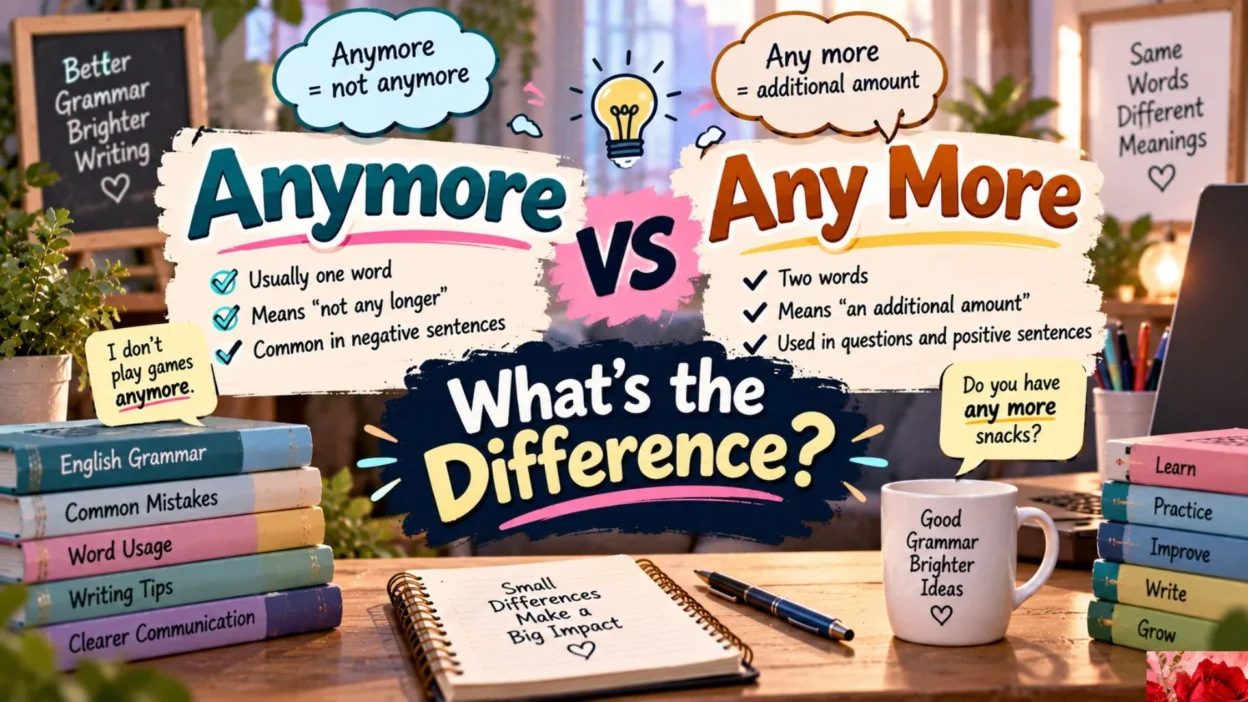
Few grammatical distinctions cause as much confusion as the difference between “anymore” and “any more.” Though they look almost identical, these two forms serve completely different functions in English sentences. Understanding the anymore vs any more distinction is essential for clear, precise writing.
The single word “anymore” is an adverb that means “any longer” or “nowadays,” while the two-word phrase “any more” functions as a determiner meaning “additional quantity” . Mixing them up can change the meaning of your sentence entirely. This comprehensive guide will help you master this tricky distinction, avoid common errors, and write with confidence.
Quick Answer
The difference is simple: “anymore” (one word) relates to time and means “any longer” or “no longer.” “Any more” (two words) relates to quantity and means “additional” or “further.” Use “anymore” when something that happened before no longer happens now. Use “any more” when referring to an additional amount of something .
Meaning Overview Table
| Aspect | Meaning |
|---|---|
| Definition | The distinction between the adverb “anymore” (time) and the determiner phrase “any more” (quantity) |
| Pronunciation | Both are pronounced the same: “en-ee MOR” |
| Part of Speech | Adverb (anymore) vs. determiner phrase (any more) |
| Usage | “I don’t go there anymore” vs. “Do you have any more questions?” |
| Context | Formal writing, professional communication, grammar study |
Main Meaning
Definition
Anymore vs any more refers to a common grammatical distinction in English where the spelling (one word or two) determines both meaning and grammatical function. The one-word form “anymore” serves as an adverb of time, while the two-word phrase “any more” functions as a determiner modifying nouns.
Origin
Historically, “any more” was always written as two words, even when used as an adverb meaning “any longer.” This usage dates back to Middle English, when “ani more” meant “to any further extent” . Over time, particularly in American English, writers began combining the words into “anymore” when used adverbially to indicate time . The distinction became more codified in the 20th century, though it remains less strict in British English .
Context
The distinction operates in several contexts:
- Formal Writing: Academic and professional writing requires careful distinction between the two forms
- Everyday Communication: Most native speakers use these forms instinctively, though misuse is common in informal writing
- Language Learning: English learners often struggle with this distinction because the two forms sound identical
- Regional Variation: British English still uses “any more” for both functions in many cases, while American English strongly prefers the distinction
Modern Usage
Today, American English strongly distinguishes between “anymore” and “any more.” The one-word form appears almost exclusively in negative sentences, questions, and conditional clauses to indicate time . The two-word form appears when referring to additional quantity. In British English, the two-word form “any more” remains acceptable for both functions, though “anymore” is increasingly common .
Detailed Explanation
Literal Meaning
“Anymore” literally means “any longer” or “to any further extent” in terms of time. It indicates that something that was once true is no longer true. “Any more” literally means “any additional quantity” or “anything further” in terms of amount .
Common Meaning
Commonly, “anymore” appears in statements about habits, situations, or conditions that have ended. People use it to say things like “I don’t eat meat anymore.” “Any more” appears when people ask for or refuse additional items: “Do you have any more cookies?” .
Text Meaning
In writing, distinguishing “anymore” from “any more” signals grammatical precision. The single word suggests you’ve given thought to word choice and grammar. The two-word phrase conveys a specific meaning about quantity .
Internet Meaning
Online, the confusion between “anymore” and “any more” is a frequent topic in grammar discussions and writing forums. Many people ask for help distinguishing the two. Quick grammar guides and writing assistants often flag misuse.
Social Media Meaning
On social media, both forms appear frequently, often incorrectly. The informality of these platforms leads to casual use where the distinction often blurs. People regularly use “anymore” when “any more” would be grammatically correct.
Cultural Meaning
This distinction reflects a broader trend in American English where common phrases combine into single words over time (“alright,” “already,” “altogether”). It also highlights the living nature of language and how it adapts across regions and generations.
Examples Table
| Example | Meaning |
|---|---|
| I don’t live there anymore. | I no longer live there (time). |
| Do you have any more coffee? | Do you have additional coffee? (quantity). |
| She doesn’t play that game anymore. | She no longer plays that game (time). |
| I can’t eat any more cake. | I cannot eat additional cake (quantity). |
| They don’t make phones like that anymore. | They no longer make those phones (time). |
| Are there any more questions? | Are there additional questions? (quantity). |
| He doesn’t talk to me anymore. | He no longer talks to me (time). |
| I don’t need any more help. | I don’t need additional help (quantity). |
| Robert doesn’t write books anymore. | Robert no longer writes books (time). |
| Robert hasn’t written any more books. | Robert hasn’t written additional books (quantity). |
Related Meanings Table
| Related Term | Meaning |
|---|---|
| Any longer | Synonym for “anymore” meaning “no longer” |
| No longer | A more formal way to express “anymore” |
| Nowadays | A positive adverb meaning “at present”; sometimes replaces “anymore” in questions |
| Additional | A synonym for “any more” meaning “extra” |
| Further | Another synonym for “any more” in some contexts |
| Every day vs everyday | Similar distinction where spacing changes meaning |
| All together vs altogether | Another pair where spacing indicates meaning |
| May be vs maybe | Similar one-word/two-word distinction |
| Any one vs anyone | Similar distinction in determiners vs pronouns |
| Every one vs everyone | Similar distinction in quantity vs universality |
| Some time vs sometime | Similar distinction in time expressions |
| No more | A phrase meaning “no longer” or “no additional” |
| No longer | More formal expression of “anymore” |
| To any further extent | A formal definition of “anymore” |
| In addition | A phrase meaning “any more” |
Common Uses
People commonly use “anymore” in various settings:
Casual Conversation: Speakers use “anymore” to indicate changes in habits or situations: “I don’t go to that restaurant anymore.”
Questions: Both forms appear in questions: “Do you read much anymore?” (time) and “Do you have any more questions?” (quantity) .
Formal Writing: The distinction matters in professional writing, where precision is valued. Writers carefully choose the correct form based on meaning.
Educational Contexts: Teachers and grammar guides frequently explain this distinction to students, particularly in American English.
British vs American: In British English, “any more” remains common for both meanings, though “anymore” is growing in use. In American English, the distinction is more rigid .
Common Mistakes
| Mistake | Correction |
|---|---|
| Writing “anymore” when referring to quantity | Use “any more” for additional amounts: “Do you have any more chairs?” |
| Writing “any more” when referring to time | Use “anymore” for time: “I don’t live here anymore.” |
| Using “anymore” as a determiner | “Anymore” is an adverb; it cannot modify nouns: not “I need anymore coffee.” |
| Using “any more” as an adverb | “Any more” is a determiner phrase; it modifies nouns, not verbs |
| Writing “no more” instead of “anymore” | Avoid “He can’t hurt us no more”—this is nonstandard |
| Confusing “any more” with “any more beautiful” | Use “any more” with adjectives: “She couldn’t have looked any more beautiful” |
| Using “anymore” in positive statements in formal writing | Positive “anymore” meaning “nowadays” is regional and informal |
| Overusing “any more” in British English for time | While acceptable, “anymore” is more concise |
| Forgetting the distinction in academic writing | Formal writing requires the distinction |
| Thinking they are always interchangeable | They are never interchangeable—they have different meanings and functions |
Related Questions
Is “anymore” one word or two?
Both are correct, but they mean different things. “Anymore” (one word) is an adverb meaning “no longer.” “Any more” (two words) is a determiner meaning “additional quantity” .
Can you use “anymore” in a positive sentence?
Yes, in some American English dialects, “anymore” can mean “nowadays” in positive statements, but this is considered informal and regional . For formal writing, use “these days” or “nowadays” instead.
What is the British English usage?
In British English, “any more” is often used for both meanings, though “anymore” is becoming more common, especially in informal contexts .
Is “anymore” acceptable in formal writing?
Yes, in American English, “anymore” is standard in formal writing when used to mean “any longer” .
How can I remember the difference?
Think of “anymore” as “any time more”—if you can replace it with “any longer,” use one word. For “any more,” think “any quantity more”—if you’re talking about additional items, use two words .
FAQs
What is the difference between “anymore” and “any more”?
“Anymore” (one word) is an adverb meaning “any longer” or “no longer.” “Any more” (two words) is a determiner phrase meaning “additional quantity” .
When do I use “anymore”?
Use “anymore” to indicate time, usually in negative sentences, questions, or conditional clauses. It means something that once happened no longer happens now .
When do I use “any more”?
Use “any more” to refer to quantity, usually before a noun. It means “additional” or “further” .
Is “anymore” correct in British English?
Yes, though British English traditionally used “any more” for both meanings. “Anymore” is increasingly accepted in British English, especially informally .
Can “anymore” be used in positive statements?
In some American regional dialects, “anymore” is used in positive statements to mean “nowadays,” but this is informal and considered nonstandard .
What is the difference between “no longer” and “anymore”?
“No longer” is more formal and often appears in the middle of a sentence, while “anymore” appears at the end and is less formal. They mean the same thing .
Why do people confuse “anymore” and “any more”?
They sound identical when spoken, and both relate to the idea of “not continuing,” so people often misapply them in writing.
Conclusion
Understanding the distinction between “anymore” and “any more” is essential for clear, precise writing. “Anymore” (one word) deals with time and means “any longer” or “no longer.” “Any more” (two words) deals with quantity and means “additional” or “further.” While both forms are pronounced identically, they serve completely different grammatical functions. In American English, the distinction is standard and expected in formal writing. In British English, “any more” remains more common for both uses, though “anymore” is increasingly accepted. Remember the simple rule: time = anymore; quantity = any more. With this guide, you can confidently choose the correct form every time.

Clara Morgan is a language and vocabulary writer passionate about making English easier to understand. At Wordestic, she creates clear and practical guides on word meanings, synonyms, antonyms, grammar, word differences, and commonly confused words.
Her writing focuses on simple explanations, useful examples, and everyday usage to help readers expand their vocabulary and communicate with greater confidence.