The English language contains many word pairs that sound similar but carry distinct meanings, and “ensure” and “insure” rank among the most commonly confused. Both verbs relate to making something certain or safe, yet they serve different purposes in professional and everyday writing. Understanding the ensure vs insure distinction helps you communicate with precision, whether you’re drafting a business contract, writing a safety memo, or composing an email to a colleague.
The confusion makes sense. These two words share Latin roots and overlap in some contexts. Many people use them interchangeably without noticing. However, style guides and dictionaries consistently draw a clear line. “Ensure” means to make certain something happens. “Insure” means to provide or obtain insurance coverage. This comprehensive guide breaks down the difference, explores their origins, provides practical examples, and helps you choose the right word every time.
Quick Answer
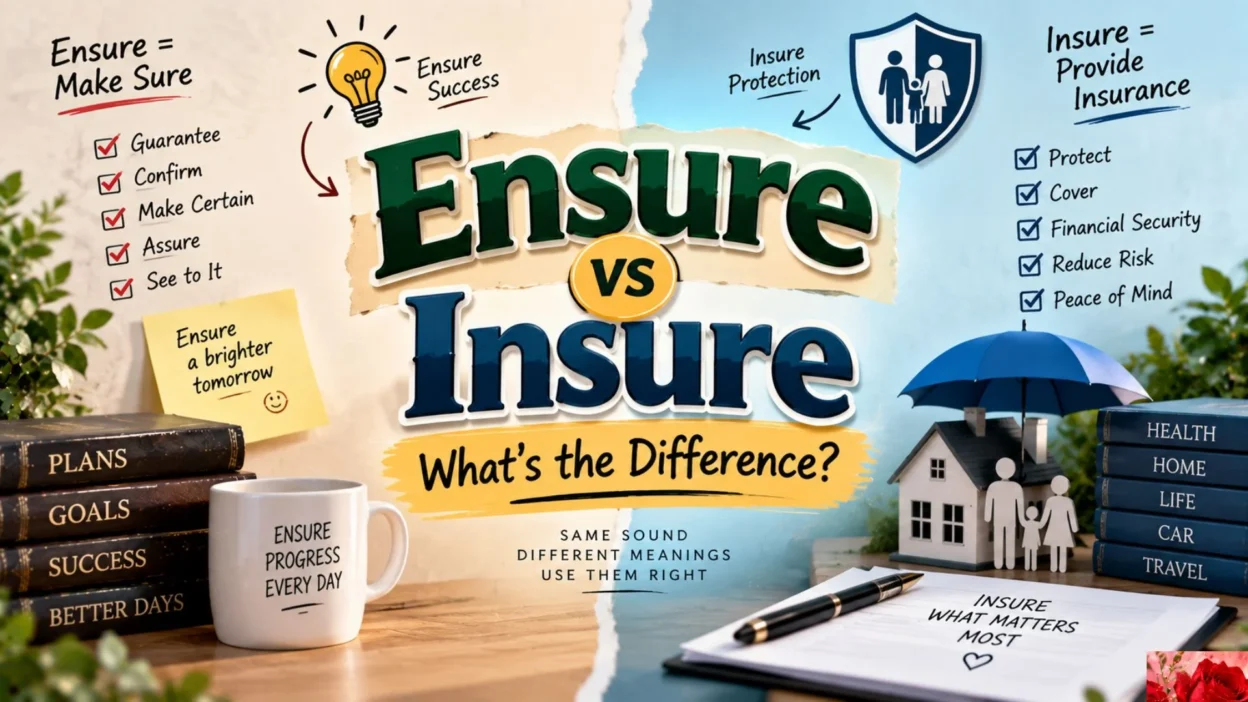
The difference between ensure and insure comes down to certainty versus coverage. “Ensure” means to make certain that something happens or is true—it’s about guaranteeing an outcome. “Insure” means to protect against financial loss through an insurance policy—it’s about risk management. You ensure that a task is completed; you insure your car against theft .
Meaning Overview Table
| Aspect | Meaning |
|---|---|
| Definition | Two verbs distinguished by purpose: “ensure” means to make certain, “insure” means to provide insurance coverage |
| Pronunciation | Ensure: in-SHOOR; Insure: in-SHOOR |
| Part of Speech | Both are verbs (transitive) |
| Usage | “Please ensure the door is locked” vs. “I insured my house against fire” |
| Context | Formal writing, business communication, legal documents, everyday speech |
Main Meaning
Definition
“Ensure” means to make something certain, safe, or guaranteed. It describes taking steps to guarantee an outcome or prevent a problem. “Insure” means to protect against loss, damage, or injury by purchasing an insurance policy. It describes a financial arrangement where a company agrees to compensate for specified losses in exchange for regular payments .
Origin
Both words trace back to Latin. “Ensure” derives from the Anglo-French enseurer, which combines en (“make”) and seur (“sure”), ultimately from the Latin securus (“secure”). “Insure” follows a similar path, coming from the Anglo-French enseurer as well. Historically, these words were used interchangeably, and the distinction between them developed gradually over centuries .
The words share a common ancestor in securus, which also gives us “secure,” “security,” and “sure.” This shared root explains why they sound alike and why people confuse them. The prefix difference—”en” versus “in”—evolved to signal different applications, though the boundary remained fuzzy until modern style guides codified the distinction.
Context
The distinction operates across several settings:
- Business Writing: Professionals use “ensure” when describing steps to guarantee outcomes, and “insure” when discussing risk management or insurance policies
- Legal Documents: Contracts use “insure” for insurance requirements and “ensure” for guarantees of performance
- Safety Communication: Safety manuals use “ensure” to describe precautions that prevent accidents
- Insurance Industry: “Insure” is the technical term for providing or obtaining coverage
- Everyday Speech: Most people use “ensure” correctly but sometimes swap in “insure” when they mean “ensure”
Modern Usage
Today, style guides consistently distinguish between the two words. Microsoft’s style guide, for example, recommends using “ensure” to mean “make sure,” “insure” to mean “provide insurance,” and “assure” to mean “state positively” . Merriam-Webster notes that while the words were once interchangeable, modern usage generally maintains the distinction . The Canadian Language Portal emphasizes this distinction in its writing tips, noting that “ensure” means to make certain while “insure” relates to insurance .
Detailed Explanation
Literal Meaning
Literally, “ensure” means “to make sure, certain, or safe.” It implies taking action to guarantee an outcome. “Insure” literally means “to protect against loss” through a financial arrangement. The literal difference reflects the practical difference: ensure is about certainty, insure is about coverage .
Common Meaning
Commonly, people use “ensure” when they want to say they will make something happen or prevent something from going wrong. They use “insure” when they discuss protecting property, health, or life through an insurance policy. For example, a manager might “ensure” that a project meets its deadline, while a homeowner might “insure” their property against flood damage .
Business Meaning
In business contexts, the distinction matters for clarity. A contract might require a party to “ensure compliance with regulations” (guarantee the outcome) and to “insure against liability” (obtain insurance coverage). Using the wrong word could create ambiguity about obligations. Style guides for professional writing consistently recommend maintaining the distinction .
Legal Meaning
Legal writing carefully distinguishes between the two. Statutes might require businesses to “ensure workplace safety” (take steps to prevent accidents) and to “insure against workers’ compensation claims” (carry insurance). The distinction helps courts interpret obligations and assign liability.
Medical Meaning
In healthcare, “ensure” appears frequently in protocols: “Ensure the patient receives medication on schedule.” “Insure” appears less often, typically in administrative contexts about malpractice coverage. The distinction helps medical professionals communicate clearly about clinical procedures versus financial protections.
Examples Table
| Example | Meaning |
|---|---|
| Please ensure the door is locked. | Make certain the door is locked |
| I insured my car against theft. | Purchased insurance coverage for my car |
| We need to ensure the project finishes on time. | Guarantee the project’s completion |
| The company insures its assets against fire. | Provides insurance coverage for assets |
| She ensured the package arrived safely. | Took steps to guarantee safe delivery |
| He insured his life for his family’s protection. | Purchased life insurance |
| The regulations ensure food safety. | Guarantee food safety standards |
| The homeowner insured against flood damage. | Obtained flood insurance |
| To ensure accuracy, check your work twice. | Make certain of accuracy |
| The business insured its equipment. | Protected equipment with insurance |
Related Meanings Table
| Related Term | Meaning |
|---|---|
| Ensure | To make certain or guarantee |
| Insure | To provide or obtain insurance |
| Assure | To convince or give confidence |
| Secure | To guard against attack or loss |
| Guarantee | To promise an outcome |
| Make certain | To ensure something happens |
| Insurance | Financial protection against loss |
| Assurance | A promise or guarantee |
| Reassure | To assure again; restore confidence |
| Safeguard | To protect against harm |
| Verify | To confirm accuracy |
| Confirm | To establish truth |
| Protect | To shield from harm |
| Cover | To provide insurance protection |
| Policy | A contract for insurance coverage |
Common Uses
People use “ensure” and “insure” across numerous contexts:
Business Communication: Managers “ensure” that projects meet deadlines and quality standards. Companies “insure” their assets, liability, and employees. The distinction helps clarify whether a statement concerns operations or risk management.
Safety and Compliance: Safety manuals use “ensure” to describe procedures that prevent accidents: “Ensure all equipment is inspected before use.” Insurance requirements use “insure” when describing coverage obligations.
Legal and Contractual Language: Contracts distinguish between “ensuring performance” (guaranteeing an outcome) and “insuring against liability” (obtaining coverage). Precision matters for legal interpretation.
Everyday Writing: People “ensure” that they lock their doors, save their files, and arrive on time. They “insure” their cars, homes, and health. The distinction helps readers understand whether the subject concerns actions or financial protections.
Common Mistakes
| Mistake | Correction |
|---|---|
| Using “insure” when meaning “make certain” | Use “ensure” for making certain: “Ensure the door is locked” |
| Using “ensure” when meaning “insurance” | Use “insure” for insurance: “Insure your car” |
| Using “assure” for things instead of people | “Assure” is for people: “I assure you” |
| Writing “ensurance” as a noun | There is no “ensurance”; use “insurance” or “assurance” |
| Confusing “assurance” and “insurance” | “Assurance” is a promise; “insurance” is a policy |
| Using “ensure” with an object pronoun | “Ensure” is not followed by “you” or “me” |
| Swapping “insure” and “ensure” in formal writing | Style guides require the distinction |
| Assuming the words are always interchangeable | Modern usage distinguishes them |
| Using “insure” for non-financial protection | Use “ensure” or “protect” instead |
| Forgetting that British English sometimes differs | American English maintains the distinction more strictly |
Related Questions
What is the main difference between ensure and insure?
“Ensure” means to make certain that something happens. “Insure” means to provide or obtain insurance coverage. You ensure an outcome; you insure against risk .
Can you use ensure and insure interchangeably?
In casual conversation, many people do. However, careful writers preserve the distinction because the words serve different purposes. Style guides consistently recommend using “ensure” for making certain and “insure” for insurance .
What does “ensure” mean in a sentence?
“Ensure” means to make something certain or safe. For example, “Please ensure the door is locked” means “Please make certain the door is locked” .
What does “insure” mean in a sentence?
“Insure” means to protect against loss through insurance. For example, “I insured my car against theft” means “I purchased insurance coverage for my car” .
What is the difference between assure, ensure, and insure?
“Assure” means to convince or give confidence to a person. “Ensure” means to make certain something happens. “Insure” means to provide insurance coverage .
Is “ensure” followed by an object pronoun?
No. “Ensure” is not followed by an object pronoun like “you” or “me.” Use “assure” when addressing a person directly: “I assure you” .
FAQs
What does ensure mean?
Ensure means to make something certain, safe, or guaranteed. It describes taking steps to ensure an outcome or prevent a problem .
What does insure mean?
Insure means to protect against loss or damage by obtaining an insurance policy. It describes a financial arrangement for risk management .
Is it “ensure” or “insure” for making sure?
Use “ensure” when you mean “make sure” or “make certain.” Use “insure” only when referring to insurance coverage .
What is the noun form of ensure?
There is no noun form of “ensure.” The related noun is “insurance” (from insure) or “assurance” (from assure). “Ensurance” is not a word .
Can I use “ensure” in business writing?
Yes. “Ensure” is appropriate in business writing when you mean “make certain.” For example, “Please ensure the report is submitted by Friday” .
What is the difference between insurance and assurance?
“Insurance” covers uncertain events (like car accidents). “Assurance” is a promise that something will happen. In British English, “life assurance” is sometimes used for life insurance .
How do I remember the difference?
Think of “insure” and “insurance” sharing the same root. If you’re talking about an insurance policy, use “insure.” For everything else about making certain, use “ensure.”
Is “ensure” always followed by “that”?
No. “Ensure” can be followed by a noun (“ensure safety”) or a clause with or without “that” (“ensure that the door is locked” or “ensure the door is locked”).
Conclusion
Mastering the ensure vs insure distinction elevates your writing and communication. “Ensure” means to make certain something happens—it’s about guaranteeing outcomes and preventing problems. “Insure” means to protect against financial loss through an insurance policy—it’s about risk management and coverage. While casual conversation often blurs the line, careful writers preserve the difference. Remember the simple rule: ensure for certainty, insure for coverage. This small distinction carries real weight in business contracts, safety protocols, and professional communication. Choose your words deliberately, and your readers will trust your precision.

Clara Morgan is a language and vocabulary writer passionate about making English easier to understand. At Wordestic, she creates clear and practical guides on word meanings, synonyms, antonyms, grammar, word differences, and commonly confused words.
Her writing focuses on simple explanations, useful examples, and everyday usage to help readers expand their vocabulary and communicate with greater confidence.