The words “discrete” and “discreet” sound exactly the same when spoken, yet they carry completely different meanings. This homophone pair confuses even experienced writers, making the discrete vs discreet distinction one of the most commonly misunderstood topics in English grammar. Both words function as adjectives, but they describe entirely different concepts.
“Discrete” means separate, distinct, or individually disconnected. “Discreet” means careful, tactful, or unobtrusive. The confusion arises because these words share Latin roots and identical pronunciations, but their modern meanings have diverged completely. A “discrete” unit is separate from others, while a “discreet” person acts with prudence. This comprehensive guide breaks down the difference with clear rules, practical examples, and memory tricks to help you choose the correct word every time.
Quick Answer
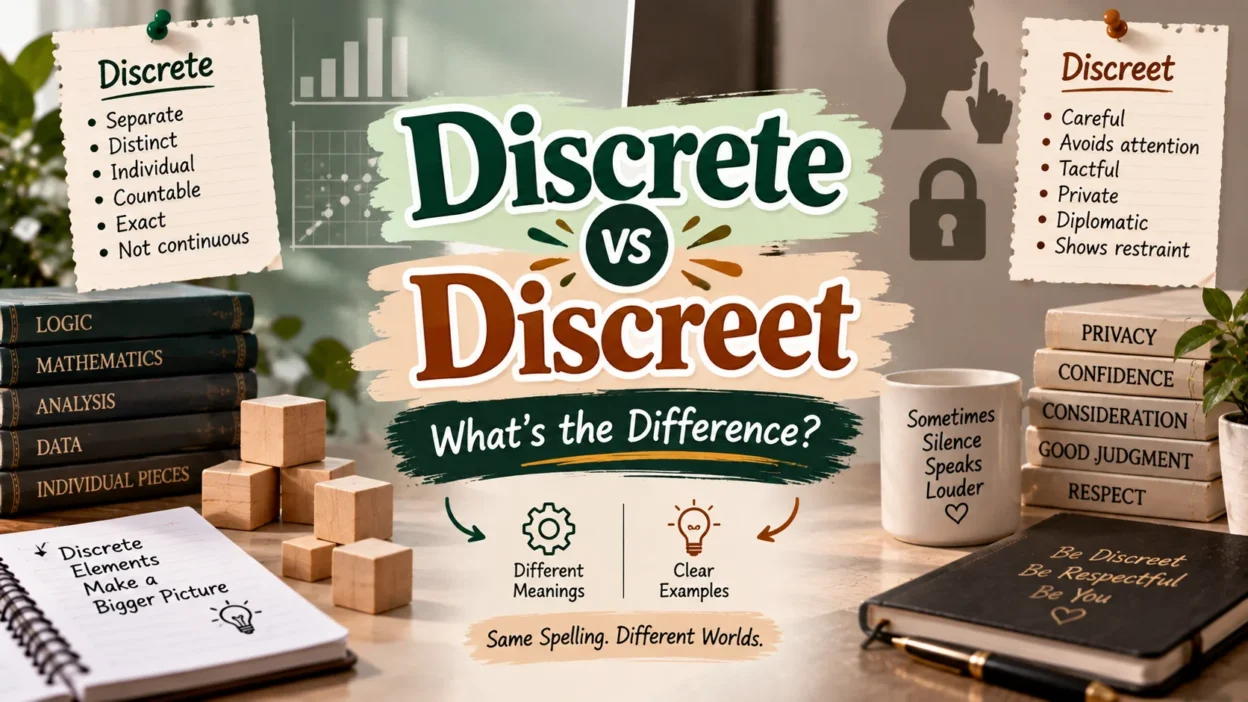
The difference between discrete and discreet comes down to separation versus subtlety. “Discrete” means separate, distinct, or individual—like discrete parts of a machine. “Discreet” means careful, tactful, or unobtrusive—like a discreet whisper. Remember: in “discrete,” the two E’s are separated by the T, just like the meaning “separate.” In “discreet,” the two E’s stay together, like a secret kept quiet.
Meaning Overview Table
| Aspect | Meaning |
|---|---|
| Definition | Two homophones: “discrete” means separate or distinct; “discreet” means careful, tactful, or unobtrusive |
| Pronunciation | Both: dih-SKREET |
| Part of Speech | Both are adjectives |
| Usage | “The discrete sections of the report” vs. “She made a discreet inquiry” |
| Context | Discrete: technical, scientific, mathematical; Discreet: social, personal, professional |
Main Meaning
Definition
“Discrete” is an adjective meaning “separate,” “distinct,” or “individually disconnected.” It describes things that exist as independent units rather than continuous wholes. “Discreet” is an adjective meaning “careful,” “tactful,” “prudent,” or “unobtrusive.” It describes people or actions that avoid drawing attention or causing embarrassment.
Origin
Both words come from the Latin word discretus, the past participle of discernere, meaning “to separate” or “to discern.” Both entered English in the 14th century. Originally, spelling was not fixed, and the words were used interchangeably. By the 16th century, however, the spellings and meanings diverged: “discrete” became fixed as the word for “separate,” while “discreet” became fixed as the word for “judicious” or “prudent.”
The etymological journey of these two words reveals how English absorbs Latin vocabulary and gradually differentiates meanings that once overlapped. Latin discernere meant both “to separate” and “to distinguish mentally.” This dual meaning carried into Middle English, where a single spelling served both senses. Over time, writers and printers standardized different spellings to reflect the two distinct meanings, giving us the modern pair.
Context
The context for each word differs significantly:
- Discrete: Appears in technical, scientific, and mathematical contexts. Used to describe separate components, distinct categories, or countable variables
- Discreet: Appears in social, personal, and professional contexts. Used to describe tactful behavior, private inquiries, or unobtrusive objects
- Academic Writing: “Discrete” appears frequently in fields like mathematics, computer science, and statistics. “Discreet” appears in ethics, communication, and social science research
- Business Communication: “Discreet” is common in discussions of confidentiality and professional conduct. “Discrete” appears in project management and organizational structure discussions
Modern Usage
Today, both words appear frequently in written English. “Discrete” is common in academic writing, technical documentation, and mathematical texts. “Discreet” is common in etiquette discussions, business communication, and descriptions of personal behavior. Despite their identical pronunciation, careful writers preserve the distinction.
The rise of spell-check and autocorrect has created new challenges. Software often cannot distinguish between the two words because they sound the same. Writers must consciously choose the correct spelling based on meaning, rather than relying on technology to catch errors. This makes understanding the distinction more important than ever.
Detailed Explanation
Literal Meaning
Literally, “discrete” means “separate” or “distinct.” It describes things that exist as individual, unconnected units. “Discreet” literally means “showing discernment” or “judicious”—it describes actions or people that demonstrate good judgment, especially regarding privacy.
Common Meaning
Commonly, people use “discrete” when discussing separate items, categories, or components. A report might have “discrete sections,” and a machine might have “discrete parts.” People use “discreet” when discussing tactful behavior, private matters, or unobtrusive objects. Someone might make a “discreet inquiry” or wear a “discreet necklace.”
Mathematical Meaning
In mathematics, “discrete” has a specialized meaning: it describes variables that take on distinct, countable values rather than continuous ranges. The number of cars passing a point is a discrete variable, while the weight of a car is continuous.
Discrete mathematics is a whole branch of study that deals with countable structures: integers, graphs, and logical statements. Computer science relies heavily on discrete mathematics because computers process discrete bits of data. The opposite of discrete in mathematics is continuous, which describes values that can take any point along a scale.
Technical Meaning
In technology, “discrete” describes separate components. A discrete graphics card has its own processing unit and memory, unlike integrated graphics that share resources with the main processor. In electronics, discrete components are individual parts like resistors and capacitors, as opposed to integrated circuits.
Discrete manufacturing refers to the production of distinct items, like cars or appliances, as opposed to continuous manufacturing, like chemicals or food processing. This distinction matters in industrial engineering and supply chain management.
Social Meaning
In social contexts, “discreet” describes tactful, prudent behavior. A discreet person keeps confidences, avoids gossip, and handles sensitive matters with care. A discreet inquiry is private and low-profile.
Discretion is a valued social skill. People who act discreetly earn trust and respect. Those who act indiscreetly may embarrass themselves or others. The word carries connotations of maturity, professionalism, and emotional intelligence.
Professional Meaning
In professional settings, “discreet” describes conduct that protects confidentiality. Lawyers, doctors, and therapists must be discreet about client information. Financial advisors handle money matters discreetly. Human resources professionals conduct discreet investigations.
“Discrete” appears in professional contexts too, particularly in project management, where tasks are divided into discrete phases, and in organizational design, where departments are discrete units.
Examples Table
| Example | Meaning |
|---|---|
| The report is divided into five discrete sections. | Separate, distinct sections |
| She made a discreet inquiry about the job. | Private, tactful inquiry |
| The machine consists of many discrete parts. | Individual, unconnected parts |
| He was discreet about his personal life. | Careful, private about personal matters |
| Discrete mathematics deals with countable structures. | Separate, distinct mathematical objects |
| They met at a discreet location. | Unobtrusive, private place |
| The data points are discrete, not continuous. | Individually separate values |
| She wore a discreet gold necklace. | Unobtrusive, modest jewelry |
| The company uses discrete manufacturing processes. | Separate, individual production steps |
| Please be discreet about this information. | Keep it private, don’t share |
| The project has three discrete phases. | Separate, distinct stages |
| He made a discreet exit from the party. | Unobtrusive departure |
| Discrete variables take specific values. | Countable, separate values |
| The hotel offers discreet service. | Unobtrusive, respectful service |
| The software uses discrete algorithms. | Separate, individual computational steps |
Related Meanings Table
| Related Term | Meaning |
|---|---|
| Separate | Distinct, individual, not connected (synonym of discrete) |
| Distinct | Clearly different or separate (synonym of discrete) |
| Individual | Single, separate entity (synonym of discrete) |
| Tactful | Showing sensitivity in dealing with others (synonym of discreet) |
| Prudent | Acting with care and good judgment (synonym of discreet) |
| Unobtrusive | Not attracting attention (synonym of discreet) |
| Discrete variable | A variable that takes countable values |
| Continuous variable | A variable that can take any value (opposite of discrete) |
| Discretion | The quality of being discreet; also freedom to decide |
| Discreetly | In a careful, unobtrusive manner |
| Discretely | In a separate, distinct manner |
| Indiscreet | Lacking discretion; not careful |
| Discrete space | A mathematical space where all sets are open |
| Discrete graphics | Separate graphics processing unit |
| Discrete component | Individual electronic part |
| Discreet shipping | Packaging that hides the contents |
| Discrete data | Data with separate, countable values |
| Discreet meeting | A private, low-profile gathering |
Common Uses
People use “discrete” and “discreet” across numerous contexts:
Academic and Technical Writing: Researchers use “discrete” to describe separate categories, countable variables, or distinct components. “The study identified three discrete groups of participants” appears in scientific literature.
Business Communication: Professionals use “discreet” to describe confidential inquiries, private meetings, or tactful handling of sensitive matters. “We made discreet inquiries about the merger.”
Mathematics and Statistics: Mathematicians distinguish between discrete and continuous variables. Discrete variables take specific values (like whole numbers), while continuous variables can take any value within a range.
Technology and Engineering: Tech writers use “discrete” to describe separate hardware components. “The laptop has a discrete graphics card” means it has a dedicated GPU.
Social and Personal Contexts: People use “discreet” to describe behavior that avoids drawing attention. “She was very discreet about the breakup” means she kept it private.
Healthcare: Medical professionals use “discrete” to describe separate symptoms or conditions. They use “discreet” to describe confidential patient care.
Law and Finance: Attorneys and accountants handle client matters discreetly. Legal documents might describe discrete legal issues or separate claims.
Common Mistakes
| Mistake | Correction |
|---|---|
| Using “discrete” to mean “careful” or “tactful” | Use “discreet” for careful, tactful behavior |
| Using “discreet” to mean “separate” or “distinct” | Use “discrete” for separate, distinct items |
| Writing “discreet parts” when meaning separate components | Write “discrete parts” for separate components |
| Writing “discrete inquiries” when meaning private inquiries | Write “discreet inquiries” for private inquiries |
| Confusing the two in technical writing | “Discrete” is correct for separate technical components |
| Using “discretely” for “discreetly” | “Discretely” means separately; “discreetly” means carefully |
| Assuming the words are interchangeable | They have completely different meanings and cannot be swapped |
| Using “discreet” in mathematical contexts | Use “discrete” for mathematical concepts |
| Forgetting the memory trick | In “discrete,” the E’s are separated by T—just like the meaning “separate” |
| Misspelling “discreet” as “discrete” in social contexts | Double-check the spelling based on the intended meaning |
| Using “discreet” to describe separate items | Use “discrete” for separate items |
| Using “discrete” to describe private behavior | Use “discreet” for private behavior |
Related Questions
What is the difference between discrete and discreet?
“Discrete” means separate or distinct, while “discreet” means careful, tactful, or unobtrusive. They sound identical but have completely different meanings.
How can I remember the difference?
In “discrete,” the two E’s are separated by the T—just like the word means “separate.” In “discreet,” the two E’s stay together—like a secret kept quiet.
Is it “discrete mathematics” or “discreet mathematics”?
“Discrete mathematics” is correct. It deals with countable, separate mathematical structures.
What does “discreet inquiry” mean?
A “discreet inquiry” is a private, tactful investigation or question that avoids drawing attention.
Can discrete mean “secret”?
No, “discrete” never means secret. “Discreet” means secretive or private. “Discrete” always means separate.
What is a discrete variable?
A discrete variable is a mathematical variable that takes on distinct, countable values, like whole numbers, rather than continuous values.
What does “at a discreet distance” mean?
It means at a distance that is far enough to avoid notice or intrusion.
Is “discreet” always about people?
No. “Discreet” can also describe objects, like a “discreet necklace” (unobtrusive jewelry) or a “discreet location” (a private place).
FAQs
What does discrete mean?
Discrete is an adjective meaning “separate,” “distinct,” or “individually disconnected.” It describes things that exist as independent units.
What does discreet mean?
Discreet is an adjective meaning “careful,” “tactful,” “prudent,” or “unobtrusive.” It describes people or actions that avoid drawing attention.
Is it “discrete data” or “discreet data”?
“Discrete data” is correct. It refers to data that consists of separate, countable values.
What is the opposite of discrete?
The opposite of “discrete” is “continuous.” Discrete data has separate values; continuous data can take any value within a range.
What is the opposite of discreet?
The opposite of “discreet” is “indiscreet,” meaning lacking discretion or not careful.
How do I use discrete in a sentence?
“The project was divided into three discrete phases: planning, execution, and review.” This shows “discrete” meaning separate.
How do I use discreet in a sentence?
“She was discreet about the surprise party, keeping it secret from the guest of honor.” This shows “discreet” meaning careful and private.
Which word is more common?
Both are common, but “discreet” appears more often in everyday language. “Discrete” is more common in technical and academic writing.
Can I use “discrete” to describe a person?
You can, but only to describe someone as separate or distinct from others. You cannot use “discrete” to mean careful or tactful.
Is “discreet” a compliment?
Yes, calling someone discreet is generally a compliment. It means they are trustworthy, tactful, and respectful of privacy.
Can a place be discrete?
A place can be discrete if it is separate or distinct from other places. But a “discreet place” is one that is private and unlikely to attract attention.
What is a discrete choice?
In economics and psychology, a discrete choice involves selecting one option from a set of distinct alternatives. It is a technical term.
Conclusion
Mastering the discrete vs discreet distinction elevates your writing and prevents embarrassing errors. “Discrete” means separate, distinct, or individually disconnected—it describes things that stand apart. “Discreet” means careful, tactful, or unobtrusive—it describes behavior that avoids attention. These homophones share Latin roots but have completely different modern meanings. Remember the simple memory trick: in “discrete,” the two E’s are separated by the T, just like the meaning “separate.” In “discreet,” the two E’s stay together, like a secret kept quiet. Practice using these words correctly, and your writing will gain precision and clarity. Whether you’re a student, a professional, or simply someone who appreciates precise language, knowing the difference between discrete and discreet will serve you well in every context.

Clara Morgan is a language and vocabulary writer passionate about making English easier to understand. At Wordestic, she creates clear and practical guides on word meanings, synonyms, antonyms, grammar, word differences, and commonly confused words.
Her writing focuses on simple explanations, useful examples, and everyday usage to help readers expand their vocabulary and communicate with greater confidence.