
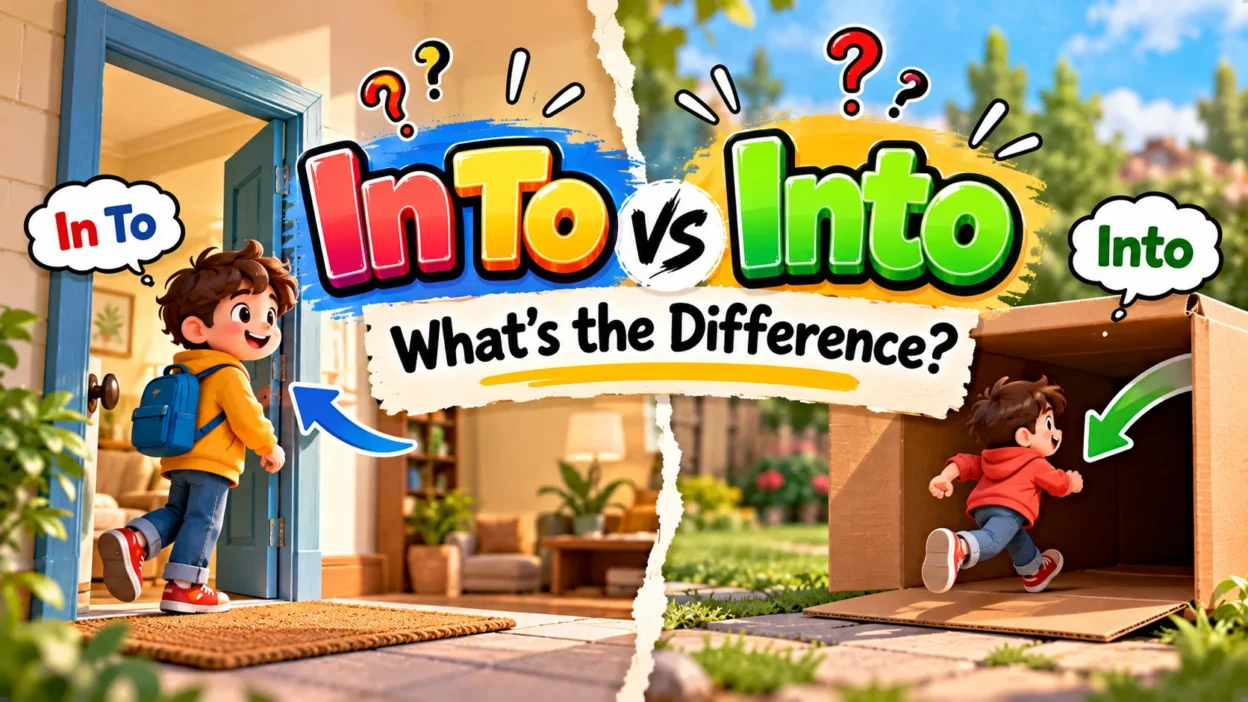
English contains countless pairs of words that sound identical but serve different grammatical purposes, and the in to or into dilemma ranks among the most confusing. Both the one-word preposition “into” and the two-word phrase “in to” appear constantly in writing, yet they function in completely different ways.
The confusion makes sense. When spoken aloud, “into” and “in to” sound exactly the same. The difference only becomes visible in writing, and even experienced writers sometimes stumble. “Into” is a preposition that shows movement, transformation, or direction. “In to” consists of two separate words that happen to sit next to each other—usually because “in” belongs to a phrasal verb and “to” introduces an infinitive. This comprehensive guide breaks down the distinction with clear rules, practical examples, and memory tricks to help you choose correctly every time.
Quick Answer
Use into as one word when showing movement from outside to inside, transformation, or direction toward something. Use in to as two words when “in” is part of a phrasal verb (like “log in” or “check in”) and “to” is part of an infinitive phrase or preposition. A simple test: if you can replace it with “inside,” use “into.” If the verb naturally ends with “in,” use “in to” .
Meaning Overview Table
| Aspect | Meaning |
|---|---|
| Definition | One-word preposition showing movement/transformation vs. two words where “in” belongs to a verb phrase |
| Pronunciation | Both: /ˈɪntu/ or /ˈɪntə/ |
| Part of Speech | “Into” is a preposition; “in to” combines an adverb/particle with a preposition or infinitive marker |
| Usage | “She walked into the room” vs. “She logged in to her account” |
| Context | Grammar, writing, academic English, professional communication |
Main Meaning
Definition
Into is a preposition that indicates movement toward the inside of something, a transformation or change of state, or deep engagement with a topic . In to consists of two separate words: “in,” which often functions as part of a phrasal verb, and “to,” which serves as either a preposition or part of an infinitive verb phrase .
Origin
“Into” derives from the Old English preposition into, a compound of in and to. It has functioned as a single preposition for centuries, expressing entry, direction, and transformation. The two-word sequence “in to” arises naturally when an “in” that belongs to a verb phrase happens to precede a “to” that introduces an infinitive or prepositional phrase .
Context
The distinction matters across several contexts:
- Formal Writing: Academic and professional writing requires the correct form
- Digital Communication: Phrases like “log in to” and “check in to” appear constantly online
- Everyday Speech: The two sound identical, so the distinction only matters in writing
- Phrasal Verbs: Many verbs pair with “in” (log in, check in, tune in), creating frequent “in to” situations
Modern Usage
Today, writers frequently confuse the two forms, especially with technology-related phrases. Many people write “log into” when “log in to” is more precise . Style guides and grammar resources consistently recommend preserving the distinction, though informal usage often blurs it.
Detailed Explanation
Literal Meaning
Literally, “into” means “to the inside of” something. It describes movement from an exterior position to an interior one. “In to” literally means that the word “in” (indicating position or belonging to a verb) appears immediately before “to” (indicating direction, purpose, or infinitive).
Common Meaning
Commonly, people use “into” when describing entering a place, transforming something, or expressing interest. They use “in to” when a phrasal verb ending in “in” meets an infinitive or prepositional phrase. For example, “She walked into the room” uses “into” as a preposition of movement. “She came in to help” uses “in” as part of the phrasal verb “come in” and “to help” as an infinitive explaining purpose .
Grammatical Meaning
Grammatically, “into” is always a preposition. It takes an object: into the house, into a butterfly, into photography. “In to” involves two separate grammatical units. The “in” may be an adverb particle completing a phrasal verb (log in, check in, tune in). The “to” may be a preposition (to her account) or an infinitive marker (to help, to see) .
Phrasal Verb Meaning
The most common source of “in to” is phrasal verbs ending in “in.” Verbs like log in, check in, tune in, drop in, and call in form complete units. When these verbs are followed by “to” (either as a preposition or infinitive marker), the words remain separate . Examples include:
- “Log in to your account” (not “log into”)
- “Check in to the hotel” (not “check into”)
- “Tune in to the podcast” (not “tune into”)
Transformation Meaning
“Into” expresses transformation when something changes form, state, or condition. The caterpillar turned into a butterfly. Water turns into ice. The frog turned into a prince. In these cases, “into” never separates because the transformation meaning requires the single preposition .
Movement Meaning
“Into” expresses movement from outside to inside. She walked into the room. He jumped into the pool. The car turned into the driveway. This meaning is the most common and intuitive use of the one-word form .
Examples Table
| Example | Meaning |
|---|---|
| She walked into the room. | Movement from outside to inside |
| The caterpillar turned into a butterfly. | Transformation from one form to another |
| He’s really into photography. | Deep engagement or interest |
| Please log in to your account. | Phrasal verb “log in” + preposition “to” |
| She came in to help. | Phrasal verb “come in” + infinitive “to help” |
| They checked in to the hotel. | Phrasal verb “check in” + preposition “to” |
| The car turned into the driveway. | Movement in a direction |
| I tuned in to the radio show. | Phrasal verb “tune in” + preposition “to” |
| She turned her paper in to the professor. | Phrasal verb “turn in” + preposition “to” |
| The water froze into ice. | Transformation |
| He dropped in to say hello. | Phrasal verb “drop in” + infinitive “to say” |
| She’s into yoga and meditation. | Interest or engagement |
| Please put the books into the box. | Insertion into a container |
| I ran into an old friend. | Unexpected meeting |
| The company merged into a larger corporation. | Integration or combination |
Related Meanings Table
| Related Term | Meaning |
|---|---|
| Enter | To go into a place |
| Inside | Within the interior of something |
| Transform | To change into a different form |
| Interest | Engagement or involvement with something |
| Phrasal Verb | A verb combined with a particle that changes meaning |
| Preposition | A word showing relationship between elements |
| Infinitive | The base form of a verb preceded by “to” |
| Particle | A word that combines with a verb to form a phrasal verb |
| Movement | Change of position or location |
| Direction | The path toward something |
| Transformation | Change from one state to another |
| Log in | Phrasal verb meaning to access a system |
| Check in | Phrasal verb meaning to register |
| Tune in | Phrasal verb meaning to watch or listen |
| Turn in | Phrasal verb meaning to submit |
Common Uses
People use “into” and “in to” across numerous contexts:
Everyday Movement: “She walked into the store.” “He jumped into the lake.” These describe physical movement from outside to inside .
Transformation: “The company turned into a global brand.” “The argument escalated into a fight.” These show change from one state to another .
Interest and Engagement: “He’s really into gaming.” “She’s into fitness.” These express enthusiasm or involvement .
Phrasal Verbs with “To”: “Log in to the website.” “Check in to the flight.” “Tune in to the broadcast.” These require the two-word form because “in” completes the verb .
Purpose Clauses: “She came in to ask a question.” “He stopped in to see us.” The “to” introduces an infinitive explaining purpose .
Mathematical Division: “Three into twelve equals four.” This specialized use always employs “into” .
Common Mistakes
| Mistake | Correction |
|---|---|
| Writing “log into” | Write “log in to” (phrasal verb + preposition) |
| Writing “check into” | Write “check in to” (phrasal verb + preposition) |
| Writing “tune into” | Write “tune in to” (phrasal verb + preposition) |
| Using “in to” when transformation is meant | Use “into” for transformation: “turned into a frog” |
| Using “into” when movement is not involved | Use “in to” when “in” belongs to a phrasal verb |
| Writing “drop into” for visiting | Write “drop in to” (phrasal verb “drop in”) |
| Confusing “turn into” with “turn in to” | “Turn into” = transform; “turn in to” = submit to |
| Assuming they are always interchangeable | They have different grammatical functions |
| Using “in to” for physical movement | Use “into” for movement: “walked into the room” |
| Forgetting the “inside” test | If “inside” works, use “into” |
Related Questions
What is the difference between in to and into?
“Into” is a preposition showing movement, transformation, or direction. “In to” is two words where “in” belongs to a phrasal verb and “to” introduces an infinitive or preposition .
Is it “log into” or “log in to”?
“Log in to” is correct. “Log in” is a phrasal verb, and “to” is a preposition. “And Log into” is generally considered incorrect .
Is it “check into” or “check in to”?
“Check in to” is correct for hotels and flights. “Check in” is the phrasal verb .
What does “into” mean?
“Into” means movement toward the inside of something, transformation, or interest in a topic .
What does “in to” mean?
“In to” occurs when “in” completes a phrasal verb and “to” introduces an infinitive or preposition. It has no single meaning on its own .
How can I remember the difference?
If you can replace it with “inside,” use “into.” If the verb naturally ends with “in” (like log in), use “in to” .
Is “into” always one word?
Yes, when it functions as a preposition meaning movement, transformation, or interest, “into” is always one word .
Can “in to” ever be one word?
No. “In” and “to” are separate grammatical units when they appear together. They never merge into a single word .
FAQs
What is the main difference between in to and into?
“Into” is a preposition meaning movement inside, transformation, or interest. “In to” is two separate words where “in” belongs to a phrasal verb and “to” introduces an infinitive or preposition .
Is it “log into” or “log in to”?
“Log in to” is correct. “Log in” is a phrasal verb, and “to” is a separate preposition. “And Log into” is a common error .
Is it “tune into” or “tune in to”?
“Tune in to” is correct. “Tune in” is the phrasal verb, and “to” is the preposition.
Can into and in to be used interchangeably?
No. They have different grammatical functions. “Into” is a preposition; “in to” involves separate words belonging to different phrases .
What does “turned into” mean?
“Turned into” means transformed or changed into something else. The caterpillar turned into a butterfly .
What does “turned in to” mean?
“Turned in to” means submitted to someone or something. She turned her paper in to the professor .
How do I know when to use into?
Use “into” when showing movement from outside to inside, transformation, or interest. If you can replace it with “inside,” “into” is usually correct .
How do I know when to use in to?
Use “in to” when “in” is part of a phrasal verb (log in, check in, tune in) and “to” introduces an infinitive or preposition .
Conclusion
Mastering the in to or into distinction elevates your writing and prevents common errors. “Into” is a single preposition expressing movement, transformation, or interest. “In to” is two separate words where “in” belongs to a phrasal verb and “to” serves as a preposition or infinitive marker. The simple test: if you can replace it with “inside,” use “into.” If the verb naturally ends with “in” (like log in, check in, tune in), use “in to.” While the two sound identical in speech, written English requires precision. Practice using these forms correctly, and your writing will gain clarity and professionalism. Whether you’re composing an email, writing an essay, or updating your resume, knowing the difference between in to and into will serve you well.

Clara Morgan is a language and vocabulary writer passionate about making English easier to understand. At Wordestic, she creates clear and practical guides on word meanings, synonyms, antonyms, grammar, word differences, and commonly confused words.
Her writing focuses on simple explanations, useful examples, and everyday usage to help readers expand their vocabulary and communicate with greater confidence.