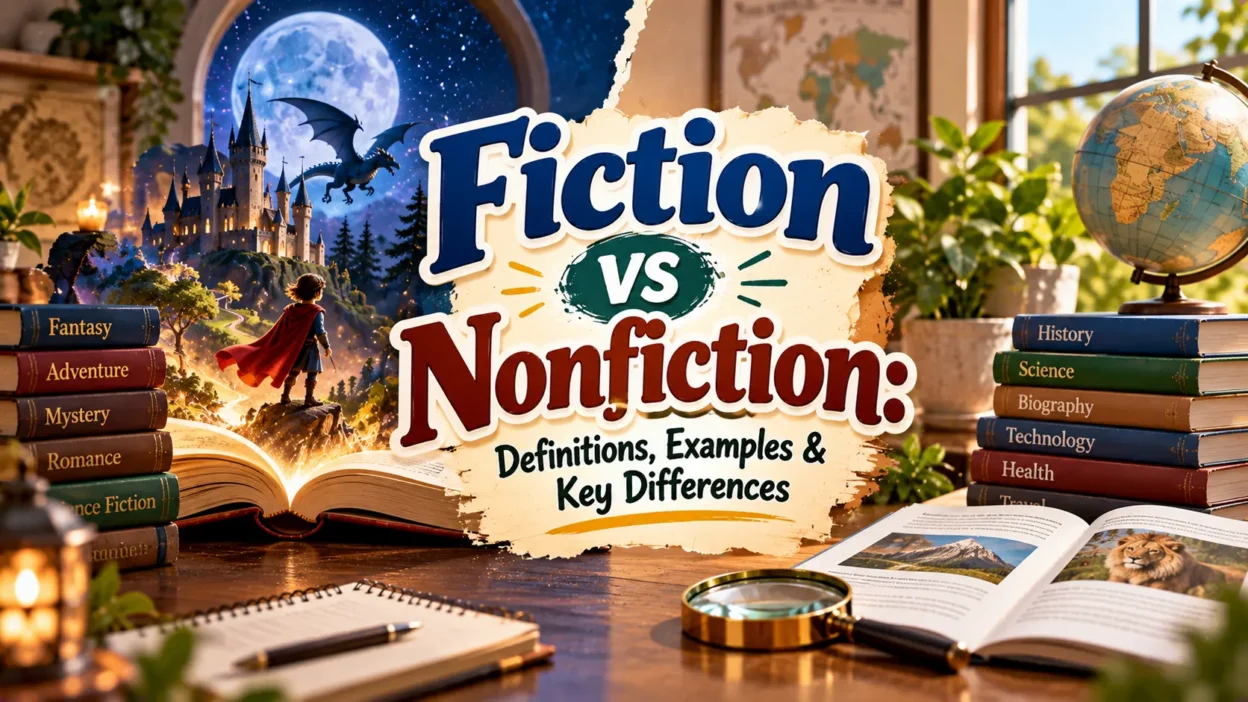
Understanding the difference between fiction and nonfiction is one of the most fundamental skills in reading and writing. Yet the fiction vs nonfiction distinction often confuses students, writers, and casual readers alike. At its core, fiction refers to literature created from the imagination, while nonfiction describes writing based on facts and real events . This simple definition, however, barely scratches the surface of a distinction that shapes how we categorize books, how we read them, and how we understand the relationship between storytelling and truth. Whether you are a student learning to identify text types, a writer deciding how to frame your next project, or a reader choosing your next book, grasping this difference opens the door to more intentional and rewarding reading experiences.
Quick Answer
Fiction is imaginative writing that describes invented people, places, and events. Nonfiction is factual writing that describes real people, places, and events. The key test is not whether something is true, but whether the author claims it is true. Fiction entertains and explores ideas through invented stories; nonfiction informs, explains, and instructs using verifiable information .
Meaning Overview Table
| Aspect | Meaning |
|---|---|
| Definition | Fiction: imaginative literature; Nonfiction: factual literature based on reality |
| Pronunciation | FIK-shun vs non-FIK-shun |
| Part of Speech | Both are nouns (also used as adjectives) |
| Usage | “She prefers fiction for entertainment but reads nonfiction to learn new skills.” |
| Context | Literature, education, publishing, library science, writing craft |
Main Meaning
Definition
Fiction encompasses any narrative or creative work that derives from the imagination rather than from fact. It includes novels, short stories, plays, films, and poetry that invent characters, settings, and events. Nonfiction refers to any written work that presents factual information, real events, or verifiable claims. It includes biographies, memoirs, history books, textbooks, journalism, essays, and instructional guides .
Origin
The distinction between fiction and nonfiction emerged gradually as literature evolved. Ancient storytelling traditions, including the Epic of Gilgamesh and Greek myths, blended historical events with imaginative elements. The modern categorization solidified with the rise of print culture and the novel as a distinct literary form in the 18th century. Today, the distinction forms the backbone of library organization, bookstore shelving, and educational curricula worldwide .
Context
The fiction vs nonfiction distinction operates across multiple contexts:
- Libraries and Bookstores: Fiction and nonfiction occupy separate sections, helping readers find desired materials
- Education: Teachers use the distinction to develop comprehension skills for different text types
- Publishing: Agents and editors categorize submissions based on market expectations
- Writing Craft: Authors choose their approach based on whether they want to invent or report
- Reading Preferences: Many readers gravitate toward one type over the other
Modern Usage
In contemporary publishing, the lines between fiction and nonfiction sometimes blur. Creative nonfiction and narrative nonfiction use literary techniques traditionally associated with fiction to tell true stories in compelling ways. Meanwhile, some fiction incorporates extensive historical research, making it feel authentic. The distinction remains crucial for categorizing works, but readers and writers increasingly appreciate the spectrum between pure imagination and strict fact .
Detailed Explanation
Literal Meaning
Literally, fiction means “something invented or feigned,” from the Latin fictio, meaning “a making” or “a shaping.” Nonfiction literally means “not fiction,” indicating writing that is not invented. The literal definitions establish a binary: invented versus not invented, imaginative versus factual .
Common Meaning
Commonly, people understand fiction as stories that are made up and nonfiction as books that teach or inform. A novel about dragons is fiction; a book about actual dragon myths is nonfiction. This common understanding works well for most everyday purposes, though it oversimplifies the nuances of genres like historical fiction or creative nonfiction .
Text Meaning
In text-based categorization, fiction includes novels, novellas, short stories, flash fiction, and epic poems. Nonfiction includes memoirs, autobiographies, biographies, essays, journalism, textbooks, self-help books, cookbooks, and technical manuals. Textbooks and educational materials frequently distinguish between the two to help students develop different reading strategies .
Slang Meaning
In casual conversation, people sometimes use “fiction” to describe something false or unbelievable, as in “that excuse is pure fiction.” Conversely, “nonfiction” can describe something very real or gritty, as in “this situation is nonfiction.” These colloquial uses extend the literary distinction into everyday speech.
Internet Meaning
Online, the fiction vs nonfiction distinction appears in book reviews, reading recommendations, and writing communities. Platforms like Goodreads and StoryGraph categorize books by genre, helping users find similar titles. BookTube and BookTok creators frequently discuss whether they prefer fiction or nonfiction, influencing reading trends .
Social Media Meaning
On social media, fiction and nonfiction reading challenges, recommendations, and discussions are common. Hashtags like #FictionFriday and #NonfictionNovember encourage readers to explore different genres. The distinction helps readers find communities aligned with their tastes.
Cultural Meaning
Culturally, the fiction vs nonfiction distinction reflects deeper questions about truth, storytelling, and knowledge. Fiction allows exploration of hypothetical scenarios and emotional truths; nonfiction preserves and transmits factual knowledge. Both serve essential human needs—to understand reality and to imagine alternatives .
Examples Table
| Example | Meaning |
|---|---|
| Harry Potter and the Sorcerer’s Stone | Fiction—invented characters and magical world |
| The Diary of Anne Frank | Nonfiction—a real diary kept during the Holocaust |
| To Kill a Mockingbird | Fiction—novel exploring racial injustice through invented characters |
| The Immortal Life of Henrietta Lacks | Nonfiction—narrative journalism about real scientific history |
| Charlotte’s Web | Fiction—talking animals and invented farm life |
| A Brief History of Time | Nonfiction—science writing explaining real physics |
| The Great Gatsby | Fiction—novel about invented characters in 1920s New York |
| Into the Wild | Nonfiction—true account of Christopher McCandless |
| The Hobbit | Fiction—fantasy novel with invented races and languages |
| Unbroken | Nonfiction—biography of Louis Zamperini |
Related Meanings Table
| Related Term | Meaning |
|---|---|
| Novel | A long work of fiction, typically 50,000+ words |
| Novella | A short novel, 17,500–50,000 words |
| Short story | Fiction under 7,500 words |
| Memoir | Nonfiction account of the author’s personal experiences |
| Biography | Nonfiction account of another person’s life |
| Autobiography | Nonfiction account of one’s own life |
| Literary fiction | Fiction prioritizing artistic merit and character depth |
| Genre fiction | Fiction categorized by plot conventions (mystery, romance, sci-fi) |
| Creative nonfiction | Factual writing using literary techniques |
| Narrative nonfiction | True stories told with narrative structure |
| Expository nonfiction | Nonfiction that explains or informs |
| Persuasive nonfiction | Nonfiction that argues a position |
| Procedural nonfiction | Nonfiction that gives instructions |
| Historical fiction | Fiction set in real historical periods with invented characters |
| Semi-fiction | Blends substantial nonfiction with invented elements |
Common Uses
People encounter fiction and nonfiction in various settings:
Education: Teachers use both types to develop different reading skills. Fiction builds empathy and imagination; nonfiction builds knowledge and critical thinking .
Library Classification: Libraries separate fiction and nonfiction to help patrons find materials. Fiction is organized by author; nonfiction often uses the Dewey Decimal System .
Publishing and Bookstores: Publishers market books based on category. Bookstores shelve fiction and nonfiction in distinct sections with subgenres for easy browsing .
Writing Practice: Writers choose their form based on purpose. Aspiring novelists write fiction; journalists, memoirists, and researchers write nonfiction.
Personal Reading: Readers select based on mood and goals. Fiction offers escape and emotional exploration; nonfiction provides learning and practical knowledge.
Common Mistakes
| Mistake | Correction |
|---|---|
| Assuming nonfiction is always boring | Narrative nonfiction reads like a novel |
| Thinking fiction is “false” or “untrue” | Fiction conveys emotional and thematic truth |
| Believing all nonfiction is 100% accurate | Memoirs can contain errors; verify facts |
| Confusing historical fiction with history books | Historical fiction invents characters; history books report facts |
| Thinking creative nonfiction is fiction | Creative nonfiction uses literary style but remains factual |
| Assuming all fiction is novels | Fiction includes short stories, plays, and poetry |
| Believing nonfiction must be read start to finish | Reference books and cookbooks allow non-linear reading |
| Thinking the author’s claim determines truth | The test is whether the work claims to be true |
| Confusing semi-fiction with nonfiction | Semi-fiction blends invention with fact |
| Assuming children prefer fiction | Some children devour nonfiction |
Related Questions
What is the main difference between fiction and nonfiction?
Fiction is created from imagination, describing invented people and events. Nonfiction is based on fact, describing real people and events. The key test is whether the work claims to be true .
Is a true story fiction or nonfiction?
A true story is nonfiction if the author claims it is true. However, if the author invents scenes or dialogue beyond what they can verify, the work edges toward semi-fiction .
Can a book be both fiction and nonfiction?
A single book cannot be both simultaneously, but semi-fiction blends substantial nonfiction with invented elements. Creative nonfiction uses literary techniques while remaining factual .
What is narrative nonfiction?
Narrative nonfiction tells true stories using the storytelling techniques of fiction, including scene-setting, character development, and dramatic pacing. Examples include Into the Wild and Unbroken .
Is poetry fiction or nonfiction?
Poetry can be either. Narrative poems may be fictional or factual. The categorization depends on whether the poem’s content claims to be true.
What percentage of adult reading is nonfiction?
Approximately 80% of the reading adults do outside of school is nonfiction, including articles, manuals, emails, and books .
Can fiction teach facts?
Yes. Fiction often incorporates accurate historical, scientific, or cultural details. Readers can learn from fiction, though they should verify facts independently .
What is the oldest fiction story?
The Epic of Gilgamesh, an ancient Mesopotamian poem, is often considered the world’s oldest known fictional story .
FAQs
What is fiction?
Fiction is literature created from the imagination, including novels, short stories, and plays. It describes invented characters, places, and events. Fiction entertains, explores ideas, and conveys emotional truths .
What is nonfiction?
Nonfiction is writing based on facts and real events. It includes biographies, memoirs, history, journalism, textbooks, and instructional guides. Nonfiction informs, explains, instructs, and persuades .
Is Harry Potter fiction or nonfiction?
Harry Potter is fiction. The characters, magical world, and events are entirely invented by J.K. Rowling .
Is a memoir fiction or nonfiction?
A memoir is nonfiction. It presents the author’s real experiences and memories, though some memoirs contain factual inaccuracies .
Why is creative nonfiction called creative if it’s true?
Creative nonfiction uses literary techniques like scene-setting and character development to tell true stories engagingly. The “creative” refers to the writing style, not invented content .
Can a novel be based on a true story and still be fiction?
Yes. Many novels draw inspiration from real events but invent characters, dialogue, or plot details. If the author presents it as a novel, it is fiction .
What is the difference between literary fiction and genre fiction?
Literary fiction prioritizes character depth and artistic prose; genre fiction follows conventions of categories like mystery, romance, or science fiction. Both are fiction .
How do I know if a book is fiction or nonfiction?
Check the publisher’s categorization. Fiction is shelved separately from nonfiction. The book’s description will indicate whether it is a novel or a factual account.
Conclusion
The fiction vs nonfiction distinction shapes how we read, write, and understand literature. Fiction invents people, places, and events to entertain, explore ideas, and illuminate emotional truths. Nonfiction reports facts, teaches skills, and preserves knowledge about the real world. The key test is not whether something is true, but whether the author claims it is true . Understanding this difference empowers readers to choose books intentionally and writers to select the right form for their purpose. Whether you prefer the imaginative escape of a novel or the factual grounding of a memoir, both fiction and nonfiction enrich our lives in distinct and valuable ways. Embrace both, and your reading life will be all the richer for it.

Clara Morgan is a language and vocabulary writer passionate about making English easier to understand. At Wordestic, she creates clear and practical guides on word meanings, synonyms, antonyms, grammar, word differences, and commonly confused words.
Her writing focuses on simple explanations, useful examples, and everyday usage to help readers expand their vocabulary and communicate with greater confidence.