
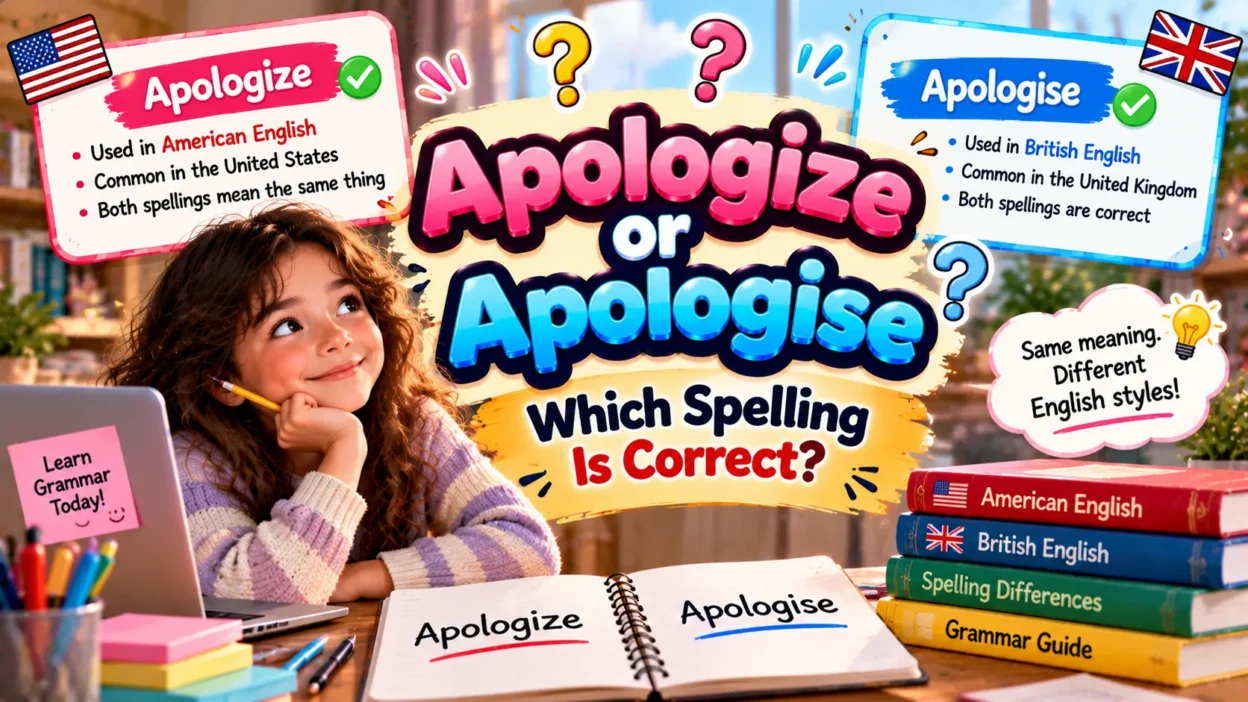
English spelling often creates confusion when a single word has two accepted forms, and the apologize or apologise debate ranks among the most common. Both spellings are correct, but choosing the right one depends entirely on your audience and the version of English you use. This distinction matters for professional writing, academic work, and everyday communication.
“Apologize” is the standard spelling in American English, while “apologise” is the preferred form in British English, Australian English, and most other English-speaking regions outside the United States. The word means to express regret for a fault or offense, to acknowledge a mistake, or to ask for forgiveness. Despite the spelling difference, both forms carry identical meanings and pronunciations. This comprehensive guide explains the difference, explores the word’s origins, provides practical examples, and helps you choose the correct spelling for your writing.
Quick Answer
Both “apologize” and “apologise” are correct—the difference is regional. Use “apologize” (with a “z”) in American English. Use “apologise” (with an “s”) in British English, Australian English, and most other English-speaking regions. The meaning remains identical regardless of spelling. Interestingly, many British publishers and the Oxford Dictionary accept “apologize” with a “z” as well, though “apologise” remains the more common British form.
Meaning Overview Table
| Aspect | Meaning |
|---|---|
| Definition | To express regret for a fault or offense; to acknowledge a mistake and ask for forgiveness |
| Pronunciation | /əˈpɒlədʒaɪz/ (both spellings) |
| Part of Speech | Verb (intransitive) |
| Usage | “I apologize for the delay” (US) / “I apologise for the delay” (UK) |
| Context | Professional emails, personal relationships, public statements, customer service |
Main Meaning
Definition
“Apologize” (American) or “apologise” (British) is a verb meaning to express regret for something done or said, to acknowledge a fault, or to make an apology. The word describes the act of saying sorry and taking responsibility for a mistake, offense, or failure. It functions as an intransitive verb, meaning it does not take a direct object—you apologize to someone for something.
Origin
The word derives from the Greek apologia, meaning “a speech in defense.” The Greek root combines apo (“away from”) and logos (“speech” or “reason”). In ancient Greece, an apologia was a formal defense of one’s actions or beliefs, not an expression of regret. The word entered Latin as apologia and then French as apologie before reaching English in the 16th century. Originally, “apology” meant a defense or justification. The modern sense of expressing regret emerged in the late 16th century. The verb form “apologize” appeared in the early 18th century.
Context
The spelling choice depends on your audience:
- American English: Always use “apologize” with a “z”
- British English: Use “apologise” with an “s,” though “apologize” is also accepted by Oxford
- Australian English: Follow British convention with “apologise”
- Canadian English: Both spellings appear; “apologize” is more common in business writing
- Academic Writing: Follow the style guide of your institution or publisher
Modern Usage
Today, “apologize” dominates in the United States across all contexts—business, media, and everyday language. “Apologise” remains standard in the UK, Australia, New Zealand, and other Commonwealth countries. In digital communication, both forms appear frequently, and spell-checkers often default to the regional standard. The word appears constantly in customer service interactions, public statements from celebrities and politicians, and personal relationships.
Detailed Explanation
Literal Meaning
Literally, the word means “to speak in defense” or “to make a defense.” This original meaning survives in the noun “apology,” which can still refer to a formal defense of a belief or position, though this usage is now rare. The modern literal meaning is “to express regret for an offense.”
Common Meaning
Commonly, people use “apologize” or “apologise” to acknowledge a mistake and express remorse. The word appears in phrases like “I apologize for the inconvenience,” “She apologized for being late,” and “He refused to apologize.” It describes the social act of taking responsibility and seeking forgiveness.
Text Meaning
In text-based communication, the word appears in emails, text messages, and formal letters. A professional email might begin with “I apologize for the delay in responding.” A text message might say “Sorry, I apologise for the confusion.” The spelling choice signals the writer’s regional background or audience.
Internet Meaning
On the internet, both spellings appear constantly in social media posts, comment sections, and online reviews. People apologize for late replies, misunderstandings, and mistakes. Public figures issue apologies on X (formerly Twitter), Instagram, and YouTube. The internet has made public apologies a daily occurrence.
Social Media Meaning
On social media, apologies take many forms. Influencers apologize for controversial statements. Brands apologize for poor service. Individuals apologize for misunderstandings in comment threads. The spelling chosen often reflects the platform’s dominant audience—American users typically write “apologize,” while British and Australian users write “apologise.”
Cultural Meaning
Culturally, the act of apologizing carries significant weight. Different cultures have different norms around apology—some expect frequent, explicit apologies, while others value indirect communication. The word itself has become a symbol of accountability and emotional intelligence. Public apologies from celebrities and politicians often become cultural events, analyzed for sincerity and completeness.
Examples Table
| Example | Meaning |
|---|---|
| I apologize for the delay. | American spelling for expressing regret |
| She apologised for the mistake. | British spelling for acknowledging a fault |
| He refused to apologize. | American spelling for declining to express regret |
| We apologise for any inconvenience. | British spelling in customer service |
| The company apologized publicly. | American spelling for a corporate apology |
| I must apologise for my behavior. | British spelling in personal communication |
| She apologized to her friend. | American spelling for interpersonal apology |
| They apologised for the confusion. | British spelling for clarifying a misunderstanding |
| He apologized profusely. | American spelling for expressing strong regret |
| The politician apologised for his remarks. | British spelling in public statement |
Related Meanings Table
| Related Term | Meaning |
|---|---|
| Apology | A formal expression of regret or defense |
| Apologetic | Feeling or showing regret |
| Apologetically | In a manner showing regret |
| Sorry | An expression of regret or sympathy |
| Regret | To feel sad or disappointed about something |
| Remorse | Deep regret for a wrong committed |
| Contrition | Sincere remorse for wrongdoing |
| Repent | To feel sincere regret and change one’s ways |
| Excuse | To forgive or overlook a fault |
| Pardon | To forgive an offense |
| Forgiveness | The act of pardoning an offense |
| Amends | Compensation for a loss or injury |
| Atonement | Reparation for a wrong |
| Mea culpa | An acknowledgment of personal fault |
| Apologia | A formal defense of a belief or position |
Common Uses
People use “apologize” and “apologise” across numerous contexts:
Professional Communication: Emails, customer service interactions, and business letters frequently include apologies for delays, errors, or misunderstandings.
Personal Relationships: Apologies play a central role in maintaining relationships. People apologize for arguments, hurtful comments, and broken promises.
Public Statements: Celebrities, politicians, and corporate leaders issue public apologies for controversial statements, mistakes, or scandals.
Customer Service: Businesses train employees to apologize for poor service, defective products, and billing errors.
Academic Writing: Scholars apologize for limitations in their research or for errors in their work.
Everyday Conversation: People apologize for minor inconveniences, like bumping into someone or arriving late.
Common Mistakes
| Mistake | Correction |
|---|---|
| Using “apologise” in American publications | American English always uses “apologize” with a “z” |
| Using “apologize” in British publications | British English typically uses “apologise” with an “s” |
| Spelling “apology” with an “s” in American English | American English uses “apology” with a “g” |
| Confusing “apologize” with “apologetics” | “Apologetics” means a formal defense of a belief, not an expression of regret |
| Assuming one spelling is “wrong” | Both are correct; the difference is regional |
| Mixing spellings within one document | Choose one convention and apply it consistently |
| Using “apologize” to mean “defend” | The modern meaning is to express regret; “apologize for” a position is rare |
| Forgetting the preposition “for” | You apologize for something, not of something |
| Using “apologize” as a transitive verb | You apologize to someone, not someone |
| Ignoring style guide preferences | Academic and professional writing often specifies regional spelling |
Related Questions
Is it apologize or apologise?
Both are correct. “Apologize” is standard in American English. “Apologise” is standard in British, Australian, and most Commonwealth English.
Which spelling is more common?
“Apologize” with a “z” is more common globally due to American media influence. “Apologise” with an “s” remains standard in British and Commonwealth publications.
Is “apologize” acceptable in British English?
Yes. Many British publishers, including Oxford University Press, accept “apologize” with a “z.” However, “apologise” remains the more common British form.
What does “apologize” mean?
“Apologize” means to express regret for a fault or offense, to acknowledge a mistake, and to ask for forgiveness.
What is the past tense of apologize?
The past tense is “apologized” in American English and “apologised” in British English.
What is a public apology?
A public apology is a formal statement of regret made to a group of people, often through media or social platforms.
Is “apologize” a noun?
No. “Apologize” is a verb. The noun form is “apology.”
FAQs
Which spelling is correct, apologize or apologise?
Both are correct. Use “apologize” for American audiences and “apologise” for British, Australian, and Commonwealth audiences.
Is it “apology” or “apologie”?
“Apology” is the correct spelling in both American and British English. “Apologie” is an archaic form.
How do you spell “apologizing”?
“Apologizing” in American English; “apologising” in British English.
Is “apologize” acceptable in formal writing?
Yes, “apologize” is standard in American formal writing. British formal writing typically uses “apologise.”
Can I use both spellings in the same document?
No. Choose one spelling convention and apply it consistently throughout your document.
What is the difference between “apologize” and “sorry”?
“Apologize” is a formal verb meaning to express regret. “Sorry” is an adjective or interjection expressing regret or sympathy.
Why do Americans spell it with a “z”?
Noah Webster’s spelling reforms in the early 19th century standardized “apologize” with a “z” in American English, distinguishing it from British conventions.
Is “apologise” wrong in America?
It is not grammatically wrong, but it looks unusual and may be flagged as a spelling error by American readers and spell-checkers.
Conclusion
Mastering the apologize or apologise distinction is straightforward: the only difference is regional spelling. American English uses “apologize” with a “z.” British, Australian, and most Commonwealth English uses “apologise” with an “s.” The meaning remains identical across all contexts—expressing regret, acknowledging a mistake, and asking for forgiveness. Remember the simple rule: “z” for the States, “s” for the Commonwealth. Interestingly, many British publishers accept “apologize” as well, though “apologise” remains the more common form. Whether you’re writing a professional email, a personal text, or a public statement, choosing the correct regional spelling demonstrates attention to detail and respect for your audience’s conventions. Write with confidence, and your apologies will land with sincerity.

Clara Morgan is a language and vocabulary writer passionate about making English easier to understand. At Wordestic, she creates clear and practical guides on word meanings, synonyms, antonyms, grammar, word differences, and commonly confused words.
Her writing focuses on simple explanations, useful examples, and everyday usage to help readers expand their vocabulary and communicate with greater confidence.