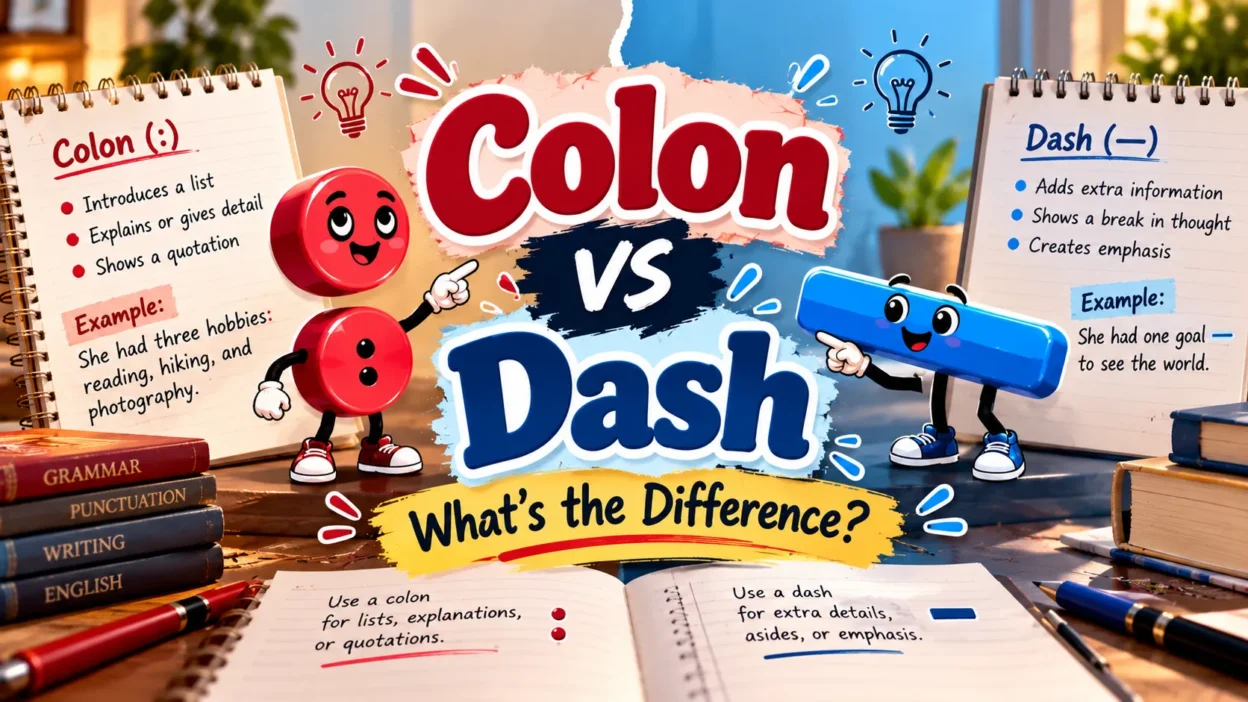
Punctuation marks shape how readers understand sentences, and few choices cause more confusion than the colon vs dash decision. Both marks create pauses and draw attention to what follows, but they serve distinct purposes and carry different tones. A colon formally introduces information that expands on what came before. A dash interrupts, emphasizes, or sets off information with dramatic flair.
Writers often wonder when to use one over the other, especially since both can introduce lists or explanations. The key lies in formality, structure, and emphasis. This guide breaks down the colon vs dash distinction with clear rules, practical examples, and memory tricks to help you punctuate with confidence.
Quick Answer
Use a colon (:) to formally introduce a list, explanation, or quotation after a complete sentence. Use a dash (—) to emphasize information, signal an abrupt break in thought, or set off parenthetical content. Colons are more formal and common in academic writing; dashes are more dramatic and conversational. A colon follows an independent clause; a dash can interrupt anywhere.
Meaning Overview Table
| Aspect | Meaning |
|---|---|
| Definition | Colon: a punctuation mark introducing information after an independent clause. Dash: a punctuation mark emphasizing or interrupting information |
| Pronunciation | Colon: /ˈkoʊlən/; Dash: /dæʃ/ |
| Part of Speech | Nouns (punctuation marks) |
| Usage | “He brought three things: a tent, a stove, and a map” vs. “He brought everything—tent, stove, map—for the trip” |
| Context | Academic writing, creative writing, journalism, everyday composition |
Main Meaning
Definition
A colon (:) is a punctuation mark that directs attention to what follows, typically introducing a list, explanation, quotation, or elaboration. It appears after an independent clause—a complete sentence—and signals that the upcoming information expands or clarifies the preceding statement .
A dash (—), specifically the em dash, is a punctuation mark that creates emphasis, signals an abrupt break in thought, or sets off parenthetical information. Unlike the colon, the dash can interrupt a sentence at almost any point and carries a more dramatic, less formal tone .
Origin
The colon traces back to ancient Greek punctuation, where it marked a pause in recitation. It entered English through Latin and has long served as a formal marker of introduction and elaboration.
The dash emerged later, gaining popularity in the 18th and 19th centuries as writers sought a punctuation mark for dramatic interruption and emphasis. It remains less standardized than the colon, with usage varying by style guide and region.
Context
The colon vs dash distinction matters across several contexts:
- Academic Writing: Colons are standard for introducing lists, quotations, and explanations; dashes appear less frequently
- Creative Writing: Dashes create rhythm, emphasis, and conversational tone; colons feel more deliberate and formal
- Journalism: Dashes add punch and clarity; colons introduce quotes and lists
- Business Writing: Colons introduce information formally; dashes add emphasis sparingly
Modern Usage
Today, both marks appear frequently in written English. Colons dominate formal and academic prose, introducing lists, quotations, and explanations after complete sentences. Dashes appear in creative writing, journalism, and casual communication, where writers use them for emphasis, interruption, and parenthetical asides. Style guides vary on dash spacing—some prefer no spaces, others allow them—but the em dash (—) remains the standard symbol .
Detailed Explanation
Literal Meaning
Literally, a colon is a mark of introduction. It tells the reader: “Here comes the information you were promised.” A dash is a mark of interruption or emphasis. It tells the reader: “Pause—something important is coming.”
Common Meaning
Commonly, people use colons to introduce lists and explanations. “She bought three items: bread, milk, and eggs.” People use dashes to emphasize or interrupt. “She bought everything—bread, milk, eggs—for the recipe.”
Grammatical Meaning
Grammatically, the colon requires an independent clause before it. You cannot place a colon between a verb and its object or a preposition and its object . The dash has no such restriction. It can interrupt anywhere, though careful writers avoid overuse.
Stylistic Meaning
Stylistically, colons signal formality and deliberation. They say, “I have prepared this information for you.” Dashes signal spontaneity and drama. They say, “Wait—here’s something important” . Academic writing favors colons; creative writing favors dashes .
Emphatic Meaning
Both marks create emphasis, but differently. A colon emphasizes by promising and delivering information. A dash emphasizes by interrupting and surprising. Compare: “He had one goal: victory” versus “He had one goal—victory.” The colon feels formal and declarative. The dash feels urgent and dramatic .
Examples Table
| Example | Meaning |
|---|---|
| She brought three things: a notebook, a pen, and a ruler. | Colon introduces a formal list |
| She brought everything—notebook, pen, ruler—for the exam. | Dash sets off parenthetical list |
| He had one reason for leaving: boredom. | Colon introduces an explanation |
| He left for one reason—boredom. | Dash emphasizes the reason |
| The recipe requires the following: flour, sugar, and eggs. | Colon introduces formal list |
| The recipe requires flour, sugar, eggs—and patience. | Dash adds emphasis to final item |
| The professor made one point clear: attendance matters. | Colon introduces explanation |
| The professor made one point clear—attendance matters. | Dash emphasizes the point |
| She whispered the answer: “Paris.” | Colon introduces quotation |
| She whispered the answer—”Paris”—and walked away. | Dash sets off interrupted quotation |
Related Meanings Table
| Related Term | Meaning |
|---|---|
| Semicolon | Separates related independent clauses; gentler than a colon |
| Em dash | The standard dash (—), used for emphasis and interruption |
| En dash | Shorter dash (–), used for ranges and compound adjectives |
| Hyphen | Joins compound words; not a dash |
| Parentheses | Set off supplementary information with less emphasis |
| Comma | Separates elements; less emphatic than dash or colon |
| Period | Ends a sentence; stronger than colon |
| Ellipsis | Indicates omission or trailing thought |
| Punctuation | System of marks organizing written language |
| Independent clause | A complete sentence that can stand alone |
| Appositive | A noun phrase renaming another noun |
| Parenthetical | Supplementary information set off by punctuation |
| Interruption | A break in sentence flow, often marked by dashes |
| Emphasis | Stress placed on particular information |
| Style guide | Rules governing punctuation usage (APA, MLA, Chicago) |
Common Uses
People use colons and dashes across numerous contexts:
Academic Writing: Colons introduce lists, quotations, and explanations after complete sentences. They signal formal, deliberate prose. Dashes appear rarely in academic writing, typically for emphasis or clarity .
Creative Writing: Dashes create rhythm, signal interruptions, and add conversational tone. They set off asides, emphasize revelations, and mimic speech patterns. Colons appear for formal lists and dramatic declarations .
Business Communication: Colons introduce information efficiently: “Please note the following: the deadline is Friday.” Dashes add emphasis: “The deadline—Friday—is firm.”
Journalism: Colons introduce quotes and lists. Dashes add punch and clarity, especially in headlines and feature writing.
Everyday Writing: Colons appear in formal emails and reports. Dashes appear in casual messages, social media posts, and notes where emphasis matters.
Common Mistakes
| Mistake | Correction |
|---|---|
| Placing a colon between a verb and its object | Use a colon only after an independent clause |
| Placing a colon between a preposition and its object | Rewrite without the colon |
| Using a hyphen (-) instead of an em dash (—) | Use the em dash for interruptions and emphasis |
| Overusing dashes in formal writing | Limit dashes; use colons and commas for formality |
| Using a colon after “such as” or “including” | These phrases already introduce information; omit the colon |
| Using a dash to introduce a formal list | Use a colon for formal lists after complete sentences |
| Capitalizing after a colon inconsistently | Follow style guide rules; American English often capitalizes full sentences |
| Using a single dash where a pair is needed | Use paired dashes for parenthetical information |
| Confusing the en dash (–) with the em dash (—) | En dash for ranges; em dash for interruptions |
| Using a colon in informal writing where a dash fits better | Match punctuation to tone and context |
Related Questions
What is the main difference between a colon and a dash?
A colon formally introduces information after a complete sentence. A dash emphasizes, interrupts, or sets off information with dramatic flair. Colons are formal; dashes are dramatic .
Can a colon and a dash be used interchangeably?
Sometimes, but not always. Both can introduce lists or explanations, but the colon requires an independent clause before it, while the dash can interrupt anywhere. The tone differs: colon is formal, dash is dramatic .
When should I use a colon?
Use a colon after a complete sentence to introduce a list, explanation, quotation, or elaboration. Example: “She had one goal: to win” .
When should I use a dash?
Use a dash to emphasize information, signal an abrupt break in thought, or set off parenthetical content. Example: “She had one goal—to win” .
Can I use a dash to introduce a list?
Yes, but place the list in the middle of a sentence, not at the end. Example: “The tools—hammer, saw, wrench—filled the box.” For lists at the end of a sentence, use a colon .
Is a dash more formal than a colon?
No. A colon is more formal. Dashes are less formal and more dramatic, making them common in creative writing and casual communication .
What is the difference between a dash and a hyphen?
A hyphen (-) joins compound words. A dash (—) marks interruptions and emphasis. They are different symbols with different functions .
FAQs
What does a colon do in a sentence?
A colon introduces information that expands on the preceding independent clause. It typically introduces lists, explanations, quotations, or elaborations.
What does a dash do in a sentence?
A dash emphasizes information, signals an interruption, or sets off parenthetical content. It adds drama and emphasis to writing.
Can I use a colon after a verb?
No. A colon should follow an independent clause, not interrupt a verb and its object. “She bought: bread, milk, eggs” is incorrect. Write “She bought bread, milk, and eggs” instead .
Can I use a dash in academic writing?
Sparingly. Academic writing favors colons, commas, and parentheses. Dashes appear occasionally for emphasis or clarity, but overuse creates a choppy, informal tone .
What is an em dash?
An em dash (—) is the standard dash used for emphasis and interruption. It is longer than an en dash (–), which shows ranges, and a hyphen (-), which joins words .
How do I type an em dash?
On Windows, hold Alt and type 0151. On Mac, press Option+Shift+Hyphen. Many word processors auto-format double hyphens (–) into em dashes.
Is it ever wrong to use a dash?
Dashes become problematic when overused or when they replace clearer punctuation. Use them sparingly and deliberately. In formal writing, prefer colons and commas.
Can a colon and a dash appear in the same sentence?
Rarely. Mixing them creates confusion. Choose one mark and structure the sentence accordingly.
Conclusion
Mastering the colon vs dash distinction elevates your writing and clarifies your meaning. Colons formally introduce lists, explanations, and quotations after complete sentences. Dashes emphasize, interrupt, and set off information with dramatic flair. Remember the simple rule: colons follow independent clauses and signal “here comes the information”; dashes interrupt and signal “wait—this matters.” Match your punctuation to your tone: formal writing favors colons, while creative and casual writing embraces dashes. Whether you’re drafting an academic paper, a business report, or a personal essay, choosing the right mark ensures your readers understand exactly what you intend.

Clara Morgan is a language and vocabulary writer passionate about making English easier to understand. At Wordestic, she creates clear and practical guides on word meanings, synonyms, antonyms, grammar, word differences, and commonly confused words.
Her writing focuses on simple explanations, useful examples, and everyday usage to help readers expand their vocabulary and communicate with greater confidence.