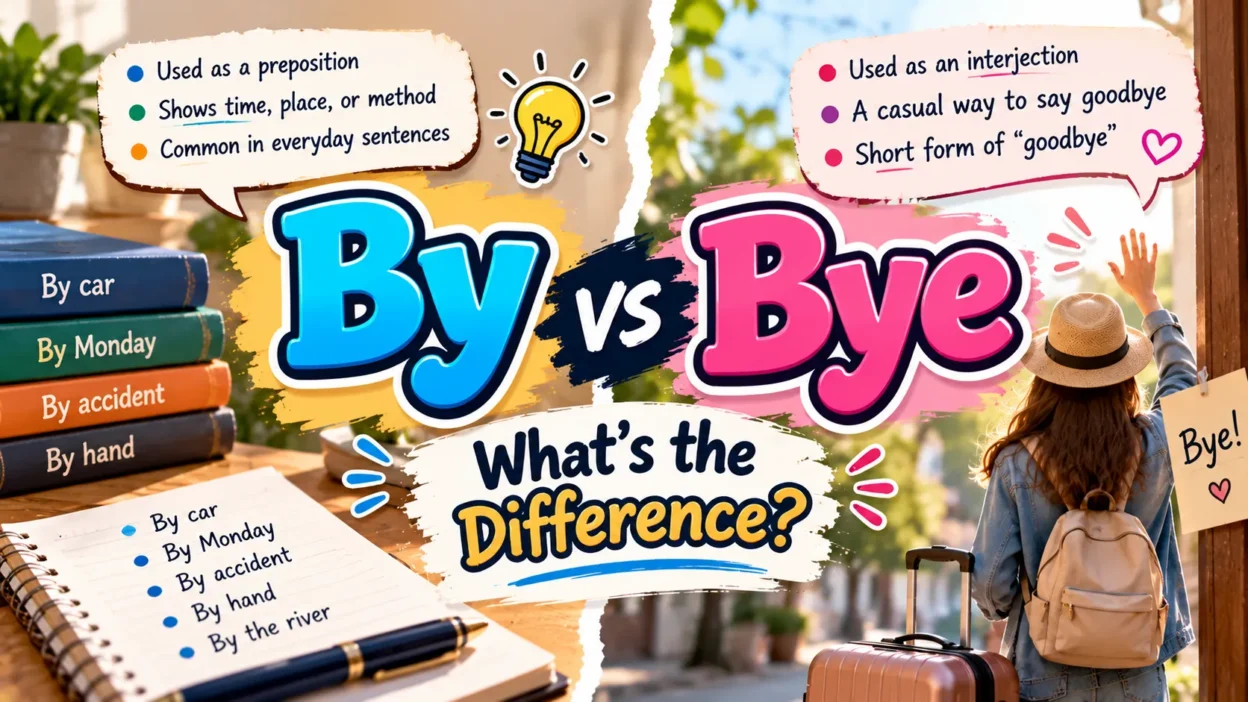
The words “by” and “bye” sound exactly alike, yet they serve completely different purposes in English. One is a workhorse preposition that appears in nearly every sentence; the other is a casual farewell. The by or bye confusion trips up writers of all skill levels, especially in quick texts and social media posts where proofreading takes a back seat.
“By” is a preposition and adverb used to indicate proximity, agency, time limits, and methods. “Bye” is an informal interjection meaning “goodbye,” or a noun in sports referring to an automatic pass to the next round. These words share identical pronunciation but no shared meaning. This comprehensive guide explains the difference, explores their origins, provides practical examples, and helps you choose the correct word every time you write.
Quick Answer
Meaning Overview Table
| Aspect | Meaning |
|---|---|
| Definition | By: a preposition/adverb indicating agency, proximity, or time. Bye: an informal farewell or a sports term |
| Pronunciation | Both: /baɪ/ |
| Part of Speech | By: preposition and adverb. Bye: interjection and noun |
| Usage | “The book was written by her” vs. “She waved bye and left” |
| Context | By: grammar, writing, everyday speech. Bye: casual conversation, sports tournaments |
Main Meaning
Definition
By is primarily a preposition with numerous functions. It identifies the agent performing an action (“written by Shakespeare”), indicates proximity (“by the sea”), specifies a time limit (“by Friday”), or describes a method (“by train”) . It also functions as an adverb meaning “past” (“the bus went by”) .
Bye functions as an interjection meaning “goodbye,” a shortened form of the farewell . In sports, is a noun referring to a situation where a player or team advances to the next round without playing an opponent .
Origin
“By” comes from Old English bī, meaning “near” or “about.” It has Germanic roots and has been a fundamental preposition in English for over a millennium.
“Bye” derives from “goodbye,” which itself is a contraction of “God be with you” (originally “God be with ye”) . The phrase shortened over centuries to “goodbye” and then to in casual speech. The sports usage of “bye” comes from the game of cricket, where “bye” originally referred to a run scored without the batsman hitting the ball .
Context
The distinction matters across several contexts:
- Writing and Grammar: “By” appears constantly as a preposition; misuse of in its place creates confusing sentences
- Casual Conversation: It appears in farewells across texting, social media, and in-person partings
- Sports: It describes tournament advancement without play, common in tennis, football, and cricket
- Everyday Writing: Confusing the two creates embarrassing errors in emails, essays, and social media posts
Modern Usage
Today, “by” appears in virtually every English text, serving dozens of grammatical functions. It appears frequently in casual communication, often doubled or extended to “goodbye.” The sports usage of “bye” remains common in tournament contexts. The confusion between the two persists because they sound identical and spell-check often fails to catch the error.
Detailed Explanation
Literal Meaning
Literally, “by” means “near” or “through the agency of. It literally means “farewell” or, in sports, “advancement without play.” These literal meanings remain the primary definitions of both words.
Common Meaning
Commonly, people use “by” to describe who did something, how something happened, or where something is located. “The cake was baked by Grandma.” “We traveled by car.” “The house is by the river.” People use it when parting: “Bye, see you tomorrow.”
Grammatical Meaning
In grammar, “by” serves as a preposition in phrases indicating:
- Agency: “a painting by Picasso”
- Proximity: “sit by me”
- Time limits: “finish by noon”
- Method: “pay by credit card”
- Measurement: “a room 10 by 12 feet”
“Bye” has no grammatical function beyond its role as an interjection or noun.
Sports Meaning
In sports tournaments, it allows a player or team to advance to the next round without competing. Tournaments use byes when they have an odd number of participants, or to reward top-seeded players with a free pass . For example, “She got a into the second round of the tennis tournament” .
Idiomatic Meaning
“By” appears in numerous idioms and phrases:
- By the way: Introducing a side topic
- By all means: Certainly, of course
- By chance: Accidentally
- By heart: From memory
- By and large: Generally speaking
- By the by: Incidentally (also written “by the bye”)
Examples Table
| Example | Meaning |
|---|---|
| The novel was written by a famous author. | Agency: who did the action |
| She waved bye and walked away. | Farewell interjection |
| The house sits by the lake. | Proximity: near |
| He got a bye in the first round. | Sports: advancement without play |
| Please finish the report by Friday. | Time limit: no later than |
| Bye! See you tomorrow. | Casual farewell |
| We traveled by train. | Method of transportation |
| The bus went right by without stopping. | Adverb: past |
| By the way, I forgot to mention the meeting. | Idiom: introducing a side topic |
| The room is 12 by 15 feet. | Measurement: dimensions |
Related Meanings Table
| Related Term | Meaning |
|---|---|
| Goodbye | The full farewell from which “bye” derives |
| Bye-bye | A casual, often affectionate farewell |
| Buy | To purchase; a homophone confused with by and bye |
| By the way | An idiom meaning “incidentally” |
| By all means | An idiom meaning “certainly” |
| By chance | An idiom meaning “accidentally” |
| By heart | An idiom meaning “from memory” |
| By and large | An idiom meaning “generally speaking” |
| Bye week | A week when a sports team has no game |
| First-round bye | Automatic advancement past the first round |
| By-product | Something produced as a secondary result |
| Bystander | A person present but not involved |
| Bypass | A road passing around a town; to go around |
| Byline | The line naming the author of an article |
| By-law | A rule made by an organization (also “bye-law”) |
Common Uses
People use “by” and “bye” across numerous contexts:
Everyday Writing: “By” appears in countless sentences. It identifies authors (“a book by Stephen King”), locations (“a town by the sea”), deadlines (“due by Monday”), and methods (“paid by check”) .
Casual Conversation: It appears constantly in farewells. People say in person, on phone calls, and in text messages. ” adds affection or playfulness.
Sports Reporting: It appears in tournament coverage. Commentators note when a team earns a first-round or enters a week .
Formal and Professional Writing: “By” appears in legal documents, academic papers, and business correspondence. Precision matters: “by the deadline” versus the deadline” changes meaning entirely.
Social Media and Texting: Both words appear frequently, often with errors. Quick typing leads to appearing where “by” belongs, and vice versa.
Common Mistakes
| Mistake | Correction |
|---|---|
| Writing “written bye Shakespeare” | Write “written by Shakespeare” (agency) |
| Writing “bye the lake” | Write “by the lake” (proximity) |
| Writing “finish it bye Friday” | Write “finish it by Friday” (time limit) |
| Writing “bye the way” | Write “by the way” (idiom) |
| Writing “good-bye” as the standard farewell | “Goodbye” is the standard spelling; “good-bye” is outdated |
| Writing “a painting bye Picasso” | Write “a painting by Picasso” (agency) |
| Writing “he got a by in the tournament” | Write “he got a bye in the tournament” (sports) |
| Writing “by, see you later” | Write “bye, see you later” (farewell) |
| Assuming spell-check will catch the error | Spell-check often misses homophones; proofread manually |
| Confusing “by” with “buy” | “Buy” means purchase; “by” indicates agency, proximity, or method |
Related Questions
Is it “by” or “bye”?
It depends on meaning. Use “by” as a preposition or adverb for agency, proximity, time, or method. Use it for farewells or the sports term .
Is “goodbye” one word or two?
“Goodbye” is the standard spelling as one word.
What does “by the way” mean?
“By the way” is an idiom meaning “incidentally” or “as a side note.” It introduces a topic tangentially related to the main conversation.
Can “by” be a noun?
Rarely. “By” can function as a noun meaning “a side issue” or “something of secondary importance,” but this usage is archaic. The noun form also carries this meaning .
Why do people confuse “by” and “bye”?
They are homophones—they sound identical but have different spellings and meanings. Quick writing and reliance on spell-check lead to frequent errors.
How can I remember the difference?
Remember: It is for goodbyes. “By” is for everything else—agency, proximity, time, method. If you’re not saying farewell or discussing sports, you need “by.”
FAQs
What does “by” mean?
“By” is a preposition meaning “near,” “through the agency of,” “no later than,” or “by means of.” It identifies who did something, where something is, when something must happen, or how something is done .
What does “bye” mean?
“Bye” is an informal interjection meaning “goodbye.” In sports, it refers to a player or team advancing to the next round without playing an opponent .
Is it “bye the way” or “by the way”?
The correct phrase is “by the way.” It is an idiom meaning “incidentally.”
Is it “goodbye” or “good-bye”?
Both appear, but “goodbye” as one word is the modern standard. “Good-bye” is an older variant that appears less frequently.
What is a “bye week” in sports?
A “bye week” is a week when a team has no scheduled game, often used for rest or recovery in leagues like the NFL.
Can “bye” be used in formal writing?
“Bye” is informal and rarely appears in formal writing, except in sports reporting. Use “goodbye” or “farewell” in formal contexts.
What is the origin of “bye”?
“Bye” derives from “goodbye,” which comes from “God be with you.” The phrase shortened over centuries to “goodbye” and then .
Is “by” always a preposition?
No. “By” can also function as an adverb (“the bus went by”) and, rarely, as a noun or adjective. However, its most common role is as a preposition .
Conclusion
Mastering the by vs bye distinction protects your writing from embarrassing homophone errors. “By” is the versatile preposition and adverb that appears in nearly every sentence, indicating agency, proximity, time, or method. It is the casual farewell or the sports term for automatic advancement. Remember the simple rule: It is for goodbyes; “by” is for everything else. Whether you’re writing an email, a social media post, or a sports recap, choosing the correct word ensures your meaning is clear. Practice using “by” for prepositions and it for farewells, and your readers will understand exactly what you intend. Small distinctions like this separate careful writers from careless ones.

Clara Morgan is a language and vocabulary writer passionate about making English easier to understand. At Wordestic, she creates clear and practical guides on word meanings, synonyms, antonyms, grammar, word differences, and commonly confused words.
Her writing focuses on simple explanations, useful examples, and everyday usage to help readers expand their vocabulary and communicate with greater confidence.