The words “bought” and “brought” sound similar, differ by just two letters, and appear in everyday conversation constantly. Yet the bought vs brought confusion ranks among the most common verb errors in English, appearing in texts, emails, and even published writing.
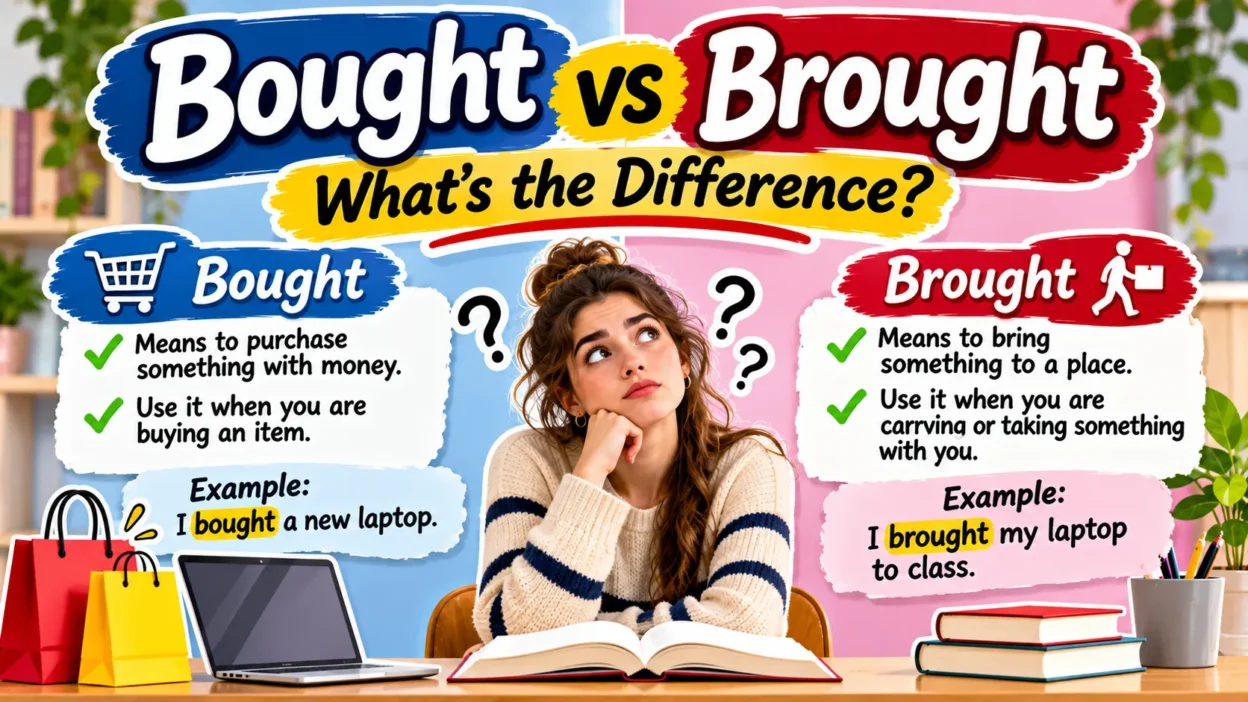
“Bought” is the past tense of “buy,” meaning to purchase something with money. “Brought” is the past tense of “bring,” meaning to carry or take something to a place. These words share similar sounds but describe completely different actions. This comprehensive guide explains the difference, explores their origins, provides practical examples, and helps you choose the correct word every time you write.
Quick Answer
“Bought” is the past tense of “buy,” meaning purchased with money, as in “I bought a new phone.” “Brought” is the past tense of “bring,” meaning carried or delivered to a place, as in “She brought cookies to the party.” Remember: bought relates to buying; brought relates to bringing. They sound similar but mean completely different things.
Meaning Overview Table
| Aspect | Meaning |
|---|---|
| Definition | Bought: past tense of buy (purchased). Brought: past tense of bring (carried to a place) |
| Pronunciation | Bought: /bɔːt/; Brought: /brɔːt/ |
| Part of Speech | Both are past tense verbs |
| Usage | “I bought groceries” vs. “I brought groceries to the party” |
| Context | Shopping, commerce, everyday actions, travel, hospitality |
Main Meaning
Definition
Bought is the past tense and past participle of the irregular verb “buy.” It means acquired something by paying money for it. Brought is the past tense and past participle of the irregular verb “bring.” It means carried, conveyed, or delivered something or someone to a place.
Origin
“Bought” comes from the Old English bycgan, meaning “to buy.” The past tense bohte evolved into modern “bought.” “Brought” comes from the Old English bringan, meaning “to bring.” The past tense brōhte evolved into modern “brought.” Both words have Germanic roots and have been irregular verbs in English for over a thousand years.
Context
The distinction matters across several contexts:
- Shopping and Commerce: “Bought” appears in discussions of purchases, transactions, and acquisitions
- Travel and Hospitality: “Brought” appears in discussions of carrying items, delivering gifts, and hosting guests
- Everyday Conversation: Both words appear constantly in casual speech and writing
- Business Writing: “Bought” appears in procurement documents; “brought” appears in meeting notes and reports
Modern Usage
Today, “bought” appears frequently in shopping contexts, financial discussions, and everyday conversation about purchases. “Brought” appears in discussions of carrying, delivering, and bringing items or people. The confusion between the two persists because they sound similar and spell-check often fails to catch the error.
Detailed Explanation
Literal Meaning
Literally, “bought” means purchased with money. “Brought” literally means carried or conveyed to a place.
Common Meaning
Commonly, people use “bought” when discussing shopping, gifts, or acquisitions. They use “brought” when discussing carrying items to events, delivering things, or bringing people along.
Shopping Meaning
In shopping contexts, “bought” describes the act of purchasing. “I bought a new car.” “She bought groceries.” The word implies a financial transaction.
Hospitality Meaning
In hospitality contexts, “brought” describes carrying items for others or delivering them to a location. “He brought wine to the dinner.” “She brought her friend to the party.” The word implies movement toward a destination.
Grammar Meaning
Both words are irregular past tense verbs. “Buy” becomes “bought.” “Bring” becomes “brought.” Neither follows the regular “-ed” pattern, which contributes to the confusion. The past participles are identical to the past tense forms: “have bought” and “have brought.”
Examples Table
| Example | Meaning |
|---|---|
| I bought a new laptop yesterday. | Purchased with money |
| She brought her sister to the party. | Carried or accompanied to a place |
| They bought a house last year. | Purchased property |
| He brought snacks to the meeting. | Carried items to a location |
| We bought tickets for the concert. | Purchased admission |
| The waiter brought our food. | Delivered to the table |
| She bought a gift for her mother. | Purchased a present |
| He brought his dog to the park. | Accompanied an animal |
| I bought this shirt on sale. | Purchased at a discount |
| The teacher brought books for the students. | Carried materials to class |
Related Meanings Table
| Related Term | Meaning |
|---|---|
| Bought | Past tense of buy |
| Brought | Past tense of bring |
| Buy | To purchase with money |
| Bring | To carry or convey to a place |
| Purchase | A formal synonym for buy |
| Fetch | To go and get something and bring it back |
| Deliver | To bring something to a destination |
| Carry | To transport something |
| Acquire | To obtain something, often through purchase |
| Obtain | To get or acquire something |
| Purchase | The act of buying |
| Bring along | To carry something with you |
| Buy up | To purchase all available stock |
| Bring about | To cause something to happen |
| Bring up | To raise a topic or child |
Common Uses
People use “bought” and “brought” across numerous contexts:
Shopping: People say “I bought groceries,” “She bought a dress,” and “They bought a new car.” The word appears constantly in retail and commerce.
Hospitality: Hosts say “I brought dessert,” “She brought a gift,” and “He brought his friend.” The word appears in social gatherings and events.
Travel: Travelers say “I brought my passport” and “She brought too much luggage.” The word describes carrying items during travel.
Business: Procurement teams track what they bought. Meeting notes record what attendees brought. Both words appear in professional documents.
Everyday Conversation: People say “I bought lunch” and “I brought lunch from home.” The distinction matters in casual conversation about food and purchases.
Common Mistakes
| Mistake | Correction |
|---|---|
| Writing “I brought a new phone” | Write “I bought a new phone” (purchased) |
| Writing “She bought cookies to the party” | Write “She brought cookies to the party” (carried) |
| Writing “They brought a house” | Write “They bought a house” (purchased) |
| Writing “He bought his dog to the park” | Write “He brought his dog to the park” (accompanied) |
| Writing “I bought lunch from home” | Write “I brought lunch from home” (carried) |
| Writing “She brought a ticket” | Write “She bought a ticket” (purchased) |
| Assuming spell-check will catch the error | Spell-check often misses homophones; proofread manually |
| Writing “bought” when meaning “delivered” | Use “brought” for carrying or delivering |
| Writing “brought” when meaning “purchased” | Use “bought” for buying |
| Confusing “bought” with “brought” in business writing | Precision matters; bought means purchased, brought means carried |
Related Questions
Is it “bought” or “brought”?
It depends on meaning. Use “bought” for purchasing with money. Use “brought” for carrying or delivering to a place.
What does “bought” mean?
“Bought” is the past tense of “buy.” It means acquired something by paying money for it.
What does “brought” mean?
“Brought” is the past tense of “bring.” It means carried, conveyed, or delivered something to a place.
What is the difference between “bought” and “brought” in a sentence?
“Bought” relates to purchasing. “Brought” relates to carrying or delivering.
Why do people confuse “bought” and “brought”?
They sound similar and share the same “ought” ending. Spell-check often misses the error, so the confusion persists in written communication.
Can “bought” be used for carrying?
No. “Bought” only means purchased. Use “brought” for carrying or delivering.
Can “brought” be used for purchasing?
No. “Brought” only means carried or delivered. Use “bought” for purchasing.
FAQs
What does “bought” mean?
“Bought” is the past tense of “buy.” It means purchased with money.
What does “brought” mean?
“Brought” is the past tense of “bring.” It means carried, conveyed, or delivered to a place.
Is it “I bought a gift” or “I brought a gift”?
Both can be correct, depending on meaning. “I bought a gift” means you purchased one. “I brought a gift” means you carried one to a place.
Is it “she brought cookies to the party” or “she bought cookies to the party”?
The correct phrase is “she brought cookies to the party.” Brought means carried to a place.
Is it “I bought lunch” or “I brought lunch”?
Both can be correct. “I bought lunch” means you purchased it. “I brought lunch” means you carried it from home.
How can I remember the difference?
Remember: “bought” contains “buy” (both start with “b” and relate to purchase). “Brought” contains “bring” (both start with “br” and relate to carrying).
What is the origin of “bought”?
“Bought” comes from the Old English bycgan, meaning “to buy.” The past tense bohte evolved into modern “bought.”
What is the origin of “brought”?
“Brought” comes from the Old English bringan, meaning “to bring.” The past tense brōhte evolved into modern “brought.”
Conclusion
Mastering the bought vs brought distinction protects your writing from embarrassing verb errors. “Bought” is the past tense of “buy,” meaning purchased with money. “Brought” is the past tense of “bring,” meaning carried or delivered to a place. Remember the simple rule: bought relates to buying; brought relates to bringing. Whether you’re writing a shopping list, a party invitation, or a business report, choosing the correct word ensures your meaning is clear. Practice using “bought” for purchases and “brought” for carrying, and your readers will understand exactly what you intend. Small distinctions like this separate careful writers from careless ones.

Clara Morgan is a language and vocabulary writer passionate about making English easier to understand. At Wordestic, she creates clear and practical guides on word meanings, synonyms, antonyms, grammar, word differences, and commonly confused words.
Her writing focuses on simple explanations, useful examples, and everyday usage to help readers expand their vocabulary and communicate with greater confidence.