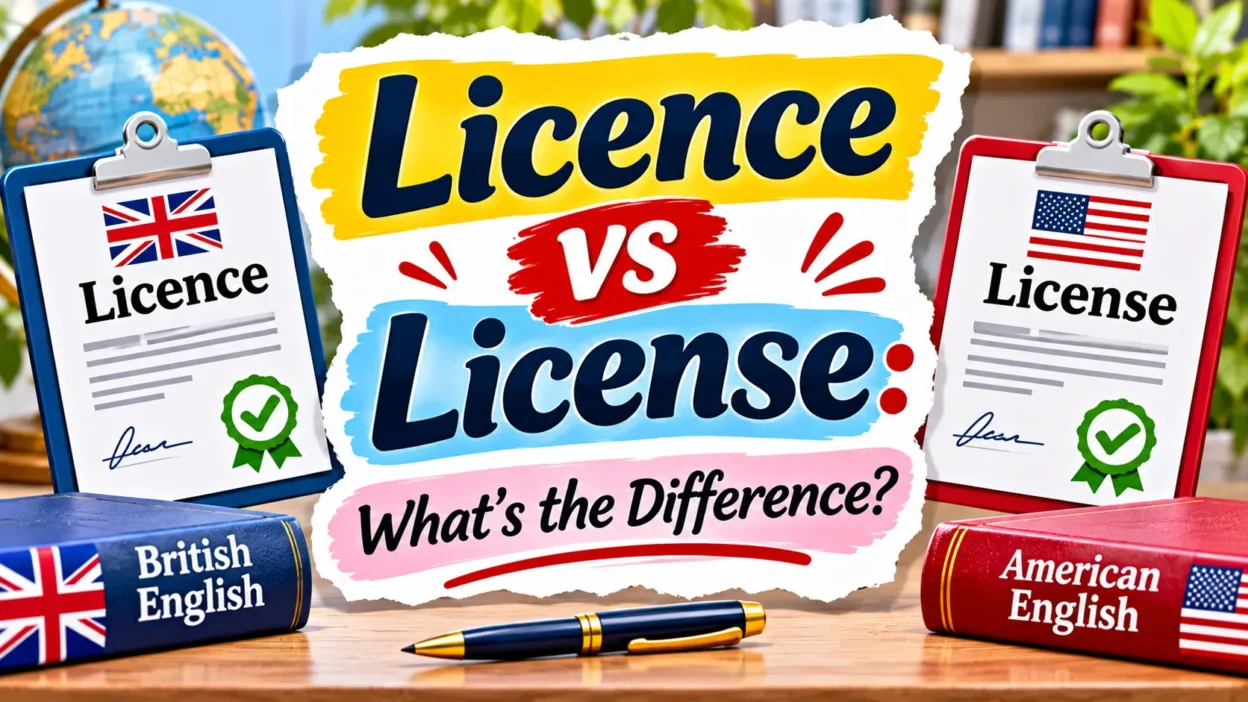
The words “licence” and “license” represent one of the most persistent spelling variations in English. Both are pronounced the same way, both relate to permission or authorization, and both appear in reputable publications across the English-speaking world. Yet the licence vs license distinction comes down to regional preference and grammatical function rather than any difference in meaning .
“Licence” is the standard spelling in British English for the noun form, referring to an official permit or permission. “License” is the standard spelling in American English for both the noun and the verb, and in British English it serves exclusively as the verb meaning to grant official permission . This comprehensive guide explains the regional differences, explores the origins of both forms, provides practical examples, and helps you choose the right spelling for your audience.
Quick Answer
In British English, “licence” is the noun (a permit or permission) and “license” is the verb (to grant permission). In American English, “license” is used for both the noun and the verb. Remember: British “licence” is the thing you hold; “license” is the action of granting it. American English simplifies by using “license” for everything .
Meaning Overview Table
| Aspect | Meaning |
|---|---|
| Definition | Licence: British noun for a permit. License: American noun and verb; British verb |
| Pronunciation | Both: /ˈlaɪsəns/ |
| Part of Speech | Licence: noun only (British). License: noun and verb (American); verb only (British) |
| Usage | “She renewed her driving licence” (UK) vs. “He renewed his driver’s license” (US) |
| Context | Legal documents, driving permits, business operations, software agreements |
Main Meaning
Definition
Licence is a noun used in British English to refer to an official document or permission that allows someone to do something, such as drive a vehicle, sell alcohol, or operate a business . License is the American English spelling for both the noun and the verb. In British English, “license” functions exclusively as the verb meaning to grant official permission .
Origin
Both words trace back to the Latin licentia, meaning “freedom” or “permission,” derived from licēre (“to be permitted”) . The word entered English in the 14th century through Old French. The spelling distinction between “licence” and “license” developed over centuries. American English, influenced by Noah Webster’s spelling reforms, standardized “license” for both noun and verb. British English retained the French-influenced “licence” for the noun while using “license” for the verb .
Context
The distinction matters across several contexts:
- British English: “Licence” for the noun, “license” for the verb
- American English: “License” for both noun and verb
- Canadian English: Generally follows British conventions, using “licence” as the noun
- Australian English: Follows British conventions
- Legal and Official Documents: Spelling follows regional conventions strictly
Modern Usage
Today, “license” dominates in American English across all contexts. In British English, the noun-verb distinction remains standard, though “license” is an acceptable variant spelling for the noun in some style guides . The confusion arises because the two spellings coexist, often appearing side by side in international documents or online content. The key is consistency: choose one convention and apply it throughout your document.
Detailed Explanation
Literal Meaning
Literally, both words refer to permission granted by an authority. The noun form refers to the document or the permission itself. The verb form refers to the act of granting that permission.
Common Meaning
Commonly, people use “licence” (British) or “license” (American) when discussing driving permits, professional credentials, business permits, and software agreements. The word appears constantly in everyday life.
British Meaning
In British English, the distinction is clear and consistent. “Licence” is the thing: a driving licence, a television licence, a fishing licence, a licence to sell alcohol. “License” is the action: the council licenses the premises; the authority licenses the operator .
American Meaning
In American English, “license” covers everything. You apply for a driver’s license. The state licenses drivers. You have a license to practice medicine. The verb form is also “license” .
Legal Meaning
In legal contexts, precision matters. British legal documents use “licence” for the noun. American legal documents use “license” for both forms. International contracts must specify which convention applies to avoid ambiguity.
Examples Table
| Example | Meaning |
|---|---|
| She applied for a driving licence. | British noun: a permit to drive |
| He renewed his driver’s license. | American noun: a permit to drive |
| The restaurant has a licence to sell alcohol. | British noun: permission to sell alcohol |
| The state licenses all commercial fishermen. | American verb: grants permission |
| The film takes artistic licence with the facts. | British noun: freedom to deviate from facts |
| The council will license the event. | British verb: grant permission |
| You need a license to operate a motor vehicle. | American noun: official permission |
| The company licensed its name to others. | American verb: granted use rights |
| I need to renew my fishing licence. | British noun: permit for fishing |
| The new drug was licensed by the government. | Verb: officially approved |
Related Meanings Table
| Related Term | Meaning |
|---|---|
| License (US) | American spelling for both noun and verb |
| Licence (UK) | British spelling for the noun only |
| Permit | An official document granting permission |
| Authorization | The act of giving official permission |
| Certification | Official recognition of qualification |
| Franchise | A license to operate a business |
| Entitlement | The right to have or do something |
| Privilege | A special right granted to a person or group |
| Exemption | Freedom from an obligation or rule |
| Consent | Permission for something to happen |
| Approval | Official agreement to something |
| Charter | A written grant of rights or privileges |
| Registration | The act of recording officially |
| Accreditation | Official certification of competence |
| Clearance | Official permission to proceed |
Common Uses
People use “licence” and “license” across numerous contexts:
Driving and Transportation: Every driver needs a driving licence (UK) or driver’s license (US). This is the most common everyday usage.
Business and Hospitality: Restaurants and bars need a licence to sell alcohol in the UK. In the US, they need a liquor license.
Professional Practice: Doctors, lawyers, and teachers must hold a valid licence or license to practice. The spelling follows regional conventions.
Software and Technology: Software licenses grant users the right to use a program. This usage typically follows American spelling even in British contexts, though “licence” appears in some British publications.
Broadcasting: The BBC operates under a television licence in the UK. This usage consistently uses the British spelling.
Common Mistakes
| Mistake | Correction |
|---|---|
| Using “licence” as a verb in British English | Use “license” for the verb: “The council will license the event” |
| Using “licence” in American English | Use “license” for both noun and verb in American English |
| Using “license” for the noun in formal British writing | Use “licence” for the noun in British English |
| Mixing spellings within one document | Choose one convention and apply it consistently |
| Writing “driver’s licence” in American English | Write “driver’s license” in American English |
| Writing “driving license” in British English | Write “driving licence” in British English |
| Assuming “licence” is always wrong | “Licence” is correct British English for the noun |
| Assuming “license” is only American | “License” is also correct British English for the verb |
| Using “licenced” as the past tense in British English | Use “licensed” for the verb past tense in British English |
| Forgetting that software licenses follow American conventions | Use “license” for software agreements in most contexts |
Related Questions
Is it “licence” or “license”?
Both are correct. “Licence” is the British noun. “License” is the American noun and verb, and the British verb. The choice depends on regional convention and grammatical function .
What is the difference between licence and license?
In British English, “licence” is the noun and “license” is the verb. In American English, “license” is both the noun and the verb .
Is “licence” British or American?
“Licence” is British English for the noun. American English uses “license” for both noun and verb .
Can I use “license” as a noun in British English?
“License” is an acceptable variant spelling for the noun in some British style guides, though “licence” remains the standard .
Why do British and American English spell it differently?
The difference stems from historical spelling reforms. American English standardized “license” for simplicity, while British English retained the French-influenced “licence” for the noun .
What is the verb form of “licence”?
In British English, the verb is “license” (not “licence”). In American English, the verb is also “license” .
FAQs
What does “licence” mean?
“Licence” is a British English noun referring to an official permit or permission to do something, such as a driving licence or a licence to sell alcohol .
What does “license” mean?
“License” is the American English spelling for both the noun and the verb. In British English, it is the verb form meaning to grant official permission .
Is it “driving licence” or “driving license”?
Both are correct. “Driving licence” is standard in British English. “Driving license” is standard in American English, though Americans usually say “driver’s license” .
Is it “licensed” or “licenced”?
“Licensed” is standard in both American and British English. “Licenced” is a rare variant that some style guides accept, but “licensed” is preferred .
Can “licence” be a verb?
No. In British English, “licence” is only a noun. The verb is “license” .
What is “artistic licence”?
“Artistic licence” is a British English phrase meaning the freedom to deviate from facts or rules for creative effect. American English uses “artistic license” .
Why do people confuse “licence” and “license”?
They sound identical and differ by only one letter. The regional and grammatical rules add to the confusion.
Conclusion
Mastering the licence vs license distinction comes down to understanding regional conventions and grammatical function. In British English, “licence” is the noun and “license” is the verb. In American English, “license” serves both roles. Remember the simple rule: British “licence” is the thing you hold; “license” is the action of granting it. American English simplifies by using “license” for everything. Whether you are writing a resume, a legal document, or a business email, choosing the correct spelling for your audience demonstrates attention to detail. Apply the convention consistently, and your writing will carry precision and professionalism.

Clara Morgan is a language and vocabulary writer passionate about making English easier to understand. At Wordestic, she creates clear and practical guides on word meanings, synonyms, antonyms, grammar, word differences, and commonly confused words.
Her writing focuses on simple explanations, useful examples, and everyday usage to help readers expand their vocabulary and communicate with greater confidence.