
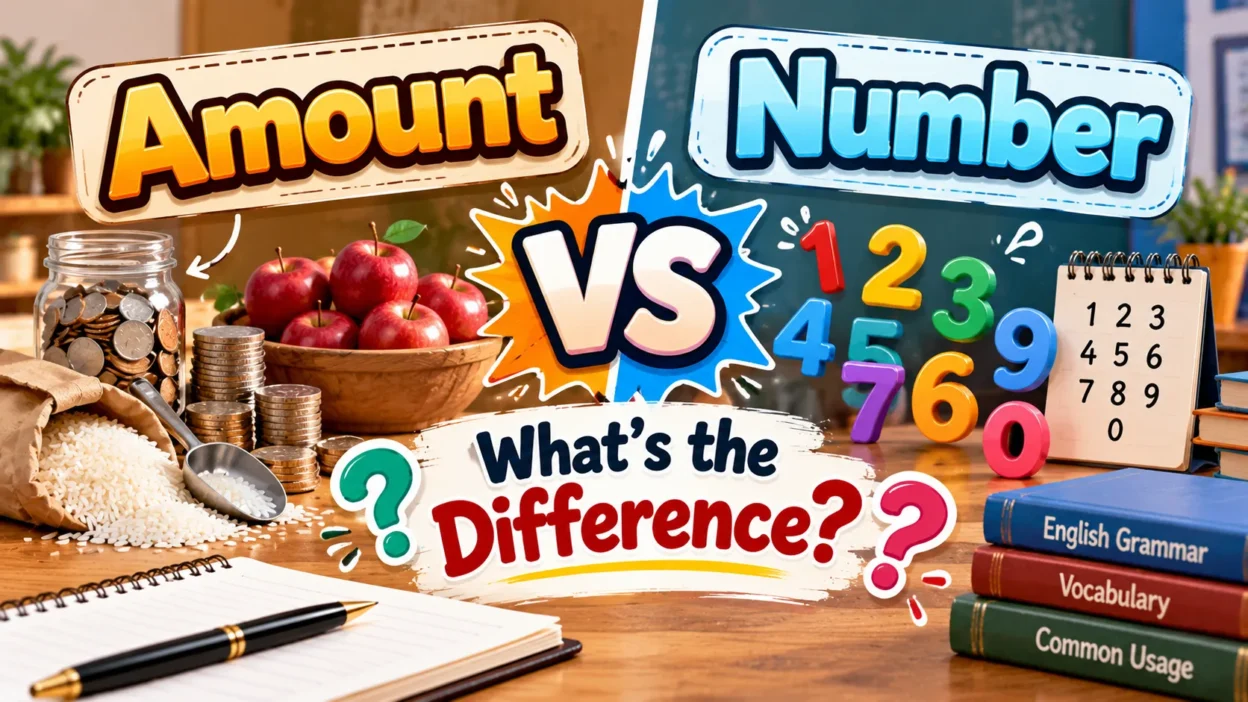
The words “amount” and “number” both describe quantity, yet they apply to different types of things. The amount vs number distinction ranks among the most common grammar errors in English writing, appearing in everything from casual emails to published reports. Understanding the difference helps you write with precision and avoid embarrassing mistakes.
“Amount” refers to uncountable or mass nouns—things you cannot count individually, like water, money, or time. “Number” refers to countable nouns—things you can count one by one, like people, cars, or ideas. You have an amount of water but a number of bottles. You have an amount of money but a number of coins. This comprehensive guide explains the difference, explores their origins, provides practical examples, and helps you choose the correct word every time.
Quick Answer
Use “amount” for uncountable nouns—things you cannot count individually, like water, money, or time. Use “number” for countable nouns—things you can count one by one, like people, cars, or books. “A large amount of water” is correct; “a large number of water” is wrong. “A large number of students” is correct; “a large amount of students” is wrong.
Meaning Overview Table
| Aspect | Meaning |
|---|---|
| Definition | Amount: quantity of uncountable nouns. Number: quantity of countable nouns |
| Pronunciation | Amount: /əˈmaʊnt/; Number: /ˈnʌmbər/ |
| Part of Speech | Both are nouns (and verbs in other senses) |
| Usage | “A large amount of sugar” vs. “A large number of cookies” |
| Context | Academic writing, business reports, everyday communication, journalism |
Main Meaning
Definition
Amount is a noun referring to the quantity or total of something, especially something that cannot be counted individually. It applies to mass nouns (uncountable nouns) like water, sand, information, money, and time. Number is a noun referring to the count or total of things that can be counted individually. It applies to count nouns (countable nouns) like people, cars, books, and ideas.
Origin
“Amount” comes from the Old French amonter, meaning “to go up” or “to mount,” from Latin ad montem (“to the mountain”). The word developed the meaning of “total” or “quantity” in Middle English. “Number” comes from the Latin numerus, meaning “number” or “count,” through Old French nombre. Both words have been part of English for centuries.
Context
The distinction matters across several contexts:
- Academic Writing: Professors and editors insist on the correct distinction for clarity
- Business Reports: Precision matters when discussing quantities of goods, money, and people
- Journalism: Style guides consistently distinguish between the two
- Everyday Speech: People often use them interchangeably, leading to errors
Modern Usage
Today, careful writers preserve the amount vs number distinction. “Amount” appears constantly with uncountable nouns: “a large amount of research,” “a small amount of sugar,” “a significant amount of time.” “Number” appears with countable nouns: “a large number of participants,” “a small number of errors,” “a significant number of voters.” The confusion persists because both words describe quantity, and the countable/uncountable distinction is not always obvious.
Detailed Explanation
Literal Meaning
Literally, “amount” means the total quantity of something considered as a mass. “Number” literally means the count of individual items. These literal meanings remain the primary definitions of both words.
Common Meaning
Commonly, people use “amount” when discussing substances, concepts, or abstract quantities. They use “number” when discussing individual items that can be counted. “A large amount of work” refers to the volume of work; “a large number of tasks” refers to the count of tasks.
Academic Meaning
In academic writing, the distinction is strict. “Amount” applies to uncountable nouns: “The study found a significant amount of evidence.” “Number” applies to countable nouns: “The study surveyed a large number of participants.” Using “amount” with countable nouns signals carelessness.
Business Meaning
In business reports, the distinction matters for clarity. “The company spent a large amount of money” (uncountable) versus “The company hired a large number of employees” (countable). Precision in these contexts prevents misunderstandings.
Everyday Meaning
In casual conversation, people often use “amount” for countable nouns, as in “a large amount of people.” This usage is technically incorrect but widespread. Careful speakers and writers preserve the distinction.
Examples Table
| Example | Meaning |
|---|---|
| A large amount of water | Water is uncountable |
| A large number of students | Students are countable |
| A significant amount of time | Time is uncountable |
| A significant number of voters | Voters are countable |
| A small amount of sugar | Sugar is uncountable |
| A small number of errors | Errors are countable |
| A tremendous amount of research | Research is uncountable |
| A tremendous number of books | Books are countable |
| An enormous amount of money | Money is uncountable |
| An enormous number of coins | Coins are countable |
Related Meanings Table
| Related Term | Meaning |
|---|---|
| Quantity | A general term for how much of something |
| Countable noun | A noun that can be counted individually (e.g., apple, car) |
| Uncountable noun | A noun that cannot be counted individually (e.g., water, music) |
| Mass noun | Another term for uncountable noun |
| Count noun | Another term for countable noun |
| Many | Used with countable nouns (many people) |
| Much | Used with uncountable nouns (much water) |
| Fewer | Used with countable nouns (fewer cars) |
| Less | Used with uncountable nouns (less traffic) |
| Quantity | A general term for amount or number |
| Total | The complete amount or number |
| Sum | The total amount of money or quantity |
| Aggregate | A total formed by combining several elements |
| Volume | The amount of space occupied or quantity |
| Measure | The size or amount of something |
Common Uses
People use “amount” and “number” across numerous contexts:
Academic Writing: Researchers use “amount” for uncountable data (amount of evidence) and “number” for countable participants (number of participants).
Business Reports: Analysts use “amount” for money, time, and resources, and “number” for employees, products, and customers.
Journalism: Reporters use “amount” for abstract quantities (amount of support) and “number” for countable things (number of protesters).
Everyday Speech: People say “a large amount of people” incorrectly, but careful speakers say “a large number of people.”
Science and Engineering: Scientists use “amount” for substances (amount of water) and “number” for countable particles (number of atoms).
Common Mistakes
| Mistake | Correction |
|---|---|
| Writing “a large amount of people” | Write “a large number of people” (people are countable) |
| Writing “a small number of water” | Write “a small amount of water” (water is uncountable) |
| Writing “a significant amount of students” | Write “a significant number of students” |
| Writing “a large number of money” | Write “a large amount of money” |
| Writing “fewer water” | Write “less water” (water is uncountable) |
| Writing “less people” | Write “fewer people” (people are countable) |
| Writing “much books” | Write “many books” (books are countable) |
| Writing “many information” | Write “much information” (information is uncountable) |
| Assuming all nouns are countable | Check whether the noun can be counted individually |
| Using “amount” for countable nouns in formal writing | Use “number” for countable nouns |
Related Questions
Is it “amount” or “number”?
It depends on the noun. Use “amount” for uncountable nouns (water, money, time). Use “number” for countable nouns (people, cars, books).
What is the difference between amount and number?
“Amount” refers to the quantity of uncountable nouns. “Number” refers to the count of countable nouns. Water comes in amounts; people come in numbers.
Can I use “amount” for people?
No. People are countable, so use “number” (a large number of people). Using “amount” with people is a common error.
What is an uncountable noun?
An uncountable noun (mass noun) is a noun that cannot be counted individually, like water, sugar, information, or time. Uncountable nouns take “amount.”
What is a countable noun?
A countable noun (count noun) is a noun that can be counted individually, like apple, car, person, or idea. Countable nouns take “number.”
Why do people confuse amount and number?
Both words describe quantity, and the countable/uncountable distinction is not always obvious. In casual speech, people often use “amount” for countable nouns.
What is the difference between “less” and “fewer”?
“Less” is used with uncountable nouns (less water). “Fewer” is used with countable nouns (fewer people). This mirrors the amount/number distinction.
How can I remember the difference?
Remember: “amount” has the word “mount,” suggesting a mass or pile. “Number” has the word “number,” suggesting counting. If you can count it, use “number.”
FAQs
What does “amount” mean?
“Amount” is a noun meaning the quantity or total of something, especially an uncountable substance like water, money, or time.
What does “number” mean?
“Number” is a noun meaning the count or total of countable things, like people, cars, or books.
Is it “a large amount of people” or “a large number of people”?
The correct phrase is “a large number of people.” People are countable, so they take “number.”
Is it “a large amount of money” or “a large number of money”?
The correct phrase is “a large amount of money.” Money is uncountable, so it takes “amount.”
Can “amount” be used with countable nouns?
Not in formal writing. “Amount” should only be used with uncountable nouns. In casual speech, people sometimes use it incorrectly with countable nouns.
Can “number” be used with uncountable nouns?
No. “Number” should only be used with countable nouns.
What are examples of uncountable nouns?
Water, sugar, information, money, time, research, evidence, air, music, and furniture are all uncountable nouns. They take “amount.”
What are examples of countable nouns?
People, cars, books, apples, ideas, voters, students, and coins are all countable nouns. They take “number.”
Conclusion
Mastering the amount vs number distinction improves your writing and clarifies your meaning. “Amount” applies to uncountable nouns—things you cannot count individually, like water, money, or time. “Number” applies to countable nouns—things you can count one by one, like people, cars, or books. Remember the simple rule: if you can count it, use “number”; if you cannot, use “amount.” This distinction mirrors the difference between “less” and “fewer,” and “much” and “many.” Whether you’re writing an academic paper, a business report, or a social media post, choosing the correct word ensures your readers understand exactly what you mean. Small distinctions like this separate careful writers from careless ones.

Clara Morgan is a language and vocabulary writer passionate about making English easier to understand. At Wordestic, she creates clear and practical guides on word meanings, synonyms, antonyms, grammar, word differences, and commonly confused words.
Her writing focuses on simple explanations, useful examples, and everyday usage to help readers expand their vocabulary and communicate with greater confidence.


