
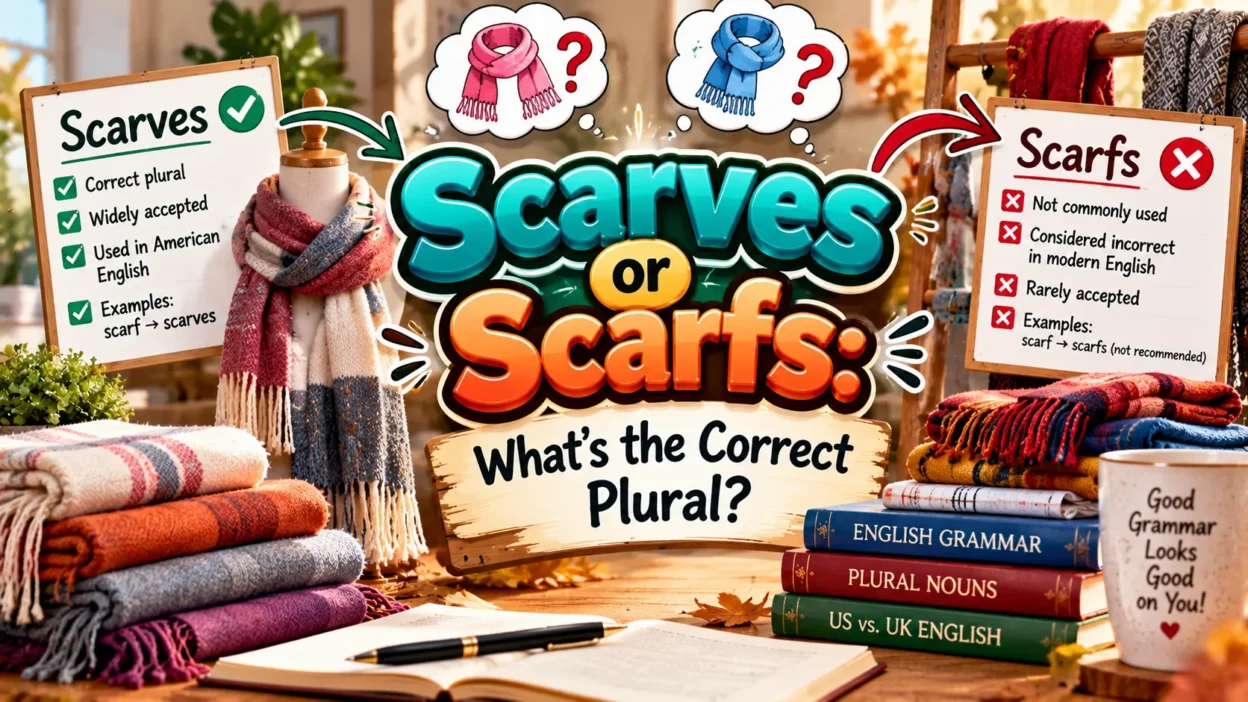
When winter arrives and you reach for your favorite woolen accessory, you might pause before typing out a message about your scarves or scarfs. This seemingly simple spelling question trips up countless writers, leaving many to wonder which plural form is actually correct. The confusion stems from a rare grammatical quirk: “scarf” belongs to a small group of English nouns that historically allowed two different plural forms.
The answer might surprise you—both “scarves” and “scarfs” are technically correct, but they carry different nuances and usage patterns . “Scarves” dominates modern English, especially in written communication, while “scarfs” has faded into relative obscurity as a noun and now functions primarily as a verb . This comprehensive guide will walk you through the history, current usage, and practical rules for choosing between these two forms.
Quick Answer
Both “scarves” and “scarfs” serve as correct plurals of “scarf,” but “scarves” is the preferred and far more common form in modern English . “Scarfs” is the older variant, though it remains acceptable. The key difference: “scarves” functions only as a noun, while “scarfs” can also serve as a verb meaning “eats quickly” .
Meaning Overview Table
| Aspect | Meaning |
|---|---|
| Definition | Two acceptable plural forms of the noun “scarf” (a piece of fabric worn around the neck or head) |
| Pronunciation | Scarves: /skɑːrvz/; Scarfs: /skɑːrfs/ |
| Part of Speech | Scarves: noun only; Scarfs: noun and verb |
| Usage | “She owns many colorful scarves” vs. “He scarfs down his food” |
| Context | Fashion, clothing, grammar, writing, everyday conversation |
Main Meaning
Definition
“Scarves” and “scarfs” are two plural forms of the singular noun “scarf,” which refers to a piece of cloth worn around the neck, head, or shoulders for warmth, fashion, or religious purposes . Both forms describe multiple scarves, but they differ in frequency, formality, and grammatical function.
Origin
The word “scarf” entered English around 1500, borrowed from the Old North French escarpe (a bag hung around the neck) . The plural “scarfs” emerged first, following the standard pattern of simply adding an “s” to nouns ending in “f.” However, English has a long tradition of changing certain “-f” endings to “-ves” in plurals—think “leaf/leaves,” “wolf/wolves,” and “loaf/loaves.” Over time, “scarf” joined this pattern, producing “scarves” .
By the 20th century, “scarves” had overtaken “scarfs” in popularity. According to Garner’s Modern American Usage, “scarves” is more than eight times as common as “scarfs” in modern print sources .
Context
The distinction between these forms operates across several contexts:
- Written English: “Scarves” dominates in books, magazines, and newspapers
- Informal Speech: Both forms appear, though “scarves” remains more common
- Verbal Usage: “Scarfs” functions as the third-person singular verb meaning “eats quickly”
- Historical Texts: Older writings may favor “scarfs” as the original plural
- Academic Writing: Style guides generally recommend “scarves” for formal prose
Modern Usage
Today, “scarves” serves as the standard plural in American and British English. Dictionaries like Merriam-Webster, Oxford, and Collins all list “scarves” as the primary or preferred form, with “scarfs” acknowledged as an alternative . Meanwhile, “scarfs” has largely shifted to verbal duty, appearing in phrases like “scarf down” to describe rapid eating . Most native speakers instinctively choose “scarves” when discussing the clothing item, reserving “scarfs” for action verbs.
Detailed Explanation
Literal Meaning
Literally, “scarves” and “scarfs” both refer to multiple pieces of fabric worn around the neck or head. The garments serve practical purposes (warmth) and decorative ones (fashion), and they appear in cultures worldwide .
Common Meaning
In everyday speech, people use “scarves” to describe their winter accessories, fashion statements, or religious head coverings. “Scarfs” appears less frequently as a noun, though it remains understood. The verb form “scarfs” describes eating quickly, as in “She scarfs her lunch before the meeting” .
Grammatical Meaning
The “-f to -ves” plural pattern applies to a specific set of English nouns: calf/calves, elf/elves, half/halves, knife/knives, leaf/leaves, life/lives, loaf/loaves, self/selves, shelf/shelves, thief/thieves, wife/wives, and wolf/wolves. “Scarf/scarves” belongs to this group, though it retains the alternative “scarfs” as a vestige of the older pattern .
Historical Meaning
Before the 20th century, “scarfs” reigned as the standard plural. The shift to “scarves” reflects a broader linguistic trend favoring the “-ves” pattern for these nouns. By the 1900s, “scarves” had become dominant, and it has remained so ever since .
Verb Meaning
“Scarfs” functions as the third-person singular present tense of the verb “scarf,” meaning “to eat rapidly or greedily” . This usage emerged in American English in the early 20th century, possibly from the word “scoff” (to eat quickly). The verb form never uses “scarves”—you would never say “He scarves his food.”
Examples Table
| Example | Meaning |
|---|---|
| She wrapped two silk scarves around her neck. | Plural noun referring to clothing items |
| The dancers waved colored scarves during the performance. | Plural noun describing props |
| I prefer nylon scarves over wool ones. | Plural noun expressing preference |
| He scarfs down his breakfast every morning. | Verb meaning “eats quickly” |
| The store sells handmade scarves and hats. | Plural noun listing merchandise |
| The women wore scarfs on their heads. | Alternative plural noun (less common) |
| She scarfs her lunch before the meeting. | Verb form in third person |
| Woolen scarves keep you warm in winter. | Plural noun describing material |
| He bought three scarves for his sisters. | Plural noun indicating quantity |
| The wind blew through the scarves on the rack. | Plural noun describing displayed items |
Related Meanings Table
| Related Term | Meaning |
|---|---|
| Scarf | Singular noun; a piece of fabric worn around the neck |
| Scarves | Preferred plural noun form |
| Scarfs | Alternative plural noun; also verb meaning “eats quickly” |
| Headscarf | A scarf worn around the head |
| Neck scarf | A scarf worn around the neck |
| Winter scarf | A warm scarf for cold weather |
| Silk scarf | A scarf made of silk |
| Wool scarf | A scarf made of wool |
| Scarf down | Phrasal verb meaning “to eat quickly” |
| Scarfing | Present participle of the verb “scarf” |
| Scarved | Past tense of the verb “scarf” |
| Scarf pin | A decorative pin for fastening a scarf |
| Scarf ring | A ring used to style a scarf |
| Infinity scarf | A circular scarf without ends |
| Blanket scarf | A large, oversized scarf |
Common Uses
People use “scarves” and “scarfs” across various contexts:
Fashion and Clothing: The most common usage refers to the garments themselves. Fashion writers and retailers consistently use “scarves” in product descriptions and style guides .
Religious and Cultural Discussion: Headscarves appear in discussions of religious practice and cultural identity. Both “scarves” and “scarfs” appear, though “scarves” dominates formal writing .
Everyday Conversation: People discuss their scarves when planning outfits, shopping, or commenting on weather. “Scarves” sounds natural to most ears, while “scarfs” may strike some as old-fashioned .
Verbal Phrases: The verb “scarf” appears in informal American English, often in the phrasal verb “scarf down.” This usage always takes “scarfs” in third-person singular .
Historical and Literary Texts: Older writings may use “scarfs” as the plural noun, reflecting pre-20th-century conventions .
Common Mistakes
| Mistake | Correction |
|---|---|
| Using “scarfs” as a verb with “scarves” | The verb is always “scarfs”: “He scarfs his food” |
| Assuming “scarfs” is always wrong | “Scarfs” is a valid plural, though less common |
| Using “scarves” as a verb | “Scarves” never functions as a verb |
| Writing “scarve” as a singular | The singular is “scarf” |
| Using “scarfs” in formal writing when “scarves” fits better | “Scarves” is preferred in formal contexts |
| Pronouncing “scarves” with an “f” sound | “Scarves” ends with a “v” sound and a “z” sound |
| Pronouncing “scarfs” with a “v” sound | “Scarfs” retains the “f” sound |
| Confusing the plural noun with the verb | “Scarfs” as verb means “eats quickly”; as noun it means multiple scarves |
| Assuming both forms are equally common | “Scarves” is more than eight times as common |
| Using “scarfs” when referring to fabric cross-sections | The engineering term uses “scarves” only |
Related Questions
Is it scarves or scarfs?
Both are correct plurals of “scarf,” but “scarves” is far more common in modern English .
Why are there two plural forms?
English historically allowed both the simple “-s” plural and the “-ves” pattern for words ending in “-f.” “Scarves” won out over time .
Which is more common, scarves or scarfs?
“Scarves” is more than eight times as common in modern print sources .
Is scarfs a word?
Yes, “scarfs” is a valid plural noun and also a verb meaning “eats quickly” .
What does “scarfs down” mean?
“Scarfs down” is a phrasal verb meaning to eat something very quickly .
Can scarves be a verb?
No. “Scarves” functions only as a noun .
FAQs
What is the plural of scarf?
Both “scarves” and “scarfs” serve as plurals, but “scarves” is the preferred and more common form .
Is it correct to say scarfs?
Yes, “scarfs” is grammatically correct as a plural noun and as a verb .
Why do people say scarves instead of scarfs?
The “-ves” plural pattern applies to many English nouns ending in “-f.” Over time, “scarves” became the dominant form .
Can you use scarfs as a verb?
Yes. “Scarfs” is the third-person singular present tense of the verb “scarf,” meaning “eats quickly” .
What is the difference between scarves and scarfs?
“Scarves” is the preferred noun plural. “Scarfs” is an older noun plural that also serves as a verb .
Is scarfs acceptable in formal writing?
“Scarves” is preferred in formal writing. “Scarfs” may appear, but it sounds less natural to modern readers .
How do you pronounce scarves?
“Scarves” is pronounced /skɑːrvz/, with a “v” sound and a “z” sound at the end .
How do you pronounce scarfs?
“Scarfs” is pronounced /skɑːrfs/, retaining the “f” sound .
Conclusion
The choice between “scarves” and “scarfs” ultimately comes down to frequency and function. Both are grammatically correct, but “scarves” has become the standard plural for the clothing item in modern English, appearing far more often in written and spoken communication. “Scarfs” survives as an acceptable alternative noun and thrives as a verb meaning “eats quickly.” When you write about your winter accessories, choose “scarves” for clarity and naturalness. When you describe someone eating rapidly, use “scarfs.” Remember the simple distinction: “scarves” for garments, “scarfs” for gobbling food. With this guide, you can navigate this grammatical quirk with confidence.

Clara Morgan is a language and vocabulary writer passionate about making English easier to understand. At Wordestic, she creates clear and practical guides on word meanings, synonyms, antonyms, grammar, word differences, and commonly confused words.
Her writing focuses on simple explanations, useful examples, and everyday usage to help readers expand their vocabulary and communicate with greater confidence.