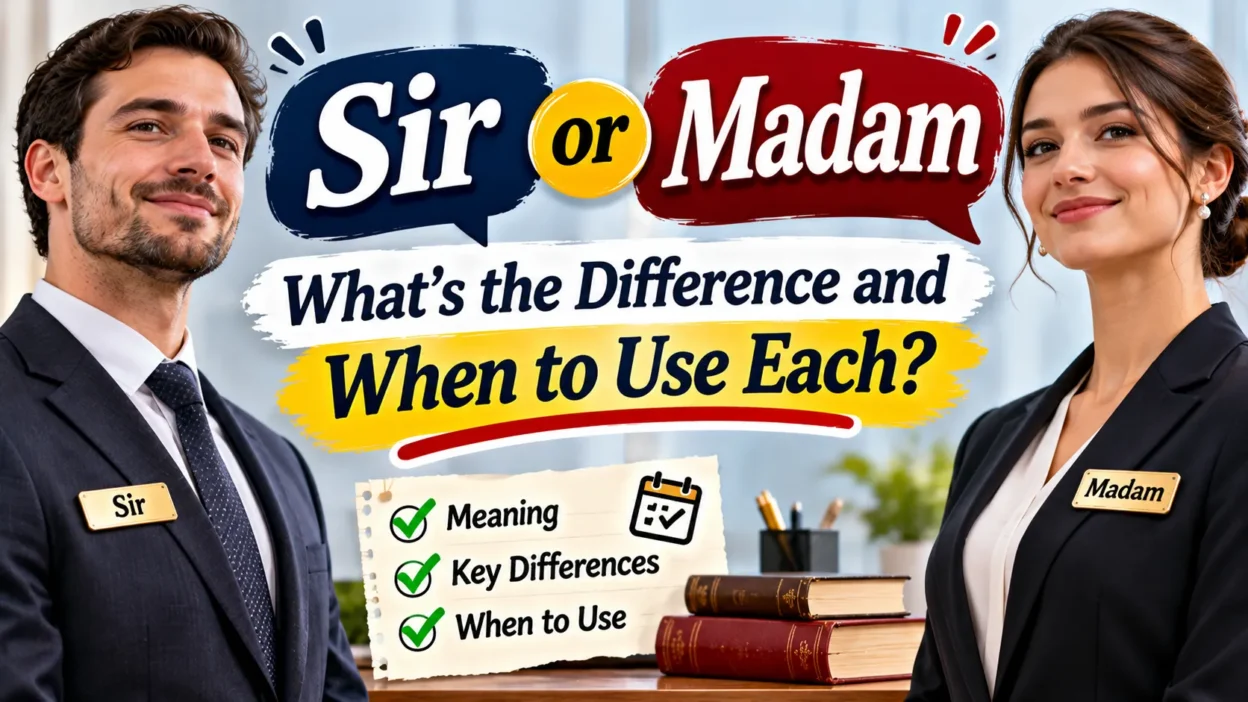
The phrase “Sir or Madam” has opened formal letters for generations, yet modern communication experts increasingly advise against it. The sir or madam debate centers on a simple question: is this traditional salutation still appropriate, or has it become outdated? The answer depends on context, audience, and your willingness to research your recipient.
However, this phrase carries risks. It can appear lazy, impersonal, and outdated in an era when finding someone’s name takes seconds . It also assumes a gender binary that excludes non-binary individuals . This comprehensive guide explains the difference between the terms, explores their origins, provides practical alternatives, and helps you choose the right greeting for every situation.
Quick Answer
However, most modern style guides recommend avoiding it. It is impersonal, outdated, and not fully gender-inclusive. Better alternatives include addressing the recipient by name, using a job title like “Dear Hiring Manager,” or using a gender-neutral greeting like “Dear Colleagues” .
Meaning Overview Table
| Aspect | Meaning |
|---|---|
| Definition | Formal terms of address: “Sir” for men, “Madam” for women, combined as a generic salutation for unknown recipients |
| Pronunciation | Sir: /sɜːr/; Madam: /ˈmædəm/ |
| Part of Speech | Nouns (titles of address) |
| Usage | “Dear Sir or Madam” opens formal letters to unknown recipients |
| Context | Formal correspondence, business letters, cover letters, official communications |
Main Meaning
Definition
Sir is a formal title of respect used to address a man, especially in British English and formal correspondence. Madam (or “Madame” in French contexts) is the female equivalent, used to address a woman formally. It combines both terms as a gender-inclusive salutation for situations where the writer does not know the recipient’s name, gender, or identity .
Origin
“Sir” derives from the Middle English sire, a variant of Old French sire, meaning “lord” or “master.” It ultimately traces to the Latin senior, meaning “older” or “elder.” The term became a standard title of respect in English by the 14th century.
“Madam” comes from the Old French ma dame, meaning “my lady,” which traces to the Latin mea domina (“my mistress” or “my lady”). The word entered English in the 14th century as a respectful term for a woman of rank.
It is used as a salutation emerged in the 19th century as a standard opening for formal letters when the recipient’s identity was unknown. Victorian letter-writing manuals prescribed it for addressing strangers .
Context
The sir or madam distinction matters across several contexts:
- Formal Correspondence: Traditional letters and official communications once used the phrase routinely
- Job Applications: Cover letters frequently used it, though modern advice discourages it
- Gender-Inclusive Language: The phrase assumes a binary gender system, excluding non-binary individuals
- Modern Business: Most style guides now recommend finding the recipient’s name or using a gender-neutral alternative
Modern Usage
Today,It appears less frequently in professional writing. Career advisors and communication experts consistently recommend avoiding it. The phrase signals a lack of research, feels impersonal, and may alienate recipients who do not identify as either of it . However, the individual words “Sir” and “Madam” remain in use in specific contexts, such as customer service, formal ceremonies, and British honors (knighthood).
Detailed Explanation
Literal Meaning
Literally, “Sir” means “lord” or “master,” and “Madam” means “my lady.” Both are titles of respect. It literally addresses “lord or lady”—a formal greeting to a person of unknown identity.
Common Meaning
Commonly, people understand as a polite way to begin a letter when you do not know who will read it. It signals formality and respect, though it also signals distance and impersonality.
Historical Meaning
Historically, “Sir” and “Madam” carried significant social weight. “Sir” indicated knighthood or social rank. “Madam” indicated a woman of authority or rank. Letter-writing manuals of the 19th century prescribed for addressing strangers, reflecting the rigid social conventions of the era .
Modern Business Meaning
In modern business,It has fallen out of favor. Recruiters and hiring managers view it as a sign that the applicant did not research the company or the recipient’s name. It can imply laziness or lack of interest . Contemporary advice recommends “Dear Hiring Manager,” “Dear [Department] Team,” or finding the specific person’s name.
Gender-Inclusive Meaning
The phrase fails to include people who do not identify as male or female. Non-binary individuals may not use “Sir” or “Madam.” Modern style guides recommend gender-neutral alternatives like “Dear Colleagues,” “Dear Recipients,” or simply “Hello” .
Examples Table
| Example | Meaning |
|---|---|
| Dear Sir or Madam, | Traditional salutation for unknown recipients |
| Dear Sir, | Formal address to a man whose name you don’t know |
| Dear Madam, | Formal address to a woman whose name you don’t know |
| Dear Hiring Manager, | Modern alternative for job applications |
| Dear [Company] Team, | Alternative addressing a department or group |
| Dear Colleagues, | Gender-neutral alternative for professional groups |
| To Whom It May Concern, | Generic greeting for organizations, not specific people |
| Hello, | Modern, informal alternative |
| Dear Professor Smith, | Specific, personalized greeting |
| Yours faithfully, | Traditional closing paired with “Dear Sir or Madam” |
Related Meanings Table
| Related Term | Meaning |
|---|---|
| Sir | Formal title for a man; also a title of knighthood |
| Madam | Formal title for a woman |
| Ma’am | Informal contraction of “Madam,” common in American English |
| Dear | A term of affection used in formal greetings |
| Salutation | The greeting at the beginning of a letter or email |
| To Whom It May Concern | Generic greeting for unknown recipients |
| Dear Hiring Manager | Specific alternative for job applications |
| Dear Colleagues | Gender-neutral greeting for professional groups |
| Gender-neutral language | Language that avoids assuming gender |
| Non-binary | A gender identity outside the male-female binary |
| Mx. | A gender-neutral title replacing Mr./Ms. |
| Yours faithfully | Traditional closing for “Dear Sir or Madam” |
| Yours sincerely | Closing for letters addressed to a named person |
| Sir/Madam | A shorthand version of “Sir or Madam” |
| Formal correspondence | Official letters and communications |
Common Uses
People use “Sir” and “Madam” across several contexts:
Customer Service: Representatives use when addressing customers whose names they do not know. This usage remains common in hospitality, retail, and formal service settings.
Formal Letters: Traditional correspondence once used routinely. Today, this usage has declined significantly in professional contexts .
British Honors: “Sir” remains the title for a knighted man in the UK. “Dame” is the female equivalent, not “Madam.”
Job Applications: Cover letters historically used but modern career advice strongly discourages it .
Official Ceremonies: “Madam” appears in formal introductions and ceremonial contexts, such as “Madam Speaker” or “Madam President.”
Common Mistakes
| Mistake | Correction |
|---|---|
| Using “Dear Sir or Madam” in a job application | Research the hiring manager’s name or use “Dear Hiring Manager” |
| Assuming “Sir or Madam” is gender-inclusive | It excludes non-binary individuals; use gender-neutral alternatives |
| Writing “Dear Sir/Madam” with a slash | Write it out as “Dear Sir or Madam” for formal correspondence |
| Using “Sir or Madam” when you know the recipient’s name | Always use the name if you can find it |
| Capitalizing “sir” and “madam” incorrectly | Capitalize them as titles: “Sir” and “Madam” |
| Using “Dear Sirs” for a mixed-gender group | Use “Dear Colleagues” or “Dear Team” |
| Ending with “Yours sincerely” after “Dear Sir or Madam” | Use “Yours faithfully” instead |
| Using “Madam” for a knighted woman | Use “Dame” for a female knight in the UK |
| Sending a mass email with “Dear Sir or Madam” | Personalize each message or use a generic greeting only for genuine bulk mail |
| Using “Sir or Madam” in casual emails | Use “Hello” or the person’s name |
Related Questions
Is “Dear Sir or Madam” still acceptable?
It is grammatically correct but widely discouraged in modern professional communication. Most career advisors and style guides recommend finding the recipient’s name or using a specific alternative like “Dear Hiring Manager” .
What is the female equivalent of “Sir”?
“Dame” is the female equivalent of “Sir” for knighthood in the UK. “Madam” is the general formal title for a woman, but it does not carry the same honorific status as knighthood .
Is “Sir or Madam” gender-inclusive?
No. It assumes a binary gender system and excludes people who identify as non-binary or who use gender-neutral titles. Modern style guides recommend gender-neutral alternatives .
What is the best alternative to “Dear Sir or Madam”?
The best alternative is always the recipient’s name: “Dear [First Name Last Name].” If you cannot find the name, use a job title (“Dear Hiring Manager”) or a department name (“Dear Sales Team”) .
When should I use “To Whom It May Concern” instead?
Use “To Whom It May Concern” when you are writing to an organization generally, not to a specific person. Use “Dear Sir or Madam” only when you intend the message for a specific person but do not know their name .
Is “Dear Sir or Madam” formal or informal?
It is formal, but also impersonal and outdated. Formality does not make it effective in modern communication .
FAQs
What does “Sir or Madam” mean?
“Sir” is a formal title for a man, and “Madam” is a formal title for a woman. Together, “Sir or Madam” is a salutation used when you do not know the recipient’s name or gender.
Is it “Sir or Madam” or “Sir/Madam”?
Both appear, but writing it out as “Sir or Madam” is preferred in formal correspondence. The slash form is less formal .
Should I use “Dear Sir or Madam” in a cover letter?
Most modern career advice recommends against it. Use the hiring manager’s name if possible, or “Dear Hiring Manager” if you cannot find it .
What is the correct closing for “Dear Sir or Madam”?
The traditional closing is “Yours faithfully.” For letters addressed to a named person, use “Yours sincerely” .
Is “Madam” still used today?
Yes, but less frequently. It appears in formal service contexts, ceremonies, and official titles (e.g., “Madam Speaker”). In everyday communication, people often prefer names or gender-neutral terms.
Can I use “Dear Sir or Madam” in an email?
You can, but it is generally not recommended. Email is often less formal than traditional letters, and using “Dear Sir or Madam” can feel stiff and impersonal .
What is a gender-neutral alternative to “Sir or Madam”?
Options include “Dear Colleagues,” “Dear Recipients,” “Dear Team,” “Hello,” or using the person’s job title or department name .
Why is “Dear Sir or Madam” considered outdated?
It signals a lack of research in an era when finding names is easy. It also fails to include people outside the gender binary, and it feels impersonal compared to modern alternatives .
Conclusion
The sir or madam distinction reveals a great deal about changing communication norms. “Sir” and “Madam” remain formal titles of respect, but the combined salutation “Dear Sir or Madam” has fallen out of favor. Modern professional communication values personalization, inclusivity, and research. Finding the recipient’s name takes seconds and signals genuine interest. When names are unavailable, specific alternatives like “Dear Hiring Manager” or “Dear Team” work better than the generic phrase. The words “Sir” and “Madam” still serve in customer service and ceremonial contexts, but as a letter opening, “Sir or Madam” belongs to an earlier era. Choose your salutation deliberately, and your reader will notice the care you took to address them properly.

Clara Morgan is a language and vocabulary writer passionate about making English easier to understand. At Wordestic, she creates clear and practical guides on word meanings, synonyms, antonyms, grammar, word differences, and commonly confused words.
Her writing focuses on simple explanations, useful examples, and everyday usage to help readers expand their vocabulary and communicate with greater confidence.