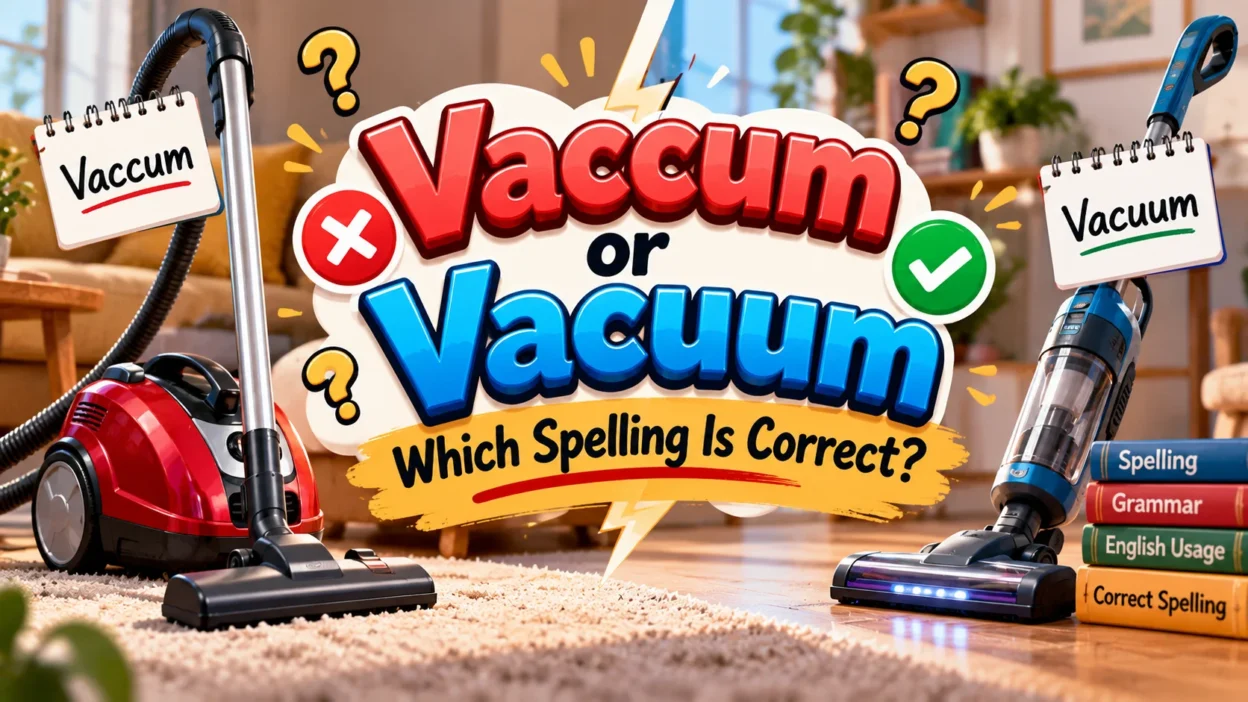
Spelling errors in English often stem from words that defy common phonetic patterns, and the vaccum or vacuum dilemma ranks among the most frequent. The word “vacuum” presents a unique challenge with its double “u” and single “c,” a combination that feels counterintuitive to many writers. This confusion leads countless people to type “vaccum,” “vacume,” or even “vacum” when referring to the absence of matter or the household cleaning device.
Understanding the correct spelling matters because “vaccum” is not a real word—it is simply a misspelling . The correct form, “vacuum,” has been part of the English language for centuries, carrying both scientific and everyday meanings . This comprehensive guide will help you master the spelling, understand the word’s origins, and avoid embarrassing mistakes in your writing.
Quick Answer
The correct spelling is vacuum—with one “c,” two “u’s,” and no “e.” “Vaccum” is a common misspelling that has no meaning in English. The word derives from the Latin adjective “vacuus,” meaning “empty” or “void,” and refers to a space devoid of matter or a device used for cleaning .
Meaning Overview Table
| Aspect | Meaning |
|---|---|
| Definition | A space devoid of matter; also a device that uses suction to clean |
| Pronunciation | /ˈvækjuːm/ (VAK-yoom) |
| Part of Speech | Noun, verb, adjective |
| Usage | “The vacuum of space contains no air.” / “I need to vacuum the carpet.” |
| Context | Physics, everyday household chores, engineering, science |
Main Meaning
Definition
Vacuum functions as a noun, verb, and adjective. As a noun, it refers to a space completely devoid of matter, or a device that uses suction to remove dirt and particles . As a verb, it means to clean with a vacuum cleaner. The word describes both a scientific concept and a common household appliance .
Origin
The word “vacuum” traces to the Latin adjective vacuus, meaning “vacant” or “void” . Latin speakers used “vacuum” as a noun form meaning “an empty space.” The word entered English in the 16th century during the Scientific Revolution, when physicists began studying the nature of empty space. Early experiments by scientists like Evangelista Torricelli and Otto von Guericke brought the concept into mainstream discourse .
Context
The word operates in several contexts:
- Physics and Science: Describing regions with extremely low pressure or complete absence of matter
- Household: Referring to the cleaning appliance and the act of cleaning
- Engineering: Vacuum technology used in manufacturing, electronics, and space exploration
- Everyday Language: Metaphorical use for feelings of emptiness or isolation
Modern Usage
Today, “vacuum” appears constantly in both technical and casual language. Scientists discuss vacuums in physics and chemistry. Homeowners vacuum their floors. The word also appears in phrases like “power vacuum” (political emptiness) and “vacuum of silence” (complete quiet) . The misspelling “vaccum” remains widespread despite being incorrect.
Detailed Explanation
Literal Meaning
Literally, “vacuum” means an empty space—a region containing no matter whatsoever. A perfect vacuum would contain zero atoms or molecules, though physicists acknowledge that creating a perfect vacuum is technically impossible . Even the vacuum of outer space contains a few hydrogen atoms per cubic meter .
Common Meaning
Commonly, people use “vacuum” to refer to the household cleaning device. When someone says “I need to vacuum,” they mean using the machine to remove dirt from floors and carpets . This everyday meaning often overshadows the scientific definition.
Scientific Meaning
In physics, a vacuum describes a space with gas pressure significantly lower than atmospheric pressure . The quality of a vacuum depends on how closely it approaches a perfect vacuum. Lower pressure means higher-quality vacuum. Ultra-high vacuum chambers operate below one trillionth of atmospheric pressure .
Historical Meaning
The concept of vacuum sparked intense debate among ancient philosophers. Aristotle argued that a vacuum was impossible because empty space would allow motion without resistance . This view persisted for centuries until experiments in the 17th century proved otherwise. Otto von Guericke’s famous 1654 experiment with the Magdeburg hemispheres demonstrated the power of vacuum pressure by showing that teams of horses could not pull apart two hemispheres once the air between them was removed .
Metaphorical Meaning
Beyond physics, “vacuum” describes emotional or social emptiness. People speak of a “vacuum in their lives” after a loss or major change. A “power vacuum” refers to a situation where no clear authority exists . These metaphorical uses extend the word’s literal meaning into emotional and political territory.
Examples Table
| Example | Meaning |
|---|---|
| The vacuum cleaner needs a new filter. | The cleaning device is broken |
| Space is a near-perfect vacuum. | Space contains very little matter |
| I need to vacuum the living room. | The action of cleaning with a vacuum |
| The power vacuum led to chaos. | Political emptiness or absence of authority |
| She felt a vacuum after moving away. | Emotional emptiness |
| The vacuum chamber simulates space conditions. | Scientific equipment for testing |
| Vacuum-packed food lasts longer. | Food sealed without air |
| The vacuum of silence was deafening. | Complete absence of sound |
| He used a vacuum pump to remove air. | Scientific equipment |
| Vacuum tubes were used in old radios. | Electronic components |
Related Meanings Table
| Related Term | Meaning |
|---|---|
| Vacuum cleaner | A device that uses suction to remove dirt |
| Vacuuming | The act of cleaning with a vacuum cleaner |
| Vacuum pump | A device that removes gas molecules from a sealed volume |
| Vacuum tube | An electronic component used in early electronics |
| Power vacuum | A political situation with no clear authority |
| Vacuum-packed | Food sealed in airtight packaging |
| Vacuum chamber | An enclosure from which air is removed |
| Magdeburg hemispheres | Famous vacuum experiment demonstrating air pressure |
| Vacuum of space | The near-empty region between celestial bodies |
| Partial vacuum | A space with reduced pressure but not completely empty |
| Torricellian vacuum | A vacuum created by inverting a mercury-filled tube |
| Ultra-high vacuum | Extremely low-pressure environment used in research |
| Vacuum energy | Quantum mechanical energy present in empty space |
| Vacuum fluctuation | Temporary changes in energy in empty space |
| Free space | A region with no matter or fields |
Common Uses
People use “vacuum” across numerous contexts:
Household Chores: The most common usage refers to cleaning floors and carpets. People vacuum regularly to maintain clean homes .
Scientific Research: Physicists and engineers use vacuums to study particle behavior and manufacture electronics. Vacuum technology enabled discoveries of the electron and subatomic particles .
Space Exploration: The vacuum of space poses unique challenges for spacecraft and astronauts. Engineers test equipment in vacuum chambers to simulate space conditions .
Food Preservation: Vacuum packing removes air from food packaging to extend shelf life and maintain freshness .
Politics and Business: “Power vacuum” describes situations where leadership is absent, often leading to instability.
Everyday Metaphors: People describe emotional emptiness as a “vacuum” in their lives.
Common Mistakes
| Mistake | Correction |
|---|---|
| Writing “vaccum” | The correct spelling is “vacuum” with one “c” |
| Writing “vacume” | Remove the “e”—the word ends in “uum” |
| Writing “vacum” | Include both “u’s”—”vacuum” has two |
| Writing “vacuumming” | The correct form is “vacuuming” (drop the second “m” concept) |
| Saying “vaccum cleaner” | Say “vacuum cleaner” with the correct spelling |
| Confusing the scientific and household meanings | Both use the same spelling—only the context differs |
| Assuming “vaccum” is an alternate spelling | “Vaccum” is never correct in any context |
| Misspelling the plural | The plural is “vacuums” or “vacua” |
| Forgetting the double “u” | The word has two consecutive “u’s”—a rare pattern |
| Using spell-check as the only guide | Spell-check may not catch all instances; learn the correct spelling |
Related Questions
Is it vacuum or vaccum?
The correct spelling is “vacuum.” “Vaccum” is always a misspelling with no accepted meaning .
Why is vacuum spelled with two u’s?
The word comes from Latin “vacuus,” and the double “u” reflects its Latin origins. English preserved the unusual spelling despite its rarity .
What does vacuum mean?
Vacuum has three main meanings: a space devoid of matter, a cleaning device, or the act of cleaning with such a device .
How do you spell vacuum in plural form?
The plural can be “vacuums” (common) or “vacua” (formal, scientific) .
What is a perfect vacuum?
A perfect vacuum is a space containing no matter whatsoever. Scientists consider it technically impossible to create .
Who discovered the vacuum?
Evangelista Torricelli produced the first laboratory vacuum in 1643. Otto von Guericke conducted famous demonstrations in 1654 .
FAQs
Is “vaccum” a word?
No. “Vaccum” is not a word in English. It is a common misspelling of “vacuum” .
Why do people misspell vacuum?
The double “u” followed by “m” is unusual in English. The pronunciation (/ˈvækjuːm/) does not clearly indicate the spelling, leading to errors .
What does “vaccum” mean?
Nothing. “Vaccum” has no meaning because it is not a real word .
How do you pronounce vacuum?
The correct pronunciation is /ˈvækjuːm/—”VAK-yoom.” The first syllable rhymes with “back,” and the second syllable sounds like “yoom” .
What is a vacuum in physics?
In physics, a vacuum is a space with gas pressure significantly lower than atmospheric pressure. Perfect vacuums contain no matter .
What is the Magdeburg experiment?
In 1654, Otto von Guericke demonstrated vacuum power by showing that teams of horses could not pull apart two hemispheres after air was removed from between them .
How do you use vacuum as a verb?
“I vacuum the floor every Saturday.” The verb form means to clean with a vacuum cleaner .
What is a power vacuum?
A power vacuum is a political situation where no single authority controls a region or organization, often leading to instability.
Conclusion
Mastering the vacuum spelling saves you from a common and embarrassing error. The correct form is always “vacuum”—one “c,” two “u’s,” no “e.” “Vaccum” is never correct, no matter the context. This word’s unusual spelling reflects its Latin origins, and its dual meanings as both a scientific concept and household appliance make it a versatile part of English vocabulary. Remember the simple rule: vacuum has one “c” and two “u’s.” Practice spelling it correctly, and you’ll avoid the “vaccum” trap that catches so many writers. Whether you’re discussing the vacuum of space, vacuuming your living room, or writing about a power vacuum, the correct spelling will serve you well.

Clara Morgan is a language and vocabulary writer passionate about making English easier to understand. At Wordestic, she creates clear and practical guides on word meanings, synonyms, antonyms, grammar, word differences, and commonly confused words.
Her writing focuses on simple explanations, useful examples, and everyday usage to help readers expand their vocabulary and communicate with greater confidence.