
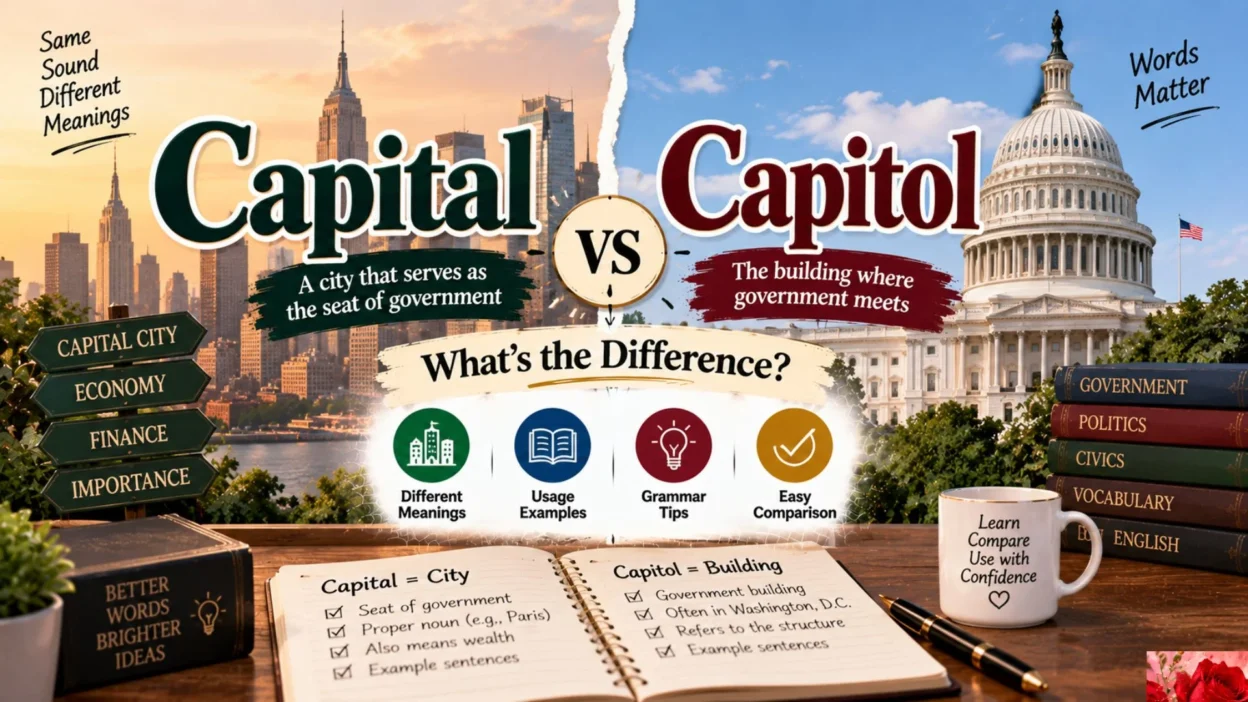
Few word pairs cause as much confusion in American English as “capital” and “capitol.” They sound identical when spoken, differ by a single letter when written, and appear in many of the same contexts—government, politics, and geography. Understanding the capital vs capitol distinction is essential for anyone who writes about government, travels to Washington, D.C., or simply wants to avoid embarrassing spelling errors in professional communication.
“Capital” is a versatile word with multiple meanings, including a city that serves as a seat of government, money used for investment, and uppercase letters. “Capitol” refers to a specific building where a legislature meets. The United States Capitol in Washington, D.C., is the most famous example, but many state capitols exist across the country. This comprehensive guide breaks down the difference with clear rules, memorable examples, and practical tips so you never mix them up again.
Quick Answer
The difference between capital and capitol is simple. “Capital” refers to a city that serves as a seat of government, money for investment, or uppercase letters. “Capitol” refers only to a building where a legislature meets. The U.S. Capitol houses Congress. State capitols house state legislatures. Remember: capital has many meanings; capitol has one.
Meaning Overview Table
| Aspect | Meaning |
|---|---|
| Definition | Two commonly confused words: “capital” has multiple meanings (city, money, letters); “capitol” refers to a legislative building |
| Pronunciation | Both: KAP-ih-tuhl |
| Part of Speech | Both are nouns (capital also functions as an adjective) |
| Usage | “Sacramento is the capital of California” vs. “The capitol building has a golden dome” |
| Context | Government, geography, finance, writing, typography |
Main Meaning
Definition
“Capital” is a noun and adjective with several distinct meanings. As a noun, it refers to a city that serves as the official seat of government, money or assets used for investment, or a capital letter. As an adjective, it describes something related to these concepts or something excellent. “Capitol” is a noun that refers specifically to a building where a legislative body meets. In the United States, “Capitol” with a capital C refers to the U.S. Capitol building in Washington, D.C.
Origin
Both words trace back to the Latin word caput, meaning “head.” “Capital” entered English through the Latin capitalis, meaning “of the head” or “chief.” Its meanings evolved to include the head city of a region (capital city), the head or principal sum of money (capital), and head letters (capital letters). “Capitol” derives from the Latin Capitolium, the name of the temple of Jupiter on the Capitoline Hill in ancient Rome. That temple served as a symbol of Roman government, and the name was later adopted for legislative buildings.
Context
The distinction matters in several settings:
- Government and Politics: “Capital” refers to the seat of government; “capitol” refers to the building
- Geography and Travel: “Capital” describes cities; “capitol” describes landmarks
- Finance and Business: “Capital” describes money and assets
- Writing and Typography: “Capital” describes uppercase letters
- Architecture and History: “Capitol” describes specific government buildings
Modern Usage
Today, both words appear frequently in news, travel writing, business, and education. Political journalists carefully distinguish between capitals (cities) and capitols (buildings). Financial writers discuss capital gains and venture capital. Teachers explain capitalization rules. Travelers visit state capitols and national capitols. The two words never overlap in meaning, despite their similar spellings.
Detailed Explanation
Literal Meaning
Literally, “capital” means “of the head” or “chief.” It describes the most important city, the principal sum of money, or the head letter of a word. “Capitol” literally names a specific building, originally the temple on Rome’s Capitoline Hill. Its literal meaning is the building itself.
Common Meaning
Commonly, people use “capital” to mean the city where a state or country’s government sits. They use “capitol” to mean the building where lawmakers meet. For example, “Austin is the capital of Texas” refers to the city. “The Texas Capitol is in Austin” refers to the building.
Financial Meaning
In finance, “capital” means money, assets, or resources used for investment. Common phrases include “capital gains,” “working capital,” “venture capital,” and “human capital.” “Capitol” never appears in financial contexts. Financial writers never confuse the two because the meanings are completely separate.
Typographical Meaning
In writing and typography, “capital” refers to uppercase letters, also called capital letters. “Capitalize” means to write with an initial capital letter. “Capitol” never appears in this context. Grammar guides and style manuals discuss capitalization rules without any reference to capitol buildings.
Architectural Meaning
In architecture and government, “capitol” refers to a building that houses a legislature. The U.S. Capitol in Washington, D.C., is the most famous example. State capitols exist in every U.S. state capital. Many feature distinctive domes, columns, and classical architecture. The word never describes the city, only the building.
Examples Table
| Example | Meaning |
|---|---|
| Washington, D.C., is the capital of the United States. | Capital = the city |
| The U.S. Capitol houses Congress. | Capitol = the building |
| Austin is the capital of Texas. | Capital = the city |
| The Texas Capitol has a pink granite dome. | Capitol = the building |
| She invested her capital in the stock market. | Capital = money or assets |
| Write your name in capital letters. | Capital = uppercase letters |
| Sacramento is the capital of California. | Capital = the city |
| The California Capitol is in Sacramento. | Capitol = the building |
| The company raised venture capital. | Capital = investment money |
| The dome of the Capitol is iconic. | Capitol = the building |
Related Meanings Table
| Related Term | Meaning |
|---|---|
| Capital city | The city that serves as a seat of government |
| Capital letter | An uppercase letter |
| Capital gains | Profits from selling assets |
| Working capital | Money available for daily operations |
| Venture capital | Investment in startup companies |
| Human capital | The value of skills and knowledge |
| Capital punishment | The death penalty |
| Capital offense | A crime punishable by death |
| Capitol building | A building where a legislature meets |
| U.S. Capitol | The building in Washington, D.C., where Congress meets |
| State capitol | A building where a state legislature meets |
| Capitol Hill | The neighborhood in Washington, D.C., where the Capitol sits |
| Capitoline Hill | The ancient Roman hill where the original Capitolium stood |
| Capitolium | The Latin name for the temple of Jupiter |
| Capitalization | The act of writing in capital letters |
Common Uses
People use “capital” and “capitol” across many professional and everyday contexts:
News and Journalism: Political reporters distinguish carefully between capitals and capitols. “The capital was abuzz with rumors” refers to the city. “Protesters gathered at the Capitol” refers to the building.
Travel and Tourism: Travel writers describe capital cities and their capitols. Visitors tour state capitols and the U.S. Capitol. Travel guides list capital cities as destinations and capitols as landmarks.
Finance and Business: Financial professionals discuss capital regularly. “Capital investment,” “capital gains,” “capital expenditures,” and “capital markets” appear in business writing daily. “Capitol” never appears in financial contexts.
Education: Teachers explain both words to students. Students learn that “capital” describes cities and money, while “capitol” describes buildings. Spelling tests often include both words to reinforce the difference.
Government and Law: Legal and government documents use both words precisely. Laws refer to “capital offenses” and “capital punishment.” Official documents refer to “the Capitol” when describing the building.
Common Mistakes
| Mistake | Correction |
|---|---|
| Writing “Capitol” when referring to a city | Use “capital” for cities: “Austin is the capital of Texas.” |
| Writing “capital” when referring to a building | Use “capitol” for buildings: “The capitol has a dome.” |
| Using “capitol” for money or investment | Use “capital” for money: “She raised capital for her business.” |
| Writing “capitol letters” instead of “capital letters” | Use “capital” for uppercase letters: “Write in capital letters.” |
| Confusing “Capitol Hill” with “Capital Hill” | The neighborhood is “Capitol Hill” because it contains the Capitol building. |
| Writing “capitol punishment” | Use “capital punishment”—the punishment involves the head (historically) or life. |
| Using “capital” when referring specifically to the U.S. Capitol | Use “Capitol” for the building: “We toured the U.S. Capitol.” |
| Mixing up “state capital” and “state capitol” | Capital = city; capitol = building. Know which you mean. |
| Writing “capital building” | Use “capitol building” for legislative buildings. |
| Assuming the words are interchangeable | They are never interchangeable—they have completely different meanings. |
Related Questions
What is the difference between capital and capitol?
“Capital” refers to a city, money, or uppercase letters. “Capitol” refers only to a building where a legislature meets. Capital has many meanings; capitol has one.
Is it “Capital Hill” or “Capitol Hill”?
It is “Capitol Hill.” The neighborhood in Washington, D.C., takes its name from the Capitol building that sits there. “Capital Hill” is incorrect.
What is the capital of the United States?
Washington, D.C., is the capital of the United States. It is a city, not a building, so it uses “capital.”
Where is the U.S. Capitol located?
The U.S. Capitol is in Washington, D.C. It sits on Capitol Hill at the eastern end of the National Mall.
What does capital mean in business?
In business, capital means money or assets used for investment. Examples include working capital, venture capital, and capital gains.
What does capital mean in writing?
In writing, capital refers to uppercase letters. “Capitalize” means to write with an initial capital letter.
Why do capital and capitol sound the same?
Both words come from the Latin caput, meaning “head.” They evolved differently but retained similar pronunciations. Only the spelling and meaning distinguish them.
Is capitol always capitalized?
“Capitol” is capitalized when referring to a specific building, like the U.S. Capitol or the Texas Capitol. When used generically, it is lowercase: “The state capitol is downtown.”
FAQs
What is a capital city?
A capital city is the city that serves as the official seat of government for a country, state, or region. Examples include Washington, D.C., London, and Tokyo.
What is a capitol building?
A capitol building is a structure where a legislative body meets. The U.S. Capitol houses Congress. State capitols house state legislatures.
Is Washington, D.C., a capital or capitol?
Washington, D.C., is a capital city. It contains the U.S. Capitol building, but the city itself is the capital.
What is capital punishment?
Capital punishment is the death penalty. The term uses “capital” because the punishment historically involved the head or because it is the most severe punishment.
What are capital gains?
Capital gains are profits from selling assets like stocks, bonds, or real estate. The term uses “capital” because it refers to money and investment.
What does capitalization mean?
Capitalization refers to writing words with capital letters. It also refers to the total value of a company’s stocks and bonds.
Can capitol ever mean a city?
No. “Capitol” always refers to a building. It never describes a city, money, or letters.
Why do people confuse capital and capitol?
They sound identical and differ by one letter. Their shared Latin root adds to the confusion. Only careful attention to meaning prevents errors.
Conclusion
The capital vs capitol distinction comes down to meaning, not sound. “Capital” is a multi-purpose word that describes cities, money, and uppercase letters. “Capitol” is a single-purpose word that describes a legislative building. Remember the simple rule: if you mean a city, money, or letters, use “capital.” If you mean the building where lawmakers meet, use “capitol.” The U.S. Capitol sits in Washington, D.C., the nation’s capital. State capitols sit in state capitals. This one-letter difference carries real weight in government, finance, and geography writing. Master it, and your writing will gain precision and credibility.

Clara Morgan is a language and vocabulary writer passionate about making English easier to understand. At Wordestic, she creates clear and practical guides on word meanings, synonyms, antonyms, grammar, word differences, and commonly confused words.
Her writing focuses on simple explanations, useful examples, and everyday usage to help readers expand their vocabulary and communicate with greater confidence.