Few word pairs in English cause as much hesitation as “farther” and “further.” Both words look similar, sound almost identical, and relate to the concept of distance. Yet careful writers and speakers distinguish between them. Understanding the farther or further distinction helps you write with precision and avoid the kind of subtle errors that mark a careful stylist.
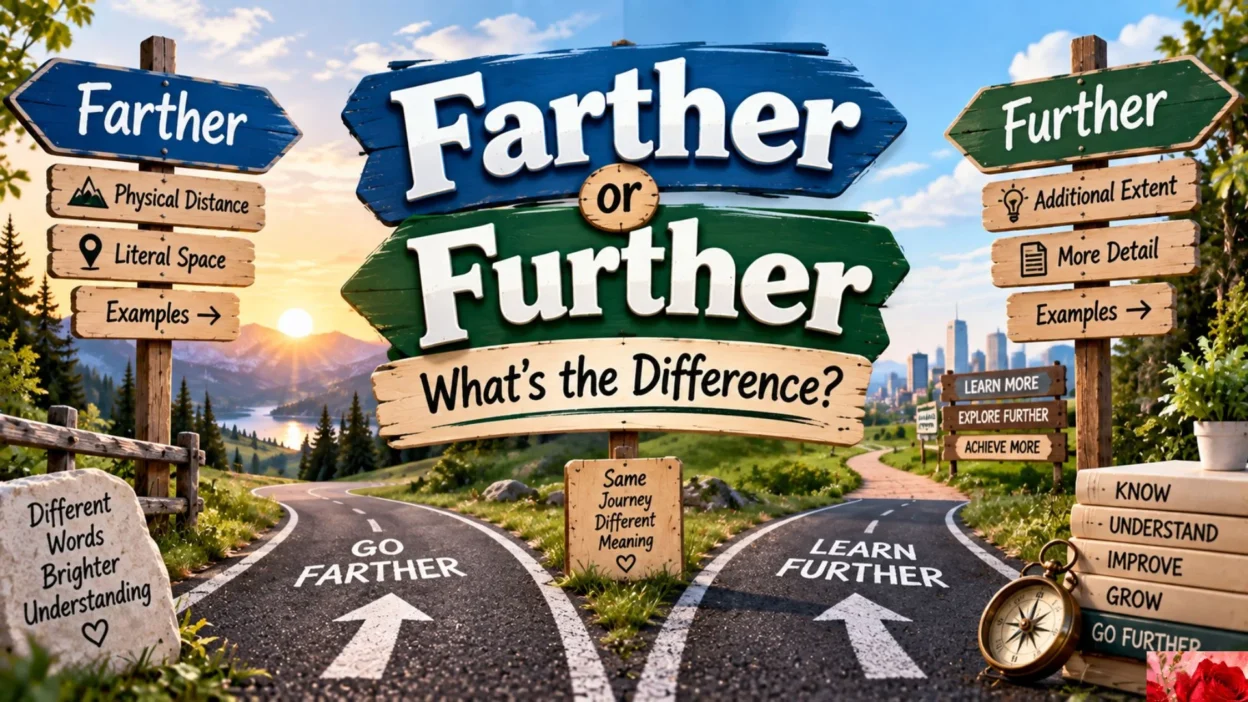
The traditional rule is simple: it refers to physical distance, while “further” refers to figurative or metaphorical distance. You walk down the road, but you discuss a topic further. However, this rule has never been absolute. These words have been used interchangeably throughout most of their history, and modern usage is more flexible than many people realize . This comprehensive guide explores the origins, meanings, and practical applications of both words, helping you choose the right one with confidence.
Quick Answer
The difference between farther and further comes down to distance type. It refers to physical, measurable distance—like walking down a street. “Further” refers to figurative or metaphorical distance—like discussing a topic further. However, both words are often used interchangeably for distance, and “further” is the only correct choice when meaning “additional,” “moreover,” or “to promote.”
Meaning Overview Table
| Aspect | Meaning |
|---|---|
| Definition | Two comparative forms of “far,” distinguished primarily by physical versus figurative distance |
| Pronunciation | Farther: FAR-thur; Further: FUR-thur |
| Part of Speech | Both can be adverbs or adjectives; only “further” can be a verb |
| Usage | “Walk farther down the road” vs. “Discuss the matter further” |
| Context | Formal writing, academic prose, everyday speech, professional communication |
Main Meaning
Definition
“Farther” is the comparative form of “far” that primarily describes physical, measurable distance. It answers the question “How far?” in terms of miles, meters, blocks, or other measurable units. “Further” is the comparative form that describes figurative or metaphorical distance—the extent of progress, degree, or addition. It also functions as a sentence adverb meaning “moreover” and as a verb meaning “to promote” or “to advance” .
Origin
“Further” is the older of the two words, dating back to Old English. It emerged as a variant in Middle English during the 14th century, likely influenced by the word “far” . For much of their history, both words were used interchangeably. The distinction between physical and figurative distance developed gradually, and it is more of a usage preference than an absolute rule . Interestingly, the word “far” inside it is etymologically unrelated—”farther” actually derives from “further,” not from “far” .
Context
The distinction operates across several settings:
- Formal Writing: Style guides often recommend reserving “farther” for literal distance and “further” for figurative distance
- Academic Prose: “Further” is preferred for meanings of addition or degree
- Everyday Speech: Most speakers use the words interchangeably without notice
- British vs. American English: British English uses “further” for both literal and figurative distance more often than American English
Modern Usage
Today, usage has shifted significantly. “Further” now dominates in most contexts, including literal distance. Corpus data shows that since the 1830s, “go further” has been more common than go in published works. Since 2000, “walk further” has been significantly more common than “walk farther” . The traditional distinction remains useful for careful writers, but using “further” for physical distance is no longer considered an error by most authorities .
Detailed Explanation
Literal Meaning
Literally, “farther” means at a greater physical distance. If you can measure the distance in miles, meters, or steps, is the traditional choice. “Further” literally means to a greater extent or degree, though it also covers physical distance in modern usage.
Common Meaning
Commonly, people use “farther” for visible, measurable distance and “further” for abstract progress. The memory trick is simple: it contains the word “far,” which reminds you of physical distance . “Further” covers everything else—addition, degree, and advancement.
Adverbial Meaning
As adverbs, both words mean “at or to a greater distance or more advanced point.” When used for spatial, temporal, or metaphorical distance, they remain interchangeable . However, “further” has additional adverbial meanings that “farther” lacks. “Further” can mean “moreover” or “additionally,” functioning as a sentence modifier. You would never begin a sentence with “Farther, I’d like to add…” .
Adjectival Meaning
As adjectives, both words mean “more distant.” “The word shore” and “the further shore” are both acceptable. However, when the meaning shifts to “additional,” only “further” works. “Further research is needed” is correct; “farther research” is not .
Verbal Meaning
Only “further” functions as a verb. To “further” something means to promote, advance, or help it progress. You can “further your career” or “further a cause,” but you can never “farther” anything .
Examples Table
| Example | Meaning |
|---|---|
| The store is farther down the street. | Physical distance that can be measured |
| We need further discussion before deciding. | Additional discussion; figurative distance |
| She walked farther than anyone else. | Physical distance covered on foot |
| Nothing could be further from the truth. | Figurative distance from accuracy |
| Further, the report notes a decline. | Adverbial use meaning “moreover” |
| He furthered his education abroad. | Verbal use meaning “advanced” |
| The farther side of town is quieter. | Physical distance across a town |
| I have no further questions. | Additional questions; not distance |
| Drive farther into the mountains. | Physical distance into terrain |
| The situation needs further investigation. | Additional investigation; figurative |
Related Meanings Table
| Related Term | Meaning |
|---|---|
| Far | At or to a considerable distance |
| Farther | Comparative form of far for physical distance |
| Further | Comparative form for figurative distance, addition, or advancement |
| Farthest | Superlative form for physical distance |
| Furthest | Superlative form for figurative distance or degree |
| Additionally | Synonym for further as an adverb |
| Moreover | Synonym for further as a sentence adverb |
| Promote | Synonym for further as a verb |
| Advance | Synonym for further as a verb |
| Remote | Distant; related to farther |
| Additional | Meaning of further as an adjective |
| Distance | The concept both words describe |
| Measurable | Describes the type of distance farther covers |
| Figurative | Describes the type of distance further covers |
| Extent | Degree or scope, described by further |
| Progress | Advancement, related to further as a verb |
| Beyond | At a greater distance |
| Comparative | Grammatical form both words share |
Common Uses
People use “farther” and “further” across numerous contexts:
Everyday Navigation: When giving directions, speakers often say “drive farther” or “walk further” without distinguishing. Both are acceptable, though “farther” remains the traditional choice for measurable distance.
Academic and Professional Writing: Writers in these contexts follow style guide recommendations. They use of this word for literal distance and “further” for addition or degree. This distinction signals careful attention to language .
Legal and Formal Documents: Legal writers use “further” extensively for meanings of addition and advancement. Phrases like “further to your letter” and “further action” are standard .
British English: British speakers and writers use “further” for both literal and figurative distance far more often than Americans. In British English, “farther” is sometimes seen as an Americanism .
Language Learning: Teachers often present the traditional rule—farther for physical distance, further for figurative—as a clear guideline for students. However, advanced learners discover the nuance through exposure .
Common Mistakes
| Mistake | Correction |
|---|---|
| Using “farther” for “additional” | Use “further” for additional: “further information,” not “farther information” |
| Using “farther” as a verb | Only “further” is a verb: “further your career,” not “farther your career” |
| Using “farther” to mean “moreover” | Only “further” works as a sentence adverb: “Further, …” not “Farther, …” |
| Insisting on strict rules in British English | British English uses “further” for physical distance; this is not an error |
| Correcting others who use “further” for distance | Modern usage accepts “further” for distance; it is not wrong |
| Using “farther” when unsure | “Further” is always safe; it works in every context |
| Assuming the distinction is absolute | The distinction is a usage preference, not a hard rule |
| Confusing “farther” with “father” in pronunciation | Farther is pronounced FAR-thur; father is FAH-thur |
| Thinking “farther” derives from “far” | Etymologically, “farther” derives from “further,” not “far” |
| Using “farther” in academic writing for addition | Academic style prefers “further” for all non-distance meanings |
Related Questions
Is it “farther” or “further” for figurative distance?
“Further” is the standard choice for figurative or metaphorical distance. However, It occasionally appears in these contexts in published writing .
Can “further” always replace “farther”?
Yes. “Further” works in every context where “farther” works, plus many where “farther” does not. If you want a safe choice, always use “further” .
What is the difference between “farther” and “further” in British English?
British English uses “further” for both literal and figurative distance far more often than American English. “Farther” in British English is sometimes perceived as an Americanism .
What is the superlative form of these words?
The superlative forms are “farthest” and “furthest.” “Farthest” is preferred for physical distance; “furthest” is preferred for figurative distance .
How do I remember the difference?
Think of “far” inside “farther” to remind yourself of physical distance. “Further” covers everything else—addition, degree, and advancement .
FAQs
What does “farther” mean?
It means at or to a greater physical distance. It describes measurable space, like miles, meters, or blocks .
What does “further” mean?
“Further” means to a greater extent or degree, or additional. It also functions as a verb meaning to promote or advance .
Can you use “further” for physical distance?
Yes. “Further” is widely accepted for physical distance, and corpus data shows it is now more common than “farther” in many contexts .
Is “farther” always wrong for figurative distance?
Not always wrong, but “further” is strongly preferred. “Farther” in figurative contexts sounds awkward to many ears .
What is the rule for “farther” vs. “further”?
The traditional rule: “farther” for physical distance, “further” for figurative distance. But modern usage allows “further” in both contexts .
Why do people confuse “farther” and “further”?
The words sound almost identical, especially in fast speech. They also share most of their history and meanings, making the distinction subtle .
Which word is older?
“Further” is older, dating to Old English. It emerged in Middle English as a variant .
What is the safest choice?
“Further” is always safe. It works in every context, and no authority considers it incorrect .
Conclusion
The farther or further distinction represents one of English’s finer points. It traditionally covers physical, measurable distance, while “further” handles figurative distance, addition, and advancement. However, language evolves, and modern usage has blurred these lines. Corpus data shows “further” now dominates even in literal distance contexts, and most authorities accept it everywhere. If you want to follow the traditional rule, use it for miles and “further” for everything else. If you want a safe choice that no one will criticize, use “further” every time. The key is understanding that this distinction is a usage preference, not an absolute law. Master it, and your writing will gain subtle precision. Recognize its flexibility, and you’ll avoid unnecessary anxiety over a rule that even experts treat gently.

Clara Morgan is a language and vocabulary writer passionate about making English easier to understand. At Wordestic, she creates clear and practical guides on word meanings, synonyms, antonyms, grammar, word differences, and commonly confused words.
Her writing focuses on simple explanations, useful examples, and everyday usage to help readers expand their vocabulary and communicate with greater confidence.