
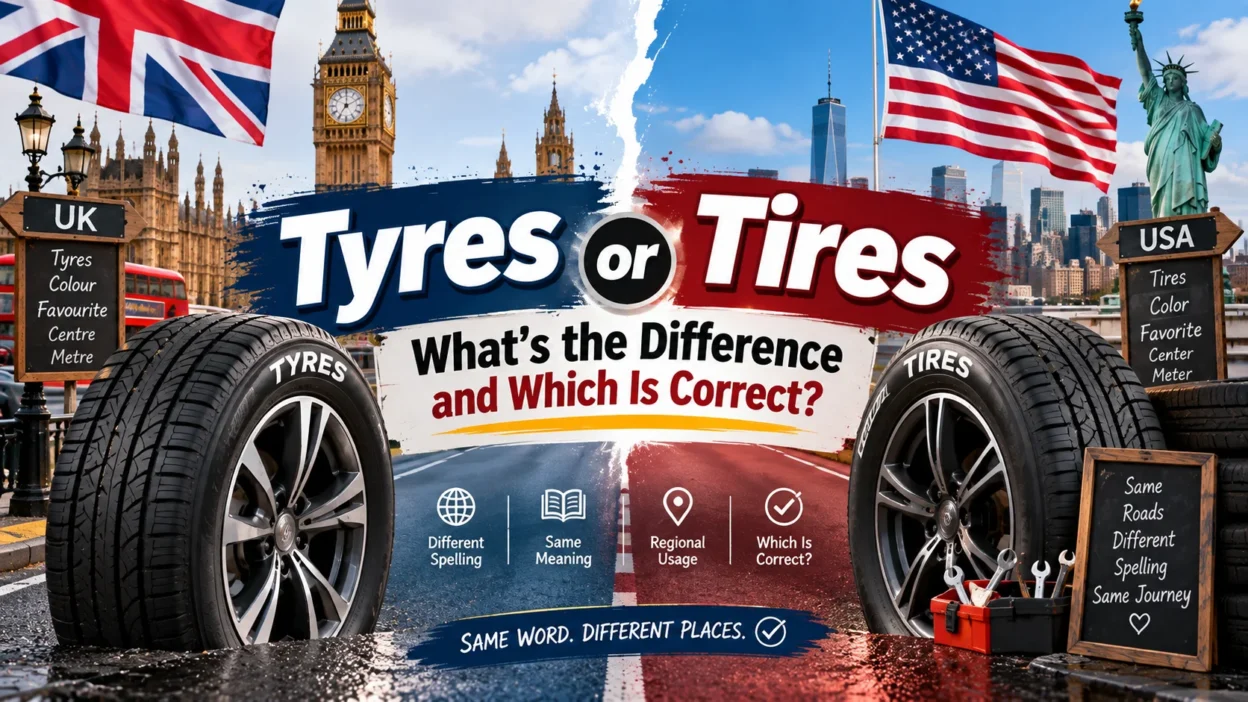
Few spelling debates cause as much confusion as the tyres or tires question. Both spellings describe the same essential component—the rubber ring that wraps around a vehicle’s wheel—yet the choice between them depends entirely on where you live and who you’re writing for. The distinction is not a matter of right versus wrong but rather a reflection of regional language conventions that have developed over centuries.
“Tire” is the standard American English spelling, while “tyre” is the standard British English spelling . The word “tyre” is actually the older of the two forms, with its use dating back to the 15th century. However, American English adopted the simplified “tire” spelling, and both versions have coexisted ever since . Today, your choice between tyres and tires signals your audience, your region, and your attention to linguistic detail. This comprehensive guide explains everything you need to know about the tyres versus tires debate.
Quick Answer
The difference between tyres and tires is purely regional spelling. “Tires” is the standard American English spelling, used in the United States and Canada. “Tyres” is the standard British English spelling, used in the UK, Ireland, Australia, New Zealand, and other Commonwealth countries . Both words mean the same thing: the rubber covering on a wheel. “Tire” also functions as a verb meaning “to become weary,” while “tyre” has no such secondary meaning .
Meaning Overview Table
| Aspect | Meaning |
|---|---|
| Definition | The rubber component fitted around a vehicle’s wheel; spelled “tire” in American English and “tyre” in British English |
| Pronunciation | Both: TAHY-er (identical pronunciation) |
| Part of Speech | Noun (the rubber wheel covering); “tire” can also be a verb (to become weary) |
| Usage | “I need new tires for my car” (US) vs. “I need new tyres for my car” (UK) |
| Context | Automotive, transportation, manufacturing, everyday language |
Main Meaning
Definition
A tire (American English) or tyre (British English) is a thick piece of rubber fitted around the rim of a wheel. It provides traction, absorbs shock, and protects the wheel itself . The spelling difference reflects broader patterns in how American and British English diverged over centuries.
Origin
The word’s history is more complex than most people realize. The original spelling “tyre” appeared in the late 15th century, referring to the iron plates that formed the rim of a carriage wheel . The term likely derives from “attire,” reflecting the idea that the metal band “dressed” or “covered” the wheel .
Meanwhile, a separate noun “tire” existed around the same time, meaning “dress or covering.” A verb “tire” (meaning to become weary) appeared even earlier. To avoid confusion between the wheel covering and the act of growing tired, “tyre” was used for the wheel component .
By the 17th and 18th centuries, spelling had shifted worldwide to “tire” for wheel rims. Then, in the 1800s, the British decided to revive the “tyre” spelling, while Americans kept “tire” for all meanings . When pneumatic tires were introduced in the late 19th century, each region adopted its preferred spelling independently .
Context
The choice between tyres and tires depends on your audience:
- American English: “Tire” is used for both the noun (wheel covering) and the verb (to weary)
- British English: “Tyre” is used exclusively for the wheel covering, while “tire” is reserved for the verb meaning “to weary”
- Canadian English: Follows American conventions, using “tire”
- Australian/New Zealand English: Follows British conventions, using “tyre”
Modern Usage
Today, both spellings are considered correct within their respective regions. The internet has created some crossover, with users encountering both forms regularly. However, style guides remain consistent: American publications use “tire,” and British publications use “tyre.” Global tire manufacturers adapt their branding accordingly—Michelin’s UK site uses “tyres,” while its US site uses “tires” .
Detailed Explanation
Literal Meaning
Literally, both “tyre” and “tire” refer to the same physical object: the rubber ring that surrounds a wheel, providing grip, cushioning, and protection. There is no difference in meaning, only in spelling convention .
Common Meaning
In everyday usage, people use these words to discuss vehicle maintenance, replacement, and performance. A driver might complain about a flat tire (US) or a flat tyre (UK). A mechanic might recommend new tires (US) or tyres (UK). The meaning remains identical across regions.
Text Meaning
In written communication, the spelling signals your audience and region. Using “tyre” in an American publication would appear foreign or incorrect, just as “tire” would look wrong in a British newspaper. Editors and proofreaders enforce these conventions rigorously.
Internet Meaning
Online, the two spellings coexist, sometimes causing confusion. Search engines typically treat “tyre” and “tire” as related but distinct queries. International websites often use one spelling consistently, while user-generated content may mix both. The internet has also popularized the “tyre vs tire” debate as a topic of linguistic curiosity.
Cultural Meaning
Culturally, the spelling choice reflects national identity and linguistic heritage. The British “tyre” represents a deliberate preservation of a distinctive spelling tradition, while the American “tire” reflects the broader American tendency toward simplified spelling . This mirrors other transatlantic spelling differences, such as “colour” versus “color” and “centre” versus “center” .
Industry Meaning
The tire industry uses both spellings strategically. Companies like Apollo Tyres use “tyre” to reflect their Indian heritage and Commonwealth markets . American manufacturers like Goodyear and Continental’s US division use “tire” . This branding choice signals target markets and regional identity.
Examples Table
| Example | Meaning |
|---|---|
| “I need to replace my car tires.” | American English; refers to the rubber wheel coverings |
| “I need to replace my car tyres.” | British English; same meaning |
| “Check your tire pressure regularly.” | American usage; maintenance advice |
| “Check your tyre pressure regularly.” | British usage; identical advice |
| “He was tired after the long drive.” | “Tire” as a verb meaning weary; used in both regions |
| “The spare tyre is in the trunk.” | British usage; note “trunk” is also American—”boot” in UK |
| “The spare tire is in the boot.” | British usage with British vocabulary throughout |
| “Winter tires improve snow traction.” | American spelling |
| “Winter tyres improve snow traction.” | British spelling |
| “Tire manufacturers invest in research.” | American spelling |
| “Tyre manufacturers invest in research.” | British spelling |
| “I tire of these endless debates.” | Verb usage; “tire” means to become weary |
| “The tyre was punctured by a nail.” | British English; past tense describes damage |
| “The tire was punctured by a nail.” | American English; same meaning |
| “Run-flat tires allow limited driving.” | American English; technical term |
Related Meanings Table
| Related Term | Meaning |
|---|---|
| Tire (verb) | To become weary or exhausted; used in both American and British English |
| Tyre (proper noun) | An ancient Phoenician city in modern Lebanon; pronounced differently |
| Pneumatic tire/tyre | A tire filled with compressed air; the standard modern design |
| Spare tire/tyre | A backup wheel covering; also slang for abdominal fat |
| Run-flat tire/tyre | A tire designed to continue functioning after pressure loss |
| Snow tire/tyre | A tire designed for winter conditions |
| All-season tire/tyre | A tire suitable for year-round use |
| Tire pressure | The amount of air inside a tire, measured in PSI |
| Tire tread | The grooved surface of a tire that provides traction |
| Tire rotation | The practice of moving tires between wheel positions for even wear |
| Wheel | The metal rim that the tire mounts onto; distinct from the tire itself |
| Rim | The outer edge of a wheel; often used interchangeably with “wheel” |
| Rubber | The primary material used in tire manufacturing |
| Vulcanization | The chemical process that strengthens rubber for tires |
| Treadwear | A tire’s durability rating; part of UTQG standards |
Common Uses
People use “tire” and “tyre” across numerous contexts:
Automotive Maintenance: Drivers regularly discuss tire/tyre pressure, tread depth, rotation schedules, and replacement needs. American drivers check their “tires,” while British drivers check their “tyres.”
Vehicle Purchasing: When buying a car, specifications list tire/tyre size, brand, and type. American dealerships advertise “tires,” while British dealerships advertise “tyres.”
International Business: Companies adapt their marketing materials to regional spelling conventions. A global tire manufacturer might use “tire” on its US website and “tyre” on its UK site .
Travel and Tourism: Rental car agreements, driving guides, and road signs in different countries use the local spelling. A tourist in the UK will see “tyre” on garage signs, while a tourist in the US will see “tire.”
Academic and Technical Writing: Style guides dictate spelling based on publication region. American academic journals require “tire,” while British journals require “tyre.”
Common Mistakes
| Mistake | Correction |
|---|---|
| Using “tyre” in American English writing | Use “tire” for US audiences |
| Using “tire” in British English writing about wheels | Use “tyre” for UK audiences when referring to the wheel component |
| Confusing “tyre” with the verb “tire” | “Tire” as a verb means to weary; “tyre” is never a verb |
| Assuming “tyre” is a misspelling | “Tyre” is the correct British spelling, not an error |
| Mixing spellings within a single document | Choose one convention and apply it consistently |
| Using “tire” to mean both the noun and verb in British English | In British English, “tyre” is the noun, “tire” is the verb |
| Thinking “tyre” is only used in the UK | “Tyre” is used across the Commonwealth, including Australia, New Zealand, and India |
| Believing “tire” is only used in the US | “Tire” is also standard in Canada |
| Pronouncing the two words differently | Both are pronounced identically: “TAHY-er” |
| Assuming one spelling is “more correct” | Both are correct within their respective regions |
Related Questions
Is it “tire” or “tyre” in the UK?
In the UK, the correct spelling for the rubber wheel covering is “tyre.” The verb meaning “to become weary” is spelled “tire” .
Why do Americans say “tire” and British say “tyre”?
The British revived the older “tyre” spelling in the 1800s to distinguish the wheel component from the verb “tire” (to weary). Americans retained “tire” for all meanings .
Is “tyre” wrong in America?
“Tyre” is not wrong, but it is non-standard in American English. American readers may perceive it as a British import or a misspelling.
What is the plural of “tyre”?
The plural of “tyre” is “tyres.” The plural of “tire” is “tires” .
Does “tire” have another meaning?
Yes. “Tire” is also a verb meaning “to become weary or exhausted,” as in “I tire of this conversation.” This meaning is used in both American and British English .
What is a “spare tyre”?
A “spare tyre” is a backup wheel covering kept in a vehicle. In British slang, it can also refer to excess fat around the waist.
Is it “tire” in Canada?
Yes. Canadian English follows American conventions for this word, using “tire” .
Which spelling is older?
“Tyre” is the older spelling, dating to the 15th century. “Tire” for wheel coverings became widespread in the 17th and 18th centuries .
FAQs
What is the difference between tyres and tires?
There is no difference in meaning. “Tires” is the American English spelling, and “tyres” is the British English spelling .
Which spelling should I use?
Use “tire” for American audiences and “tyre” for British, Australian, New Zealand, and most Commonwealth audiences. When in doubt, match the spelling convention of your target publication or region .
Is “tyre” a misspelling?
No. “Tyre” is the correct spelling in British English and many Commonwealth countries .
Why does “tire” mean both a wheel covering and being weary?
The two meanings come from different origins. The verb “tire” (to weary) is older, while the noun “tire” (wheel covering) emerged later. American English uses “tire” for both, while British English uses “tyre” for the noun .
What is the correct spelling in Australia?
Australian English follows British conventions, using “tyre” for the wheel component and “tire” for the verb meaning “to weary” .
Is “tyre” used in India?
Yes. India, as a Commonwealth country with historical British influence, uses “tyre” as the standard spelling. Companies like Apollo Tyres use this spelling in their branding .
Can I use “tire” and “tyre” interchangeably?
You can, but doing so within a single document or for a single audience may confuse readers. Choose one convention and apply it consistently.
What do tire manufacturers use?
Tire manufacturers adapt to their markets. American brands like Goodyear use “tire,” while brands targeting Commonwealth markets, like Apollo Tyres, use “tyre” .
Conclusion
The tyres or tires debate comes down to one simple fact: both spellings are correct, just in different regions. “Tires” is the standard American English spelling, used in the United States and Canada. “Tyres” is the standard British English spelling, used in the UK, Australia, New Zealand, India, and other Commonwealth countries. The word’s history reveals a fascinating journey from 15th-century iron wheel bands to modern rubber rings, with the British deliberately reviving “tyre” in the 1800s to distinguish the noun from the verb “tire” (to weary). Whether you’re writing for an American or British audience, the key is consistency. Choose the spelling that matches your region and audience, and apply it throughout your writing. Both tyres and tires will get you where you need to go.

Clara Morgan is a language and vocabulary writer passionate about making English easier to understand. At Wordestic, she creates clear and practical guides on word meanings, synonyms, antonyms, grammar, word differences, and commonly confused words.
Her writing focuses on simple explanations, useful examples, and everyday usage to help readers expand their vocabulary and communicate with greater confidence.