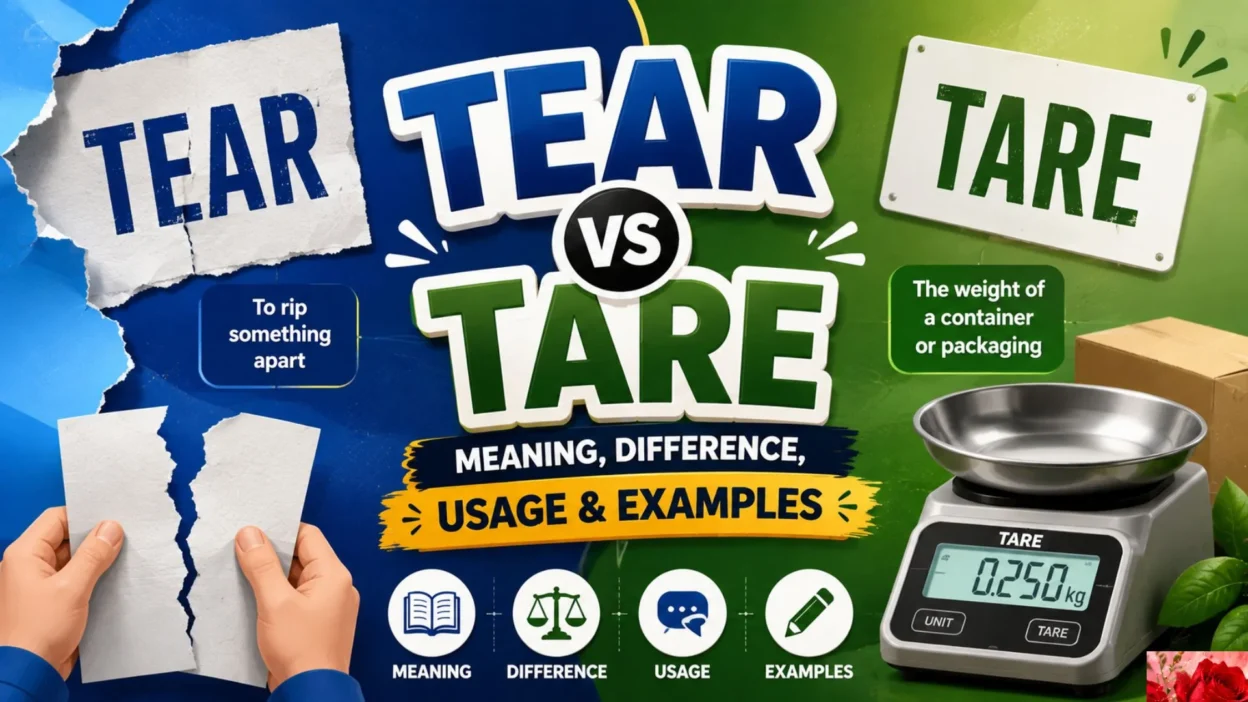
Tear vs tare are two English words that are easy to confuse because they look and sound similar in some contexts. However, they have completely different meanings and uses.
Tear can mean to rip or pull something apart. It can also refer to the drops of liquid that come from your eyes when you cry. Tare, on the other hand, is a more specialized word commonly used in weighing, packaging, agriculture, and shipping. It can refer to the weight of a container or the process of setting a scale to account for the container’s weight.
The pronunciation also depends on the meaning of tear. The verb meaning to rip is pronounced differently from the noun meaning a drop from the eye.
Understanding the difference between tear and tare is useful because choosing the wrong word can completely change the meaning of a sentence.
Tear vs Tare: Quick Answer
Tear can mean to rip something apart or a drop of liquid produced by the eye.
Tare usually refers to the weight of an empty container or the adjustment made to a scale to exclude the container’s weight.
| Word | Main Meaning | Example |
|---|---|---|
| Tear | Rip or a drop from the eye | Be careful not to tear the paper. |
| Tare | Weight of a container or scale adjustment | Press the tare button before weighing the ingredients. |
What Does Tear Mean?
Tear has several meanings in English. The most common ones are related to ripping something or a drop of fluid from the eye.
Tear Meaning to Rip
As a verb, tear means to pull, rip, or split something apart.
Examples:
- Don’t tear the paper.
- She tore her dress on a branch.
- He accidentally tore the envelope.
- Be careful not to tear the page.
- The strong wind tore the flag.
The past tense of this meaning is tore, while the past participle is torn.
Verb Forms
| Form | Word |
|---|---|
| Present | tear |
| Past | tore |
| Past participle | torn |
| -ing form | tearing |
Examples:
- I tear the paper.
- I tore the paper.
- I have torn the paper.
- I am tearing the paper.
Tear as a Drop From the Eye
Tear can also be a noun meaning a drop of liquid produced by the eye.
Examples:
- A tear rolled down her cheek.
- He wiped away a tear.
- She had tears in her eyes.
- One tear fell from his eye.
- The sad story brought a tear to her eye.
The plural form is tears.
Tear and Tears in Emotional Situations
Tears are commonly associated with sadness, happiness, pain, relief, or strong emotions.
Examples:
- She cried tears of joy.
- Tears filled his eyes.
- He had tears in his eyes after hearing the news.
- A single tear ran down her cheek.
What Does Tare Mean?
Tare is a specialized English word. It is most commonly used when talking about weight and measurement.
The tare weight is the weight of an empty container or packaging.
For example, if a box weighs 500 grams when empty and the box with its contents weighs 2,500 grams, the tare weight is 500 grams.
The actual contents therefore weigh 2,000 grams.
Example
A scale shows:
Gross weight: 2,500 g
Tare weight: 500 g
Net weight: 2,000 g
This is why tare is especially important in shipping, manufacturing, food packaging, laboratories, and commercial weighing.
Tare as a Verb
Tare can also be used as a verb.
To tare a scale means to set the scale to zero while the empty container is on it, so that the container’s weight is excluded from the measurement.
For example:
- Place the bowl on the scale and tare it.
- Press the tare button before adding flour.
- The cook tared the scale before measuring the ingredients.
- Make sure the scale is tared before weighing the contents.
This is particularly common with digital kitchen scales.
Tare Weight Explained
When weighing an item inside a container, there can be three useful terms:
Gross Weight
The total weight of everything.
Gross weight = container + contents
Tare Weight
The weight of the empty container.
Tare weight = empty container
Net Weight
The weight of the actual contents.
Net weight = gross weight − tare weight
For example:
- Container: 300 g
- Contents: 1,200 g
- Total: 1,500 g
Therefore:
Gross weight = 1,500 g
Tare weight = 300 g
Net weight = 1,200 g
Tear vs Tare: Main Difference
The simplest distinction is:
Tear = rip or eye fluid
Tare = container weight or scale adjustment
Compare these examples:
- Don’t tear the paper.
- A tear fell from her eye.
- Check the tare weight of the container.
- Tare the scale before adding the ingredients.
The words have different meanings even though their spellings are very similar.
Tear vs Tare Pronunciation
Pronunciation is another reason these words can be confusing.
The word tear has two common pronunciations because it has two different meanings.
Tear = Rip
When tear means rip, it is pronounced approximately like tair.
Example:
- Don’t tear the paper.
Tear = Eye Drop
When tear means a drop from the eye, it is pronounced approximately like teer.
Example:
- A tear rolled down her cheek.
Tare
Tare is generally pronounced like tair.
Example:
- Press the tare button.
So:
tear = rip → tair
tear = eye drop → teer
tare → tair
Tear vs Tare Examples
Tear
- Don’t tear the paper.
- She tore her shirt.
- The dog tore the toy apart.
- He tore the letter into pieces.
- The fabric was torn.
- A tear rolled down her cheek.
- She wiped away her tears.
Tare
- Check the tare weight.
- Tare the scale before weighing the ingredients.
- The package has a tare weight of 200 grams.
- Press the tare button.
- The operator recorded the tare weight.
- The scale was tared before the measurement.
Tear vs Tare in Cooking
Tare is especially common in cooking when using a kitchen scale.
Suppose you place an empty bowl on a digital scale.
The bowl weighs 350 grams.
Instead of manually subtracting 350 grams, you press the tare button. The scale returns to zero.
Then you add flour.
If the display shows 500 grams, you know that the flour weighs 500 grams rather than 850 grams.
Example
- Place the bowl on the scale.
- Press tare.
- Add the ingredients.
- Read the net weight.
Here, tare has nothing to do with ripping or crying.
Tear vs Tare in Shipping
Tare is also important in transportation and shipping.
A vehicle or container can have different weight measurements, including its empty weight and its loaded weight.
For example:
Tare weight: empty vehicle or container
Gross weight: vehicle or container plus cargo
Net weight: cargo itself
This terminology is commonly used in logistics and commercial weighing.
Tear vs Tare in Packaging
Packaging companies may use tare weight to determine the actual weight of the product inside a package.
For example, if a packaged product weighs 1,050 grams and the packaging weighs 50 grams:
Gross weight = 1,050 g
Tare weight = 50 g
Net weight = 1,000 g
The tare value helps determine the actual product weight.
Tear vs Tare: Common Mistakes
Mistake 1: Using Tare for Ripping
Incorrect:
❌ Don’t tare the paper.
Correct:
✅ Don’t tear the paper.
Mistake 2: Using Tear for a Scale
Incorrect:
❌ Tear the scale before weighing the flour.
Correct:
✅ Tare the scale before weighing the flour.
Mistake 3: Using Tare for an Eye Drop
Incorrect:
❌ A tare rolled down her cheek.
Correct:
✅ A tear rolled down her cheek.
Mistake 4: Using Tear Weight
If you’re referring to the weight of an empty container, the correct term is tare weight.
Correct:
✅ The tare weight is 250 grams.
Tear vs Tare: Easy Memory Trick
A simple way to remember the difference is to associate tare with tare weight.
Tear = Rip or Cry
Think:
Tear the paper.
Tear comes from your eye.
Tare = Scale
Think:
Tare the scale.
This gives you a quick mental shortcut:
Tear → paper or tears
Tare → scale or container
Tear vs Tare in Sentences
Here are some side-by-side examples:
| Tear | Tare |
|---|---|
| Don’t tear the paper. | Tare the scale first. |
| She tore her jacket. | Check the tare weight. |
| The dog tore the toy. | The container has a tare weight of 200 g. |
| A tear fell from her eye. | Press the tare button. |
| His eyes filled with tears. | Record the tare before loading. |
Tear vs Tare: Grammar
Tear as a Verb
- I tear the paper.
- She tears the paper.
- He tore the paper.
- They have torn the paper.
- She is tearing the paper.
And Tear as a Noun
- A tear fell from her eye.
- She wiped away a tear.
- His eyes filled with tears.
Tare as a Verb
- Tare the scale.
- She tares the scale.
- He tared the scale.
- The scale has been tared.
Tare as a Noun
- The tare is 300 grams.
- Check the tare weight.
- The machine automatically records the tare.
Tear vs Tare vs Tier
Another word that sometimes gets mixed into this group is tier.
Tear can mean rip or an eye drop.
Tare relates to weighing and container weight.
Tier means a level, rank, or row.
Examples:
- Don’t tear the paper.
- Check the tare weight.
- This is a top tier product.
The three words are spelled differently and have different meanings.
Frequently Asked Questions
What is the difference between tear and tare?
Tear can mean to rip something or a drop of liquid from the eye. Tare refers mainly to the weight of an empty container or the process of adjusting a scale to exclude the container’s weight.
Is it tear or tare the paper?
Use tear.
Please don’t tear the paper.
Is it tear or tare the scale?
Use tare.
Tare the scale before adding the ingredients.
What does tare mean on a scale?
The tare function allows you to set the scale to zero after placing a container on it. This lets you measure the contents without including the container’s weight.
What is tare weight?
Tare weight is the weight of an empty container, package, vehicle, or other weighing unit before its contents or cargo are added.
What are the two meanings of tear?
Tear can mean to rip or pull something apart, and it can mean a drop of liquid produced by the eye.
Why does tear have two pronunciations?
The two meanings of tear developed from different historical words, so they have different pronunciations in modern English.
Is tare a common English word?
Tare is less common than tear in everyday conversation. It is frequently used in contexts involving scales, packaging, shipping, manufacturing, agriculture, and measurement.
Is tare a verb or noun?
Tare can be both a noun and a verb. As a noun, it can refer to the weight of an empty container. As a verb, it means to adjust a scale so the container’s weight is excluded.
How can I remember tear vs tare?
Remember:
Tear = rip or eye drop
Tare = scale or container weight
Conclusion
The difference between tear vs tare is straightforward once you connect each word with its meaning.
Tear can mean to rip, pull, or split something apart, as in tear the paper. It can also mean a drop of liquid produced by the eye, as in a tear rolled down her cheek.
Tare is mainly used in weighing and measurement. It can refer to the weight of an empty container or the action of setting a scale to exclude the container’s weight.
The easiest memory trick is:
Tear → rip or cry
Tare → scale or container weight
Also remember that tear has two common pronunciations depending on its meaning, while tare is pronounced like the ripping sense of tear.
Once you connect tare with scales and tear with ripping or crying, you’ll be much less likely to confuse these words.

Clara Morgan is a language and vocabulary writer passionate about making English easier to understand. At Wordestic, she creates clear and practical guides on word meanings, synonyms, antonyms, grammar, word differences, and commonly confused words.
Her writing focuses on simple explanations, useful examples, and everyday usage to help readers expand their vocabulary and communicate with greater confidence.