Few grammar errors attract as much attention as mixing up “their” and “there.” The their or there confusion ranks among the most common mistakes in English writing, appearing in social media posts, business emails, and even published articles. Both words sound identical, both contain the letters “t-h-e,” and both appear constantly in everyday language.
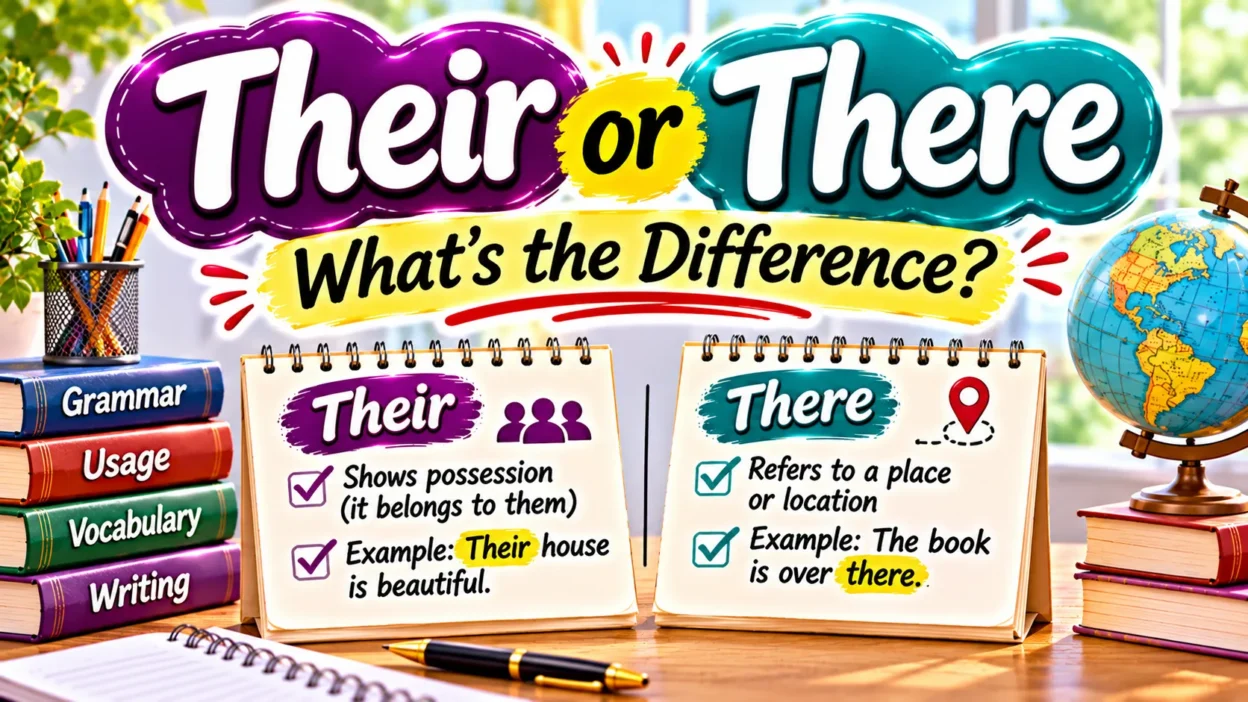
“Their” is a possessive pronoun meaning belonging to them. “There” indicates a place, a point, or serves as a placeholder in sentences. A third homophone, “they’re,” means “they are.” Mastering these three words eliminates one of the most visible grammar errors in English. This comprehensive guide explains the difference, explores their origins, provides practical examples, and helps you choose the correct word every time you write.
Quick Answer
Use “their” to show possession, meaning “belonging to them,” as in “their car.” Use “there” to indicate a place or existence, as in “over there” or “there is a problem.” Remember: “their” contains “heir,” something you inherit or possess. “There” contains “here,” a place. If you mean “they are,” use “they’re.”
Meaning Overview Table
| Aspect | Meaning |
|---|---|
| Definition | Their: possessive pronoun meaning belonging to them. There: adverb indicating place or existence |
| Pronunciation | Both: /ðɛər/ |
| Part of Speech | Their: possessive pronoun. There: adverb, pronoun, adjective |
| Usage | “Their house” vs. “There is a house” |
| Context | Everyday writing, academic prose, business communication, social media |
Main Meaning
Definition
Their is a possessive determiner or pronoun meaning “belonging to them.” It shows ownership by a group of people or things. There functions as an adverb meaning “in or at that place,” a pronoun used to introduce a clause (“there is,” “there are”), or an adjective meaning “that place.”
Origin
Both words come from Old English. “Their” derives from the Old Norse þeirra, meaning “of them,” which entered English during the Viking period. “There” comes from the Old English þǣr, meaning “at that place.” The two words share Germanic roots but developed distinct functions.
Context
The distinction matters across several contexts:
- Academic Writing: Professors and editors flag their/there errors as basic grammar mistakes
- Business Communication: Professional emails require correct usage
- Social Media: Errors appear constantly, sometimes becoming memes
- Everyday Writing: Texts and notes often contain mistakes due to quick typing
Modern Usage
Today, “their” appears constantly as a possessive. It has also gained use as a singular pronoun for unknown or nonbinary individuals (“Everyone should bring their book”). “There” appears as a place indicator and as an existential pronoun (“there is,” “there are”). The confusion persists because the words sound identical and spell-check often fails to catch the error.
Detailed Explanation
Literal Meaning
Literally, “their” means “of them” or “belonging to them.” “There” literally means “at that place” or “in that location.”
Common Meaning
Commonly, people use “their” to describe possession. “The students forgot their books.” They use “there” to point to a location or existence. “Put the box over there.” “There are three options.”
Possessive Meaning
“Their” shows that something belongs to a group. “Their car,” “their house,” “their ideas” all indicate possession by multiple people or entities. The word never indicates location.
Locational Meaning
“There” points to a place. “The keys are over there.” It also introduces existence. “There is a problem” means a problem exists. “There are many reasons” means many reasons exist.
Singular Meaning
In modern usage, “their” also functions as a singular pronoun for a person of unknown gender or for a nonbinary individual. “Someone left their umbrella.” This usage is grammatically standard and widely accepted.
Examples Table
| Example | Meaning |
|---|---|
| The students forgot their books. | Possession by the students |
| Put the box over there. | Location |
| Their house is on the corner. | Possession by a group |
| There is a problem with the engine. | Existence |
| The team celebrated their victory. | Possession by the team |
| There are three options available. | Existence |
| Their ideas changed the project. | Possession by a group |
| The restaurant is right there. | Location |
| Everyone should bring their own lunch. | Singular possessive usage |
| There was a loud noise outside. | Existence |
Related Meanings Table
| Related Term | Meaning |
|---|---|
| Their | Possessive pronoun meaning belonging to them |
| There | Adverb indicating place or existence |
| They’re | Contraction of “they are” |
| Theirs | Possessive pronoun meaning “belonging to them” |
| There’s | Contraction of “there is” |
| Here | At this place (opposite of there) |
| Where | At what place |
| Everywhere | In all places |
| Somewhere | In some place |
| Nowhere | In no place |
| Their own | Belonging to themselves |
| There are | Existence of multiple things |
| There is | Existence of one thing |
| Over there | At that distant place |
| Out there | In the world beyond |
Common Uses
People use “their” and “there” across numerous contexts:
Everyday Writing: “Their” appears constantly in descriptions of possession. “There” appears in location descriptions and existential statements.
Academic Writing: Students use “their” for possession and “there” for existence. Professors mark errors as basic grammar mistakes.
Business Communication: Professional emails require correct usage. “Their” appears in references to clients or colleagues. “There” appears in statements about availability or problems.
Social Media: Both words appear constantly, often incorrectly. Grammar enthusiasts frequently correct errors in comment sections.
Creative Writing: Authors use “their” for possession and “there” for setting scenes and introducing characters. “There was a knock at the door” appears in countless stories.
Common Mistakes
| Mistake | Correction |
|---|---|
| Writing “there house” | Write “their house” (possession) |
| Writing “their is a problem” | Write “there is a problem” (existence) |
| Writing “over their” | Write “over there” (location) |
| Writing “their are many reasons” | Write “there are many reasons” (existence) |
| Writing “the team lost there game” | Write “the team lost their game” (possession) |
| Writing “their going to the store” | Write “they’re going to the store” (they are) |
| Writing “put it their” | Write “put it there” (location) |
| Writing “there ideas are good” | Write “their ideas are good” (possession) |
| Assuming spell-check will catch the error | Spell-check often misses homophones; proofread manually |
| Writing “their is no way” | Write “there is no way” (existence) |
Related Questions
Should I use “their” or “there”?
Use “their” to show possession, meaning “belonging to them.” Use “there” to indicate a place or existence.
What is the difference between “their” and “there”?
“Their” is a possessive pronoun meaning belonging to them. “There” is an adverb indicating place or existence.
How can I remember the difference between “their” and “there”?
Remember: “their” contains “heir,” something you possess. “There” contains “here,” a place. If you mean “they are,” use “they’re.”
Is it “their is” or “there is”?
The correct phrase is “there is.” “There” introduces existence.
Is it “over their” or “over there”?
The correct phrase is “over there.” “There” indicates location.
Can “their” be singular?
Yes. “Their” functions as a singular pronoun for a person of unknown gender or for a nonbinary individual. “Someone left their umbrella.”
What is the difference between “their” and “they’re”?
“Their” shows possession. “They’re” is a contraction of “they are.” “There” indicates place or existence.
FAQs
What does “their” mean?
“Their” is a possessive pronoun meaning “belonging to them.” It shows ownership by a group.
What does “there” mean?
“There” is an adverb meaning “in or at that place.” It also introduces existence in phrases like “there is” and “there are.”
Is it “their house” or “there house”?
The correct phrase is “their house.” Their shows possession.
Is it “there is” or “their is”?
The correct phrase is “there is.” There introduces existence.
Can “their” be used for one person?
Yes. “Their” functions as a singular pronoun for a person of unknown gender or for a nonbinary individual.
What is the difference between “their,” “there,” and “they’re”?
“Their” shows possession. “There” indicates place or existence. “They’re” means “they are.”
How can I remember the difference?
Remember: “their” contains “heir” (possession). “There” contains “here” (place). “They’re” contains “re” from “are.”
What is the origin of “their”?
“Their” comes from the Old Norse þeirra, meaning “of them,” which entered English during the Viking period.
Conclusion
Mastering the their or there distinction protects your writing from one of the most visible grammar errors in English. “Their” shows possession, meaning belonging to them. “There” indicates place or existence. Remember the simple rules: “their” contains “heir” (possession), “there” contains “here” (place), and “they’re” means “they are.” Whether you’re writing an email, an essay, or a social media post, choosing the correct word ensures your meaning is clear and your writing looks professional. Practice using “their” for possession and “there” for place and existence, and your readers will understand exactly what you intend. Small distinctions like this separate careful writers from careless ones.

Clara Morgan is a language and vocabulary writer passionate about making English easier to understand. At Wordestic, she creates clear and practical guides on word meanings, synonyms, antonyms, grammar, word differences, and commonly confused words.
Her writing focuses on simple explanations, useful examples, and everyday usage to help readers expand their vocabulary and communicate with greater confidence.