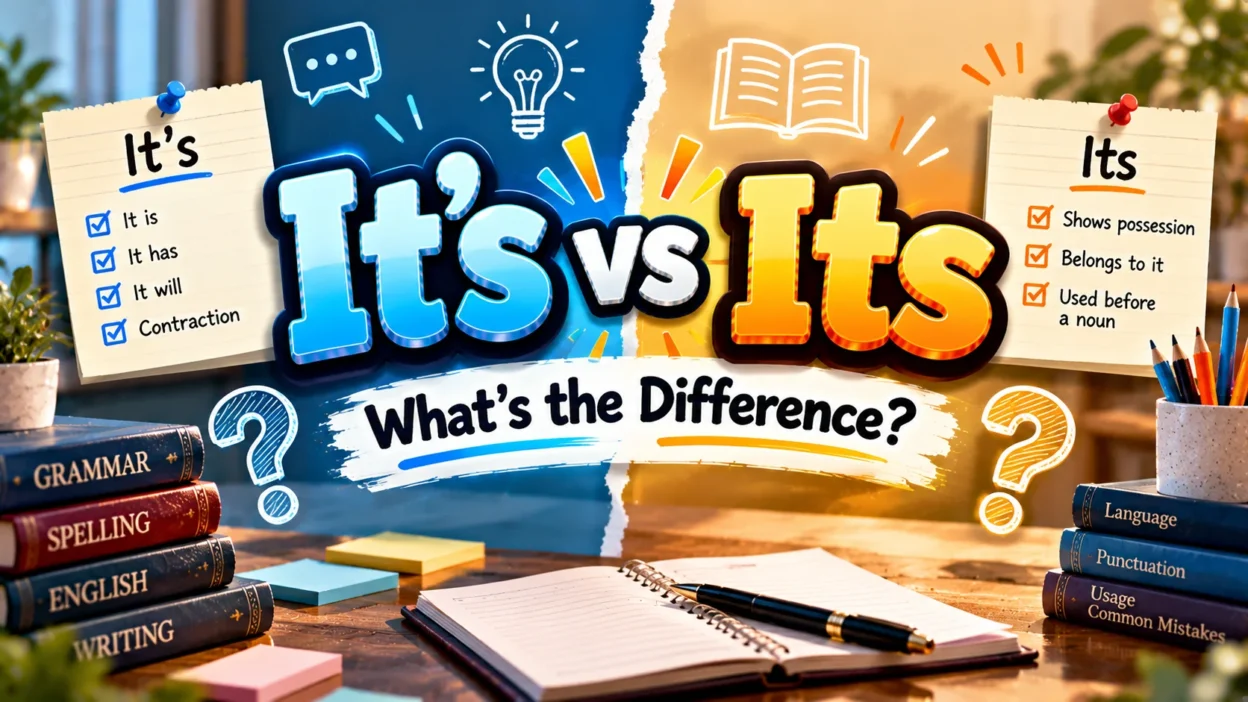
Few grammar mistakes cause more embarrassment than mixing up “it’s” and “its.” These three-letter words look almost identical, sound exactly the same, and appear in virtually every piece of English writing. Yet they serve completely different functions. Understanding the it’s vs its distinction is essential for clear, professional communication, whether you’re writing an email, drafting a report, or posting on social media.
The confusion stems from a simple fact: English normally uses apostrophes to show possession. “The dog’s bone” means the bone belongs to the dog. So why doesn’t “its” follow the same pattern? The answer lies in the special rules for possessive pronouns. “Its” belongs to a group of pronouns—including “his,” “hers,” “ours,” and “theirs”—that never take apostrophes. Meanwhile, “it’s” is always a contraction meaning “it is” or “it has”. This guide will help you master the difference with clear rules, practical examples, and memory tricks that make the distinction stick.
Quick Answer
The difference between it’s and its comes down to function. “It’s” is a contraction meaning “it is” or “it has”—the apostrophe replaces the missing letters. “Its” is a possessive pronoun meaning “belonging to it”—it never takes an apostrophe. If you can substitute “it is” or “it has” in the sentence, use “it’s.” Otherwise, use “its”.
Meaning Overview Table
| Aspect | Meaning |
|---|---|
| Definition | Two homophones: “it’s” is a contraction of “it is” or “it has”; “its” is a possessive pronoun |
| Pronunciation | Both: /ɪts/ (rhymes with “bits”) |
| Part of Speech | It’s: Contraction. Its: Possessive pronoun |
| Usage | “It’s raining” vs. “The dog wagged its tail” |
| Context | All forms of writing: academic, professional, casual, digital |
Main Meaning
Definition
“It’s” is a contraction that combines the pronoun “it” with either the verb “is” or the verb “has.” The apostrophe marks where letters have been removed. “Its” is the possessive form of the pronoun “it.” It shows that something belongs to or is associated with a previously mentioned object, animal, or concept.
Origin
The history of these two words reveals why the current rules exist. Long ago, English had gendered nouns, and the possessive pronoun for neuter nouns was actually “his.” People wrote phrases like “April with his sweet showers”. When English began linking “his” and “her” only to actual males and females, “his” for objects seemed wrong, and “it” without an “s” began appearing.
Around 1600, writers started using “it’s” with an apostrophe to show possession—just like possessive nouns such as “April’s.” This apostrophe form remained common throughout the 17th century and appears in the writings of Thomas Jefferson and Jane Austen. The version without the apostrophe only became dominant in the 18th century, probably because “it’s” took on a new role: replacing the contraction “’tis” (as in “’tis here”).
Context
The distinction operates across all writing contexts:
- Academic Writing: The rule is strictly enforced in essays, research papers, and dissertations
- Professional Communication: Errors in emails and reports can damage credibility
- Digital Writing: Text messages and social media often blur the distinction, but careful writers maintain it
- Journalism: Style guides require strict adherence to the rule
- Creative Writing: Even in fiction, the distinction matters for clarity and professionalism
Modern Usage
Today, style guides universally agree on the distinction. “It’s” means “it is” or “it has.” “Its” means “belonging to it.” Despite the simplicity of this rule, the mistake remains one of the most common in English writing. The confusion likely persists because English speakers internalize the rule that apostrophes show possession—and “its” does show possession, just without an apostrophe. The “it’s vs its” error appears everywhere, from social media posts to published books.
Detailed Explanation
Literal Meaning
Literally, “it’s” represents a compression of two words into one. The apostrophe functions as a placeholder for the missing letter or letters: “it is” becomes “it’s,” and “it has” becomes “it’s”. “Its” literally means “of or belonging to it.” The word shows that something is associated with or owned by a previously mentioned thing.
Common Meaning
Commonly, people use “it’s” in everyday speech and writing without thinking about the contraction. Phrases like “it’s cold,” “it’s time,” and “it’s been a while” flow naturally. “Its” appears when discussing possession: “The company increased its profits,” “The cat cleaned its fur,” “The car lost its wheel”.
Contraction Meaning
“It’s” serves as a contraction for two different verb phrases. When it stands for “it is,” it describes a current state or action: “It’s raining,” “It’s a beautiful day,” “It’s not fair.” When it stands for “it has,” it appears in present perfect tense constructions: “It’s been raining,” “It’s stopped,” “It’s grown”. Both uses are equally valid and equally common.
Possessive Meaning
“Its” functions as a possessive pronoun, just like “my,” “your,” “his,” “her,” “our,” and “their.” These pronouns show ownership without apostrophes. “Its” specifically refers to something owned by or associated with a non-human entity—an object, animal, concept, or institution. “The team celebrated its victory.” “The tree lost its leaves.” “The idea had its merits.”
Why the Confusion Exists
The confusion between “it’s” and “its” stems from a conflict between two rules. The first rule: apostrophes show possession (“the cat’s toy”). The second rule: personal pronouns never use apostrophes for possession (“my,” “your,” “his,” “her,” “our,” “their,” “its”). Because “its” is a pronoun, it follows the second rule. But because it shows possession, many people instinctively want to add an apostrophe. This instinct leads to errors like “the cat licked it’s paw” when the correct form is “the cat licked its paw.”
Examples Table
| Example | Meaning |
|---|---|
| It’s raining outside. | Contraction of “it is” |
| The dog wagged its tail. | Possessive meaning “belonging to the dog” |
| It’s been a long day. | Contraction of “it has” |
| The company changed its logo. | Possessive meaning “belonging to the company” |
| I think it’s time to go. | Contraction of “it is” |
| The robot lost its power source. | Possessive meaning “belonging to the robot” |
| It’s not your fault. | Contraction of “it is” |
| The plant dropped its flowers. | Possessive meaning “belonging to the plant” |
| It’s always sunny in California. | Contraction of “it is” |
| The museum is famous for its art collection. | Possessive meaning “belonging to the museum” |
| It’s been five years since we met. | Contraction of “it has” |
| The team celebrated its victory. | Possessive meaning “belonging to the team” |
Related Meanings Table
| Related Term | Meaning |
|---|---|
| Contraction | A shortened form of two words with an apostrophe replacing missing letters |
| Possessive pronoun | A pronoun showing ownership without an apostrophe |
| Its’ | A nonexistent word—never use an apostrophe after “its” |
| You’re vs Your | Similar homophone confusion: “you’re” is a contraction, “your” is possessive |
| They’re vs Their vs There | Another common homophone trio with contraction and possessive forms |
| Who’s vs Whose | “Who’s” is a contraction, “whose” is possessive |
| Apostrophe | Punctuation mark used for contractions and possessive nouns |
| Pronoun | A word that substitutes for a noun |
| It is | The expanded form of “it’s” |
| It has | The other expanded form of “it’s” |
| Possession | Ownership or association |
| Grammar check | Software tools that catch its/it’s errors |
| Style guide | A manual specifying writing conventions |
| Homophone | Words that sound the same but differ in meaning or spelling |
| Apostrophe rule | Nouns use apostrophes for possession; pronouns do not |
Common Uses
People use “it’s” and “its” across all forms of communication:
Academic Writing: Students and scholars must distinguish the two carefully. “It’s” appears in analytical prose, while “its” appears in descriptions of institutional or conceptual ownership. A thesis might argue that “the theory has its limitations” while noting “it’s important to consider alternative explanations.”
Professional Communication: Business emails, reports, and presentations require correct usage. A proposal might state “The company will expand its operations” and “It’s essential that we meet the deadline.”
Journalism: Reporters follow strict style guides. News articles contain phrases like “The senator defended its position” and “It’s unclear whether the bill will pass.”
Creative Writing: Novelists and poets use both forms. Dialogue often contains “it’s” as a natural contraction, while narration describes “the house and its secrets.”
Digital Communication: Text messages, social media posts, and blog comments frequently contain errors, but careful writers maintain the distinction even in casual settings.
Common Mistakes
| Mistake | Correction |
|---|---|
| Writing “it’s” to show possession | Use “its” for possession: “The dog wagged its tail,” not “it’s tail” |
| Writing “its” when meaning “it is” | Use “it’s” for the contraction: “It’s raining,” not “Its raining” |
| Adding an apostrophe because it “looks right” | Possessive pronouns never take apostrophes |
| Using “its'” with an apostrophe after the s | “Its'” is not a word. Never use it |
| Forgetting the “it has” meaning | “It’s” can mean “it has”: “It’s been a while” |
| Confusing “its” with “it’s” in formal writing | Double-check every instance in professional documents |
| Assuming the rule is too complicated to learn | The substitution trick makes it simple |
| Ignoring spell-check warnings | Spell-check often catches but doesn’t always fix its/it’s errors |
| Writing “it’s own” | The correct phrase is “its own” |
| Copying errors from published sources | Even published writing contains mistakes; learn the rule yourself |
Related Questions
What is the difference between it’s and its?
“It’s” is a contraction meaning “it is” or “it has.” “Its” is a possessive pronoun meaning “belonging to it.” The apostrophe in “it’s” replaces missing letters.
How can I remember the difference?
Use the substitution trick. If you can replace the word with “it is” or “it has,” use “it’s.” If not, use “its.” Also remember that possessive pronouns never take apostrophes.
Is its’ a word?
No. “Its'” does not exist in English. You can write “it’s” (contraction) or “its” (possessive), but never “its'”.
What does it’s mean?
“It’s” is a contraction of either “it is” or “it has.” The apostrophe marks where letters have been removed.
What does its mean?
“Its” is the possessive form of the pronoun “it.” It shows that something belongs to or is associated with a previously mentioned object, animal, or concept.
Why doesn’t its have an apostrophe?
Possessive pronouns like “my,” “your,” “his,” “her,” “our,” “their,” and “its” never use apostrophes. Only possessive nouns use apostrophes.
FAQs
Is it “it’s own” or “its own”?
The correct phrase is “its own.” “Its” is possessive, and “own” follows it naturally. “It’s own” would mean “it is own,” which makes no sense.
What is the golden rule for it’s vs its?
If you can substitute “it is” or “it has” in the sentence, use “it’s.” Otherwise, use “its.” This rule catches nearly every case.
Can “it’s” mean “it has”?
Yes. “It’s” is a contraction of both “it is” and “it has.” For example, “It’s been raining” means “It has been raining”.
Why do people confuse it’s and its?
The confusion arises because apostrophes normally show possession in English (like “the dog’s bone”). Since “its” shows possession, people instinctively want to add an apostrophe. However, possessive pronouns are an exception to this rule.
Is it ever correct to write “its'”?
No. “Its'” is never correct. The only valid forms are “it’s” (contraction) and “its” (possessive).
How do I proofread for its/it’s errors?
Read your writing slowly, checking each instance. Apply the substitution test. Use grammar-checking software, but verify its suggestions manually.
What does “it’s” stand for?
“It’s” stands for either “it is” or “it has.” The context of the sentence determines which meaning applies.
Does Jane Austen use “it’s” for possession?
Yes. Austen and other writers before the 19th century often used “it’s” for possession. The modern rule distinguishing the two forms became standard later.
Conclusion
Mastering the it’s vs its distinction is one of the simplest ways to improve your writing’s professionalism. The rule is straightforward: “it’s” is always a contraction of “it is” or “it has,” and “its” is always a possessive pronoun. The apostrophe in “it’s” replaces missing letters, not possession. Use the substitution trick whenever you’re unsure—if “it is” or “it has” fits, use “it’s”; if not, use “its.” Remember that possessive pronouns never take apostrophes, no matter how much your instincts tell you otherwise. With practice, this rule becomes second nature. Your writing will gain clarity, credibility, and freedom from one of English’s most embarrassing grammar errors.

Clara Morgan is a language and vocabulary writer passionate about making English easier to understand. At Wordestic, she creates clear and practical guides on word meanings, synonyms, antonyms, grammar, word differences, and commonly confused words.
Her writing focuses on simple explanations, useful examples, and everyday usage to help readers expand their vocabulary and communicate with greater confidence.