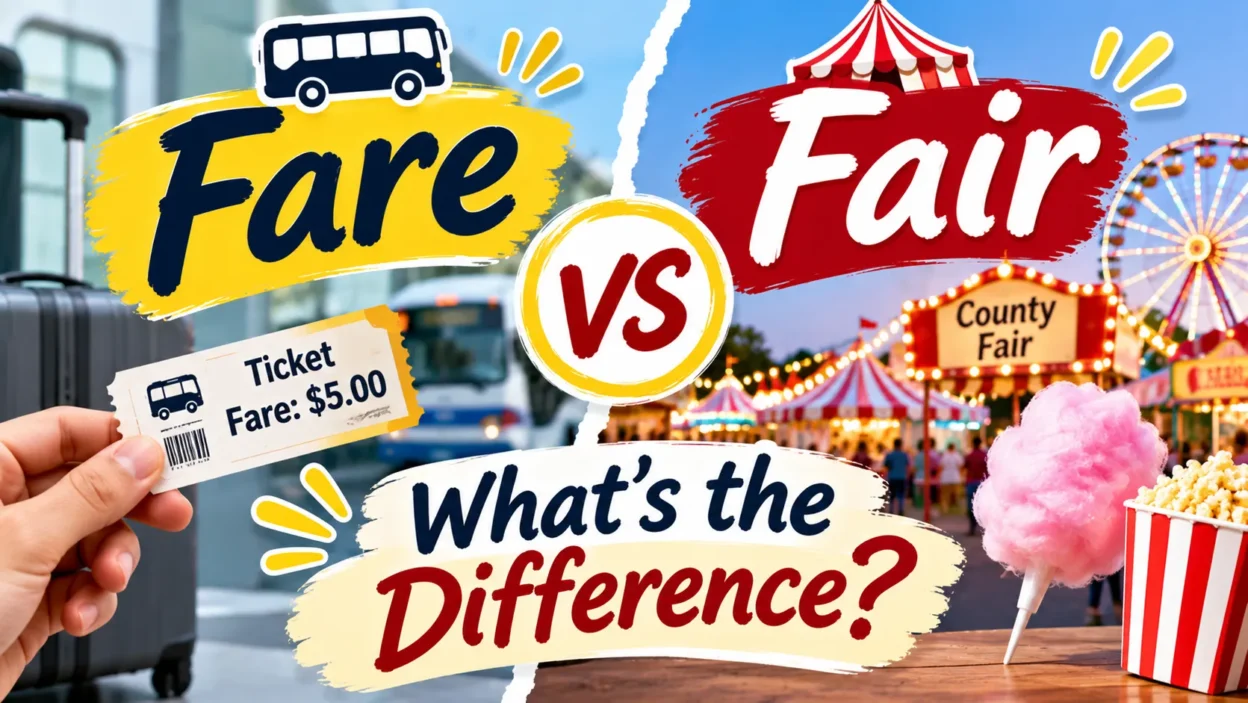
The words “fare” and “fair” sound identical, differ by just one letter, and appear in completely different contexts. The fare vs fair confusion ranks among the most common homophone errors in English writing, appearing in everything from travel bookings to carnival posters to social commentary.
“Fare” is a noun referring to the price paid for transportation or the food provided, and as a verb it means to get along or perform. “Fair” is an adjective meaning just, equitable, or light-colored, and a noun referring to a carnival or exhibition. These words share identical pronunciation but no shared meaning. This comprehensive guide explains the difference, explores their origins, provides practical examples, and helps you choose the correct word every time you write.
Quick Answer
“Fare” refers to the price of a ticket or the food provided, as in “bus fare” or “hearty fare.” “Fair” means just, equitable, or light-colored, or refers to a carnival or exhibition, as in “a fair decision” or “the county fair.” Remember: fare has “are” like “car” (you pay to ride); fair has “air” like “chair” (something pleasant or just). They sound the same but mean completely different things.
Meaning Overview Table
| Aspect | Meaning |
|---|---|
| Definition | Fare: transportation price or food. Fair: just, equitable, light-colored, or an exhibition |
| Pronunciation | Both: /fɛər/ |
| Part of Speech | Fare: noun and verb. Fair: adjective and noun |
| Usage | “The bus fare is $2” vs. “The judge made a fair ruling” |
| Context | Fare: travel, food, performance. Fair: justice, weather, carnivals, appearances |
Main Meaning
Definition
Fare functions as both a noun and a verb. As a noun, it refers to the money paid for transportation, such as a bus fare or taxi fare, or the food and drink provided, as in “hearty fare.” As a verb, it means to get along or perform in a particular way, as in “she fared well in the competition.”
Fair functions as both an adjective and a noun. As an adjective, it means just, equitable, impartial, light in color, or moderately good. As a noun, it refers to a carnival, exhibition, or market, such as a county fair or trade fair.
Origin
“Fare” comes from the Old English fær, meaning “journey” or “road,” and faran, meaning “to go.” The word originally referred to the act of traveling, then extended to the cost of travel and the food provided during a journey.
“Fair” comes from the Old English fæger, meaning “beautiful, pleasant, or good.” It shares Germanic roots with German fager. The meaning extended from “beautiful” to “just” and “equitable,” reflecting the idea that something good is also fair.
Context
The distinction matters across several contexts:
- Transportation: “Fare” appears in discussions of tickets, buses, trains, and taxis
- Food and Dining: “Fare” describes the food provided or available
- Justice and Ethics: “Fair” appears in discussions of fairness, justice, and equality
- Weather: “Fair” describes pleasant weather or light-colored conditions
- Events: “Fair” refers to carnivals, exhibitions, and markets
Modern Usage
Today, “fare” appears frequently in travel contexts, food writing, and performance descriptions. “Fair” appears constantly in discussions of justice, weather, appearances, and events. The confusion between the two persists because they sound identical and spell-check often fails to catch the error.
Detailed Explanation
Literal Meaning
Literally, “fare” means the cost of a journey or the food provided. “Fair” literally means beautiful or pleasant, but modern usage emphasizes “just” and “equitable.”
Common Meaning
Commonly, people use “fare” when discussing transportation costs or the quality of food. They use “fair” to describe justice, weather, or carnivals.
Transportation Meaning
In transportation, “fare” refers to the price paid for a ticket. Bus fares, train fares, taxi fares, and airline fares all use the word. Fare evasion means traveling without paying.
Food Meaning
In food contexts, “fare” describes the type of food provided. “Hearty fare,” “simple fare,” and “traditional fare” all refer to food. This usage is common in restaurant reviews and menus.
Justice Meaning
“Fair” describes just, equitable treatment. “A fair trial,” “fair wages,” and “fair play” all use the word. The concept of fairness appears in law, ethics, and everyday discussions.
Weather and Appearance Meaning
“Fair” describes pleasant weather (“fair skies”) or light-colored features (“fair hair,” “fair skin”). This usage appears in weather reports and physical descriptions.
Event Meaning
“Fair” refers to a carnival, exhibition, or market. County fairs, state fairs, trade fairs, and book fairs all use the word. These events feature entertainment, food, and exhibitions.
Examples Table
| Example | Meaning |
|---|---|
| The bus fare is two dollars. | Transportation price |
| The judge made a fair ruling. | Just and equitable |
| The restaurant serves hearty fare. | Food |
| The weather will be fair tomorrow. | Pleasant |
| She paid the taxi fare. | Transportation price |
| He has fair hair and blue eyes. | Light-colored |
| How did you fare in the exam? | Perform or get along |
| We went to the county fair. | Carnival or exhibition |
| The menu features traditional fare. | Food |
| Everyone deserves a fair chance. | Equitable |
Related Meanings Table
| Related Term | Meaning |
|---|---|
| Fare | Transportation price or food |
| Fair | Just, equitable, light-colored, or an exhibition |
| Farewell | A goodbye; related to fare (journey) |
| Fairness | The quality of being fair |
| Fairly | In a fair manner; moderately |
| Unfair | Not fair; unjust |
| Affair | An event or matter; contains “fair” |
| Fare evasion | Traveling without paying |
| Bus fare | The price of a bus ticket |
| Taxi fare | The price of a taxi ride |
| Train fare | The price of a train ticket |
| County fair | A local exhibition and carnival |
| Trade fair | An exhibition for businesses |
| Book fair | An event for selling books |
| Fair play | Fair and honest conduct |
| Fair trade | Ethical trade practices |
Common Uses
People use “fare” and “fair” across numerous contexts:
Transportation: “Fare” appears in discussions of tickets, buses, trains, and taxis. Passengers pay fares. Fare increases affect commuters.
Food and Dining: “Fare” describes the type of food served. Restaurant reviews mention “hearty fare” or “light fare.” Menus feature “traditional fare.”
Justice and Ethics: “Fair” appears constantly in discussions of justice, equality, and ethics. “Fair wages,” “fair treatment,” and “fair trial” are common phrases.
Weather and Appearance: “Fair” describes pleasant weather and light coloring. Weather reports mention “fair skies.” People describe “fair hair” and “fair skin.”
Events and Entertainment: “Fair” refers to carnivals, exhibitions, and markets. County fairs, state fairs, and trade fairs attract millions of visitors each year.
Performance: “Fare” appears in phrases about how someone performed. “How did you fare?” asks about performance or well-being.
Common Mistakes
| Mistake | Correction |
|---|---|
| Writing “bus fair” | Write “bus fare” (transportation price) |
| Writing “fair price” as “fare price” | Write “fair price” (just price) |
| Writing “the fair was delicious” | Write “the fare was delicious” (food) |
| Writing “county fare” | Write “county fair” (carnival) |
| Writing “fair weather” as “fare weather” | Write “fair weather” (pleasant weather) |
| Writing “taxi fair” | Write “taxi fare” (transportation price) |
| Writing “fair hair” as “fare hair” | Write “fair hair” (light-colored) |
| Writing “how did you fair?” | Write “how did you fare?” (perform) |
| Assuming spell-check will catch the error | Spell-check often misses homophones; proofread manually |
| Writing “fare play” | Write “fair play” (honest conduct) |
Related Questions
Is it “fare” or “fair”?
It depends on meaning. Use “fare” for transportation prices or food. Use “fair” for justice, weather, appearance, or events.
What does “fare” mean?
“Fare” refers to the price paid for transportation or the food provided. As a verb, it means to get along or perform.
What does “fair” mean?
“Fair” means just, equitable, light-colored, or moderately good. As a noun, it refers to a carnival or exhibition.
What is the difference between “fare” and “fair” in a sentence?
“Fare” relates to transportation costs or food. “Fair” relates to justice, weather, appearance, or events.
Can “fare” be a verb?
Yes. “Fare” as a verb means to get along or perform, as in “she fared well in the competition.”
Can “fair” be a noun?
Yes. “Fair” as a noun refers to a carnival, exhibition, or market, such as a county fair.
Why do people confuse “fare” and “fair”?
They sound identical and differ by only one letter. Spell-check often misses homophones, so the error persists in written communication.
How can I remember the difference?
Remember: fare has “are” like “car” (you pay to ride in a car). Fair has “air” like “chair” (something pleasant or just).
FAQs
What does “fare” mean?
“Fare” refers to the price paid for transportation or the food provided. As a verb, it means to get along or perform.
What does “fair” mean?
“Fair” means just, equitable, light-colored, or moderately good. As a noun, it refers to a carnival or exhibition.
Is it “bus fare” or “bus fair”?
The correct phrase is “bus fare.” Fare means the price of transportation.
Is it “county fair” or “county fare”?
The correct phrase is “county fair.” A fair is a carnival or exhibition.
Can “fair” describe weather?
Yes. “Fair weather” means pleasant, clear weather.
Can “fare” describe food?
Yes. “Fare” refers to the food provided, as in “hearty fare” or “simple fare.”
How can I remember the difference?
Remember: fare has “are” like “car” (you pay to ride in a car). Fair has “air” like “chair” (something pleasant or just).
What is the origin of “fare”?
“Fare” comes from the Old English fær, meaning “journey” or “road,” and faran, meaning “to go.”
Conclusion
Mastering the fare vs fair distinction protects your writing from embarrassing homophone errors. “Fare” refers to transportation prices or food, and as a verb means to get along or perform. “Fair” means just, equitable, light-colored, or refers to a carnival or exhibition. Remember the simple rule: fare has “are” like “car” (you pay to ride); fair has “air” like “chair” (something pleasant or just). Whether you’re writing a travel itinerary, a restaurant review, or a social commentary, choosing the correct word ensures your meaning is clear. Practice using “fare” for costs and food and “fair” for justice and events, and your readers will understand exactly what you intend. Small distinctions like this separate careful writers from careless ones.

Clara Morgan is a language and vocabulary writer passionate about making English easier to understand. At Wordestic, she creates clear and practical guides on word meanings, synonyms, antonyms, grammar, word differences, and commonly confused words.
Her writing focuses on simple explanations, useful examples, and everyday usage to help readers expand their vocabulary and communicate with greater confidence.