
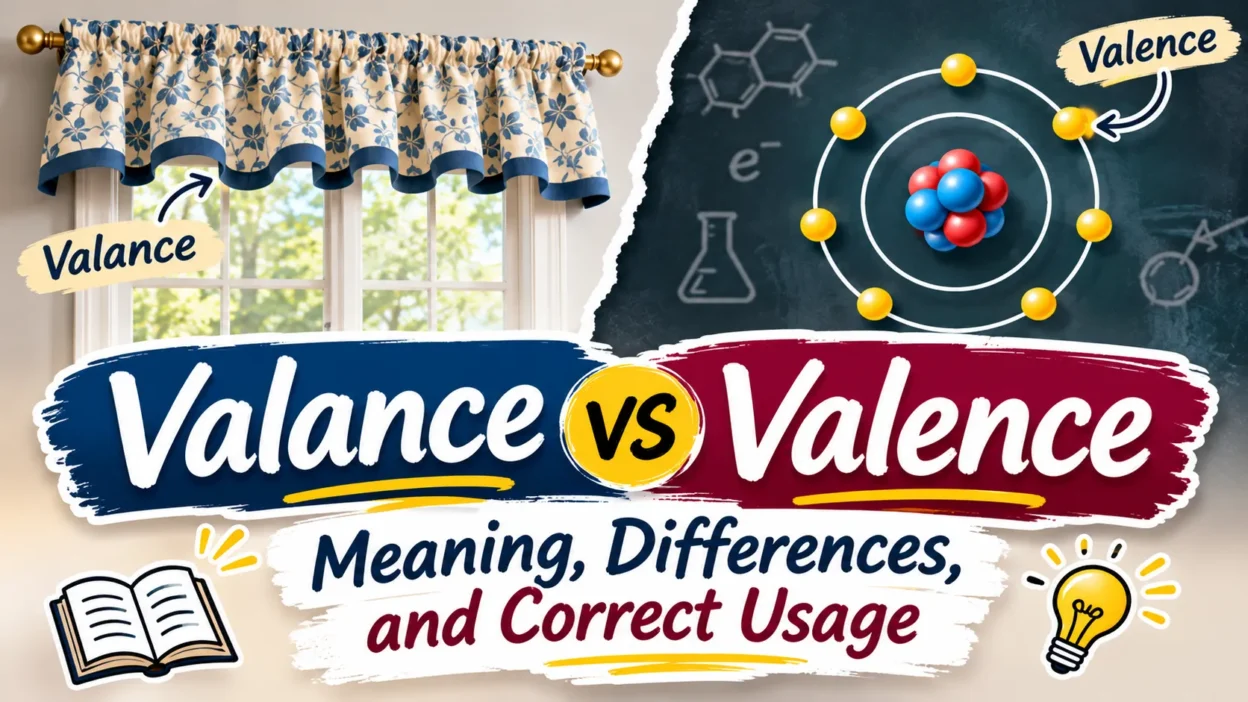
Valance vs valence is a common spelling comparison that confuses readers because both words look almost identical. However, these terms have completely different meanings. One describes a decorative covering used in homes, while the other appears in chemistry and physics. Understanding the difference helps you choose the correct spelling in writing, conversations, and academic work.
A valance is a decorative piece of fabric or material placed across the top of a window, curtain, or bed. It adds style and can hide curtain hardware. A valence, on the other hand, has several technical meanings. In chemistry, it relates to an atom’s ability to combine with other atoms. In physics, it also appears in terms such as valence electrons and the valence band. Both words have established uses, but you cannot use them interchangeably. This guide explains their definitions, pronunciation, origins, examples, and related vocabulary. You’ll also learn common spelling mistakes and practical ways to remember which word belongs in each context.
Quick Answer
Valance means a decorative fabric covering at the top of a window, curtain, or bed. Valence refers to an atom’s combining capacity in chemistry or a related property in physics. Use valance when discussing home decoration and valence when discussing science.
Meaning Overview Table
| Aspect | Valance | Valence |
|---|---|---|
| Definition | Decorative fabric or covering | Combining capacity or chemical property |
| Pronunciation | VAL-uhns | VAY-luhns |
| Part of Speech | Noun | Noun |
| Usage | Interior design and decoration | Chemistry, physics, and linguistics |
| Context | Curtains, windows, beds | Atoms, electrons, bonds, and language |
| Common Example | Window valance | Valence electrons |
| Word Category | Decorative vocabulary | Scientific and technical vocabulary |
Main Meaning of Valance vs Valence
What Does Valance Mean?
Valance is a noun that describes a decorative covering used in interior design. It usually consists of fabric, wood, or another decorative material. People place it above windows or around the bottom of beds.
A window valance covers the upper part of a window. It can hide curtain rods, tracks, and other hardware. It also creates a finished appearance around window treatments.
A bed valance serves a similar decorative purpose. It hangs around the bed frame and can conceal the space underneath. Some people also call this item a bed skirt.
Valances come in different materials, colors, and styles. Common choices include cotton, linen, lace, velvet, and polyester. Some designs feature pleats, patterns, embroidery, or decorative edges.
Examples:
- She installed a floral valance above the bedroom window.
- The white bed valance matched the new bedding.
- We selected a simple valance to complement the curtains.
The word dates back to Middle English. Its exact origin remains uncertain. One proposed explanation connects it with Anglo-French and Old French words meaning to descend or hang down. Etymology, Origin & Meaning+1
What Does Valence Mean?
Valence is a noun with several technical meanings. Its most familiar use appears in chemistry. It describes the combining capacity of an atom or element.
Chemists use valence to understand how atoms combine to form compounds. It relates to the electrons an atom loses, gains, or shares during chemical bonding. For example, carbon commonly has a valence of four.
Valence also appears in physics. Terms such as valence electrons and valence band describe important features of atomic and solid-state structures.
The word has additional meanings in linguistics and psychology. In linguistics, it describes how a word, especially a verb, connects with other sentence elements. In psychology, it can describe whether an emotion or experience feels positive or negative.
The term comes from Latin valentia, meaning strength or capacity. Its scientific meaning developed during the nineteenth century. Etymology, Origin & Meaning+2
Examples:
- Carbon has a valence of four.
- Students studied valence electrons in chemistry class.
- The verb’s valence determines which sentence elements it requires.
Detailed Explanation of Valance and Valence
How Is Valance Used in Interior Design?
Interior designers use valances to improve the appearance of windows and furniture. They often combine them with curtains, blinds, or other window treatments.
A window valance usually hangs across the top of a window. It can conceal curtain hardware and create a decorative border. Some homeowners choose matching fabric for a coordinated appearance.
Bed valances serve a different decorative purpose. They cover the lower portion of a bed frame. They can also hide storage boxes, bed legs, and items underneath the mattress.
Common styles include:
- Box pleat valance: Features neat, structured folds.
- Scalloped valance: Has curved decorative edges.
- Swag valance: Uses loose, draped fabric.
- Tailored valance: Offers a clean and simple appearance.
- Gathered valance: Uses gathered fabric for a softer look.
- Lace valance: Adds delicate decorative details.
In American English, valance is the standard term for this decorative item. British English also uses the word, although pelmet commonly describes the covering above a window. Oxford Learner’s Dictionaries+1
How Is Valence Used in Chemistry?
Chemistry uses valence to describe an atom’s combining capacity. It helps explain how different elements form chemical bonds.
Atoms contain protons, neutrons, and electrons. Electrons occupy different energy levels around the nucleus. The outermost electrons often participate in chemical bonding.
Consider a few familiar elements:
| Element | Common Valence | Example |
|---|---|---|
| Hydrogen | 1 | H₂O |
| Oxygen | 2 | H₂O |
| Nitrogen | 3 | NH₃ |
| Carbon | 4 | CH₄ |
| Sodium | 1 | NaCl |
| Magnesium | 2 | MgCl₂ |
These examples show how combining capacity helps explain chemical formulas. However, an element can display different valences in different compounds.
For example, iron commonly displays valences of two and three. This property allows it to form different chemical compounds.
What Are Valence Electrons?
Valence electrons are electrons in an atom’s outermost occupied shell. They play an important role in chemical bonding and reactions.
Atoms can share, lose, or gain electrons when they interact. These changes help create ionic and covalent bonds.
For example, sodium has one valence electron. Chlorine has seven electrons in its outermost shell. Sodium can transfer an electron to chlorine, forming sodium chloride.
This concept helps explain why scientists use the spelling valence rather than valance in chemistry.
What Is the Valence Band in Physics?
The valence band is an energy band in solid-state physics. It contains electronic states that electrons occupy under certain conditions.
The valence band matters when scientists study semiconductors, electrical conductivity, and electronic materials. The conduction band sits above it in energy.
The energy difference between these bands is called the band gap. Electrons can move into the conduction band when they receive enough energy.
Therefore, valence band is a scientific expression. It has no connection with decorative window coverings.
What Does Valence Mean in Linguistics?
Linguists use valence to describe the number and types of elements a word can require or allow. The term often applies to verbs.
For example, the verb sleep does not normally require a direct object. The verb eat can take a direct object, such as an apple. The verb give can take several sentence elements.
Consider these examples:
- She sleeps.
- She eats an apple.
- She gives her friend a gift.
Each verb has different requirements for the sentence around it. Linguists study these patterns through valence and valency.
What Does Valence Mean in Psychology?
Psychology uses valence to describe the positive or negative quality of an emotion, experience, or stimulus.
Positive valence relates to pleasant feelings. Happiness, excitement, and enjoyment are examples.
Negative valence relates to unpleasant feelings. Fear, sadness, and anger can have negative emotional valence.
Researchers use this concept when studying emotions, motivation, and human behavior. It also appears in discussions about emotional responses and decision-making.
Does Valence Have a Slang or Internet Meaning?
Neither valance nor valence has a widely established everyday slang meaning.
However, valence sometimes appears in online discussions about psychology, emotions, chemistry, and scientific subjects. Social media users may use phrases such as positive emotional valence or negative valence.
Valance generally remains connected with home decoration, curtains, and furniture. It does not have a common internet slang meaning.
Valance vs Valence: Examples in Sentences
The following examples show how context determines the correct spelling. Notice the difference between decorative and scientific situations.
| Example | Meaning |
|---|---|
| She bought a new valance for her living room. | Decorative window covering |
| The valance matches the bedroom curtains. | Fabric decoration |
| We replaced the old bed valance. | Bed covering |
| The designer selected a lace valance. | Interior decoration |
| A valance can hide curtain hardware. | Window treatment |
| Carbon has a valence of four. | Chemical combining capacity |
| The lesson covered valence electrons. | Atomic electrons |
| Oxygen commonly has a valence of two. | Chemistry |
| Scientists examined the valence band. | Solid-state physics |
| The sodium atom has one valence electron. | Atomic structure |
| The verb has a different valence pattern. | Linguistics |
| Researchers measured the emotional valence of the images. | Psychology |
| The valance added elegance to the window. | Home decoration |
| Iron can show different valences. | Chemical properties |
| The psychologist discussed positive emotional valence. | Psychology |
Related Meanings and Terms
Both spellings connect with different vocabulary areas. Understanding these related terms makes the distinction easier to remember.
| Related Term | Meaning |
|---|---|
| Valency | Another term for chemical combining capacity |
| Valence Electron | An outer-shell electron involved in bonding |
| Valence Band | An energy band in solid-state physics |
| Valence Shell | The outermost occupied electron shell |
| Chemical Bond | An attraction that holds atoms together |
| Covalent Bond | A bond formed through shared electrons |
| Ionic Bond | A bond involving electrostatic attraction between ions |
| Oxidation State | A number representing an atom’s electron accounting in a compound |
| Tetravalent | Having a valence of four |
| Bivalent | Having a valence of two |
| Monovalent | Having a valence of one |
| Trivalent | Having a valence of three |
| Polyvalent | Having multiple combining capacities |
| Electronegativity | An atom’s tendency to attract bonding electrons |
| Conduction Band | An energy band in which electrons can conduct electricity |
| Band Gap | Energy difference between two electronic bands |
| Pelmet | A covering above a window that hides curtain fittings |
| Bed Skirt | Fabric that covers the lower sides of a bed |
| Swag | Decorative fabric arranged in a hanging curve |
| Window Treatment | A decorative or functional window covering |
Common Uses of Valance and Valence
When Should You Use Valance?
Use valance whenever you discuss interior decoration or decorative fabric coverings. The word commonly appears in home improvement articles, furniture descriptions, and shopping catalogs.
You might encounter it in these situations:
- Shopping for curtains and window treatments.
- Decorating bedrooms and living rooms.
- Choosing decorative bed skirts.
- Reading interior design magazines.
- Describing fabric above windows.
- Discussing furniture and upholstery.
- Planning home renovation projects.
For example, “The new window valance gives the room a softer appearance.”
When Should You Use Valence?
Use valence when discussing scientific or technical subjects. Its meaning depends on the field, but it never describes an ordinary decorative curtain.
Common situations include:
- Chemistry lessons about atomic bonding.
- Discussions about valence electrons.
- Research involving chemical compounds.
- Physics lessons about energy bands.
- Linguistic studies of sentence structure.
- Psychological research about emotional responses.
- Scientific discussions about atomic properties.
For example, “The chemistry teacher explained how valence affects chemical bonding.”
Common Mistakes When Using Valance and Valence
These words look similar, so spelling mistakes can happen easily. However, remembering their different contexts prevents confusion.
| Common Mistake | Correct Form | Explanation |
|---|---|---|
| She purchased a new valence for her window. | She purchased a new valance for her window. | Window decorations use valance. |
| Carbon has a valance of four. | Carbon has a valence of four. | Chemistry uses valence. |
| The valence matched the curtains. | The valance matched the curtains. | Decorative fabric requires valance. |
| We studied valance electrons. | We studied valence electrons. | Atomic electrons use valence. |
| The bed needed a new valence. | The bed needed a new valance. | Bed coverings use valance. |
| Oxygen has a valance of two. | Oxygen has a valence of two. | Chemical properties use valence. |
| She selected a lace valence. | She selected a lace valance. | Lace window coverings use valance. |
| Scientists examined the valance band. | Scientists examined the valence band. | Physics uses valence band. |
| The emotional valance was positive. | The emotional valence was positive. | Psychology uses valence. |
| The verb’s valance determines its structure. | The verb’s valence determines its structure. | Linguistics uses valence. |
| The window valence looked beautiful. | The window valance looked beautiful. | Home decoration requires valance. |
| Iron displays different valances. | Iron displays different valences. | Chemistry uses valences. |
Related Questions About Valance vs Valence
Are Valance and Valence Pronounced the Same?
No, their standard American English pronunciations differ.
Valance sounds like “VAL-uhns,” while valence sounds like “VAY-luhns.” The first vowel provides an important clue to their spelling and meaning.
Is Valance a Type of Curtain?
Yes, a valance is a decorative window treatment. It usually hangs across the upper portion of a window.
It can hide curtain rods and other hardware. Some designs also add color, texture, and style to a room.
Is Valence a Chemistry Term?
Yes, valence is an important chemistry term. It describes an atom’s combining capacity when forming chemical bonds.
You will commonly encounter it in discussions about atomic structure, valence electrons, and chemical compounds.
What Is the Difference Between Valence and Valency?
Both terms describe an atom’s combining capacity in chemistry. American English commonly uses valence, while British English uses both valence and valency.
The two forms are closely related and often interchangeable in scientific contexts. baptistinternationalseminary.org+1
Is Valance the Same as a Pelmet?
They are closely related window treatments, but their construction can differ.
A valance often uses decorative fabric that hangs across the top of a window. A pelmet usually features a more structured covering made from wood or fabric.
Both can hide curtain tracks and improve the appearance of a window.
Can Valence Have More Than One Meaning?
Yes, valence has several meanings across different subjects. Chemistry uses it for atomic combining capacity, while physics uses it in terms such as valence band.
Linguistics and psychology also use the term. Its exact meaning depends on the subject being discussed.
Which Word Should I Use for Window Decorations?
Use valance when describing decorative material above a window. This is the correct spelling for curtains, fabric coverings, and similar home decorations.
For example, “The floral valance completed the bedroom’s new look.”
Which Word Is Correct in Scientific Writing?
Use valence in scientific writing about chemistry, physics, and related technical subjects. It also applies to linguistic and psychological terminology.
For example, “The experiment examined the valence electrons of the element.”
Conclusion
Understanding valance vs valence becomes easy once you recognize their different meanings. Valance belongs to the world of interior design. It describes decorative fabric or material placed above windows or around beds. Valence belongs mainly to scientific vocabulary, especially chemistry and physics. It also appears in linguistics and psychology. Remember the simple distinction: curtains need a valance, while atoms have valence. Pay attention to the context whenever you write either word. This small spelling difference can make a significant difference in meaning. With these definitions, examples, and practical explanations, you can use both terms confidently in everyday and professional writing.

Clara Morgan is a language and vocabulary writer passionate about making English easier to understand. At Wordestic, she creates clear and practical guides on word meanings, synonyms, antonyms, grammar, word differences, and commonly confused words.
Her writing focuses on simple explanations, useful examples, and everyday usage to help readers expand their vocabulary and communicate with greater confidence.